
Box Truck Startup: The Three Pillars Every New Owner-Operator Must Master
Buying a box truck and finding freight is the cheapest way into trucking, but cheap to start is not the same as easy to run. Before the first delivery, a new owner-operator has to settle three things: a DOT number, cargo insurance, and the costs most people leave out of the budget.
This guide covers each one in the order you will actually deal with them, so you know what a compliant box truck business requires before you spend money.
The DOT number ties your operation to federal safety and reporting rules. Cargo insurance covers the freight you are hauling when something goes wrong on the road. And the skipped costs — maintenance reserves, fuel swings driven by broader economic pressure on trucking — are usually what drains a new business quietly.
You do not need a fleet or years of experience. You do need a plan. By the end you will know how to register for your DOT number, choose cargo coverage, and build a budget that reflects what a box truck actually costs to run.
What a DOT Number Really Is – and How Box Truck Owners Get One
Before you book a load or sign a lease, get your DOT number. The Federal Motor Carrier Safety Administration (FMCSA) issues a USDOT number as a unique identifier for your business. Regulators use it to attach inspections, crash reports, and compliance reviews to one company; brokers and shippers use it to confirm you are a trackable carrier. For a box truck startup, it is the first real milestone.
Who Actually Has to Register
You generally need a USDOT number if your operation involves any of the following:
- You operate a commercial vehicle across state lines (interstate) with a gross vehicle weight rating over 10,001 lbs.
- You haul interstate cargo for hire, regardless of weight.
- You transport hazardous materials in quantities requiring placards.
- You carry more than 15 passengers interstate.
- You operate intrastate in a state that requires its own DOT number for in-state commercial vehicles.
A box truck often falls under that first bullet, which is why new owners ask about it so often.
Interstate vs. Intrastate: Know Which Lane You Are In
The distinction decides your paperwork. Interstate operations cross state lines and fall under FMCSA rules, which is where the federal USDOT number comes from. Intrastate operations stay inside one state and may follow state rules instead, though many states still require a USDOT number. If your regional routes occasionally cross a state line, register federally and treat yourself as interstate.
Check how federal measures shape trucking operations as you map your compliance approach.
How to Apply Through the FMCSA Registration Portal
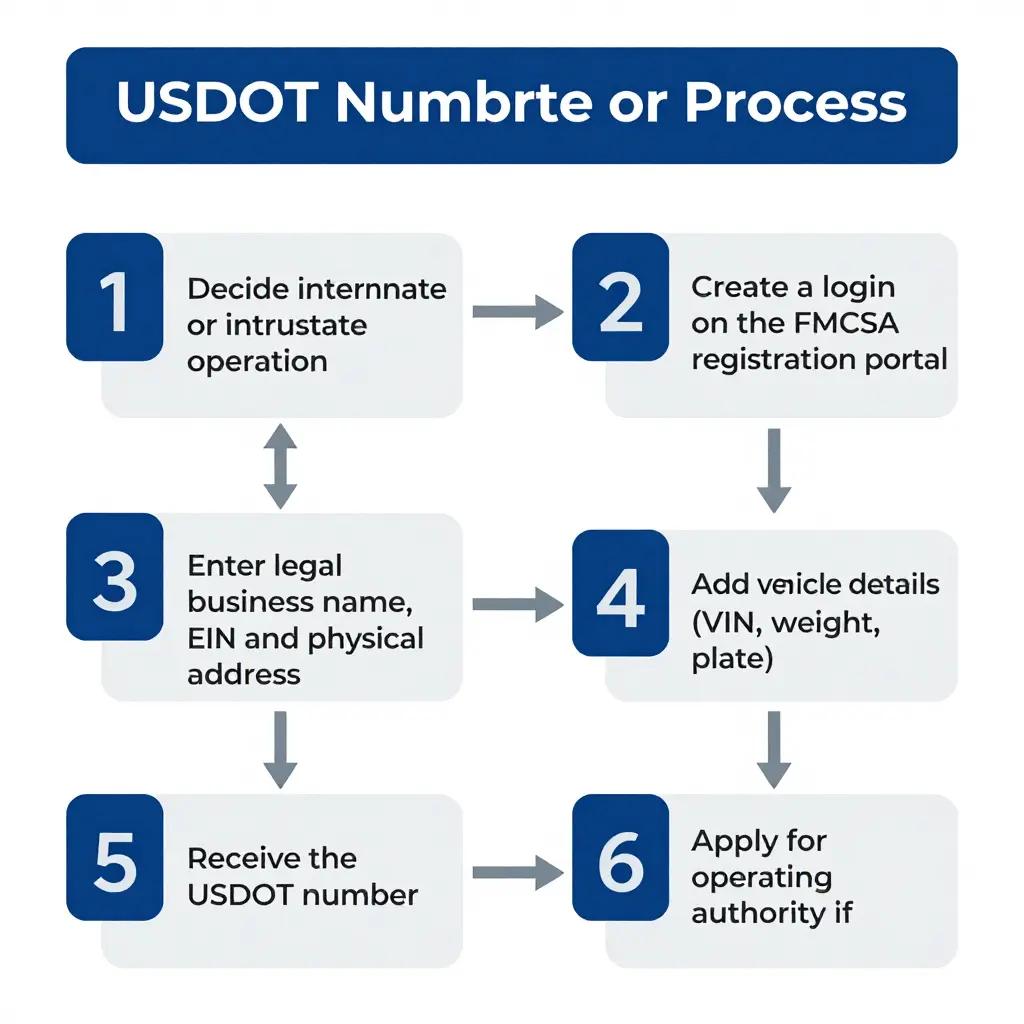
The application is free through the official FMCSA registration portal (unifiedregistration.fmcsa.dot.gov). Create a login, choose your registration type, and complete the form. Once it is approved you will receive a USDOT number, and if you haul regulated freight for hire you will also need operating authority, often called MC authority.
What You Will Need Before You Start
Have these ready:
- Your legal business name and legal structure.
- Your EIN (Employer Identification Number).
- Your physical business address, not just a P.O. box.
- Vehicle details, including the VIN, gross vehicle weight rating, and license plate.
Registering correctly the first time keeps your safety record clean and avoids the fines and rejected loads that follow a lapsed or missing number. With registration handled, the next decision is coverage — and that is where the budget surprises usually start.
MC Number vs. DOT Number: Understanding Your Operating Authority
Two credentials decide whether you can legally haul freight for pay: the USDOT number and the MC number. They come from the same agency and sound almost identical, so new operators mix them up — an expensive mistake. Get the legal structure straight first, and every cost question after that is easier to answer.
Two numbers, two very different jobs
The USDOT number is a safety identifier. It tracks your fleet’s inspection, crash, and compliance history. The MC number is your operating authority — the federal permission that lets you act as a for-hire carrier and move regulated freight across state lines for compensation.
| Credential | What it does | Who needs it |
|---|---|---|
| USDOT number | Safety and compliance identifier | Most commercial vehicles, even private fleets |
| MC number | Operating authority for hire | For-hire interstate carriers moving regulated freight |
When does a box truck startup actually need it?
If you only haul your own goods (private carriage) or stay entirely within one state, a USDOT number may be enough. But the moment you charge someone else to move their freight across state lines, you are in for-hire territory — and an MC number becomes mandatory.
The FMCSA and the filing order
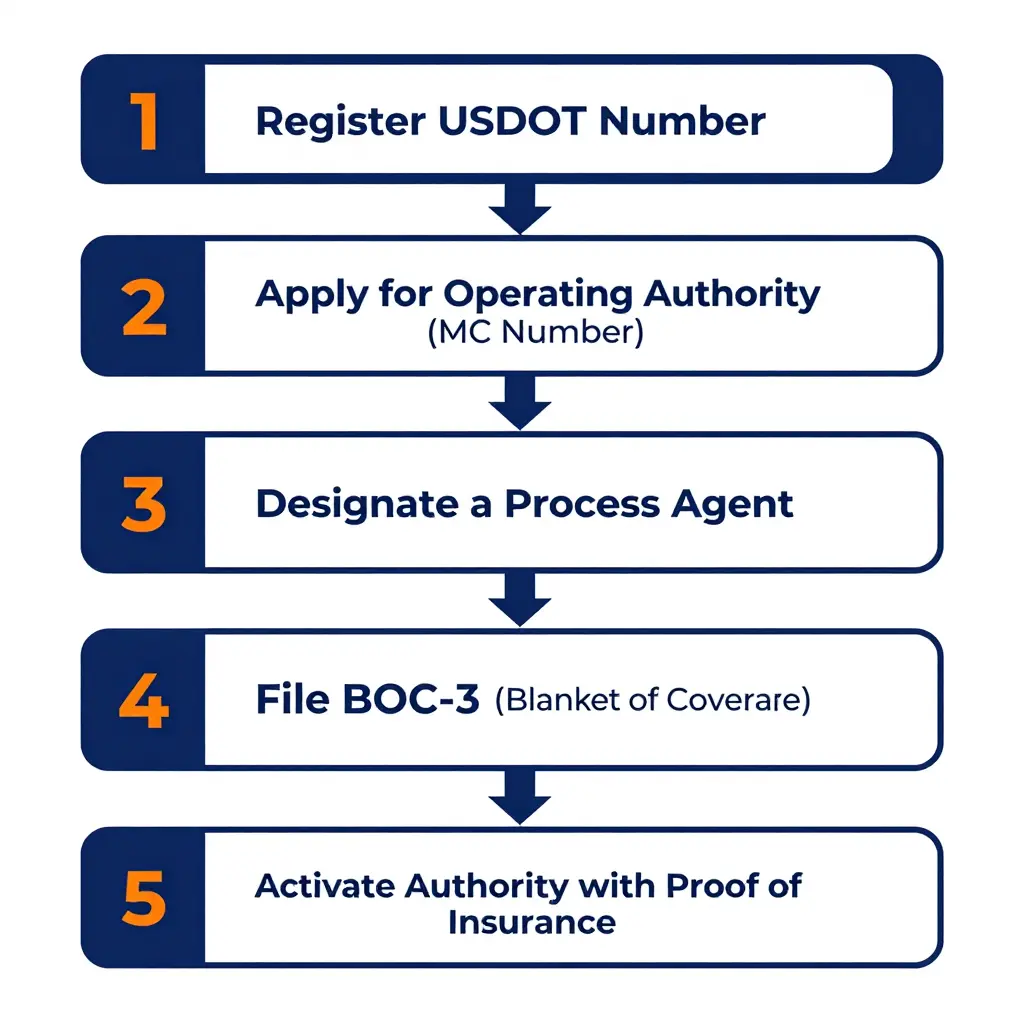
The Federal Motor Carrier Safety Administration (FMCSA) issues both credentials and enforces the rules behind them, alongside other federal measures shaping modern trucking. To activate your authority, follow this sequence:
- Register for a USDOT number.
- Apply for operating authority (your MC number) through the FMCSA.
- Designate a process agent in every state where you will operate.
- File a BOC-3 to prove those agents are in place.
A process agent is a person or company that accepts legal paperwork for you in states where you have no office. The BOC-3, or Blanket of Coverage, is the filing that documents those agents across all 50 states. The FMCSA will not activate your authority without it, because it is how you can be served with legal documents anywhere you do business. Only once these pieces are in place does it make sense to price out the launch.
The bottom line
The USDOT number is your safety ID; the MC number is your permission to earn. Settle both, and the financial planning that follows rests on solid ground.
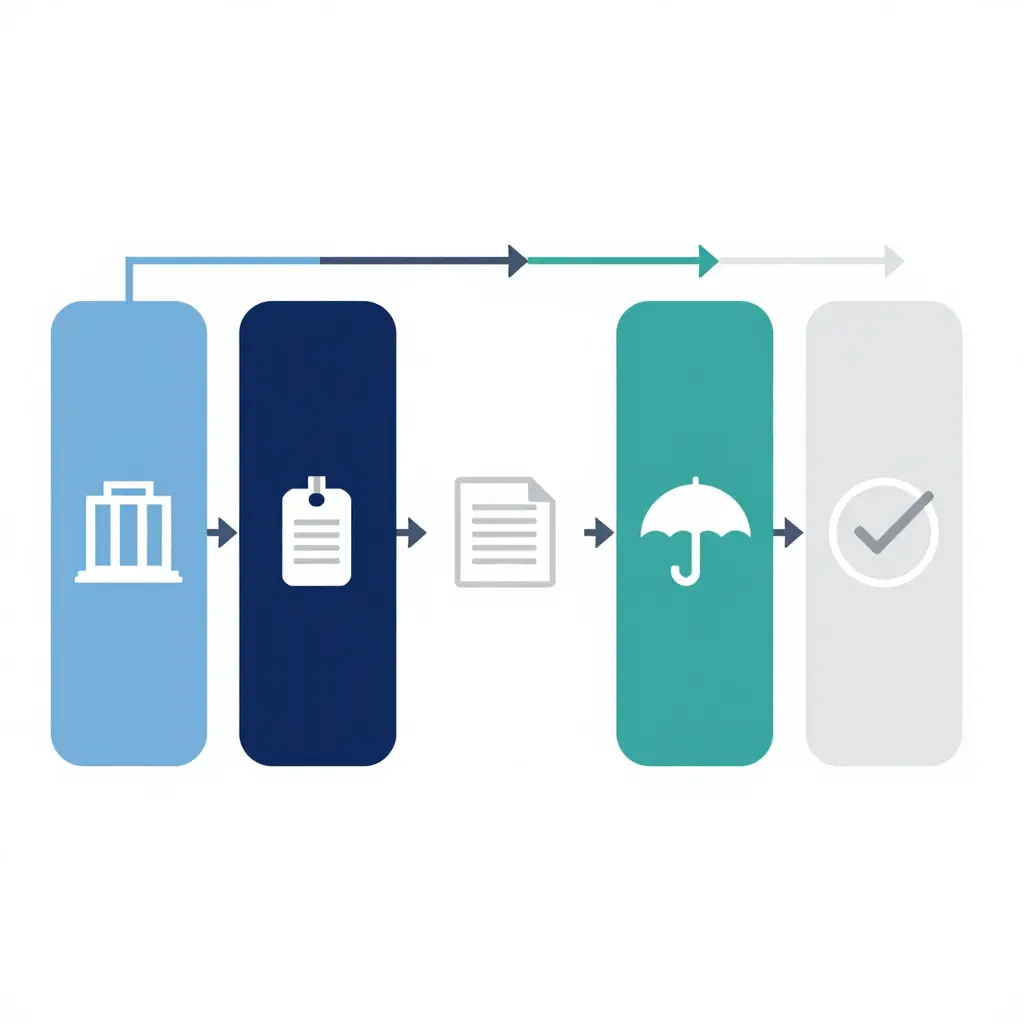
The diagram maps the registration sequence. Read it left to right and you get the order the federal system expects new carriers to complete before a paid load moves:
- Business formation – Establish your legal entity and business structure.
- USDOT number application – Register your company with the FMCSA.
- MC number and operating authority – Secure the authority to haul regulated freight for hire.
- Insurance filing – Prove your cargo and liability coverage meets federal minimums.
- Active operation – Roll compliant and legal.
Skipping a step or rushing a filing is where new owners lose money. Rules shift, and keeping up with them is ongoing work, so watch the federal measures shaping the trucking industry as you scale. Work the flow as a checklist and you will have a foundation that holds up in an audit instead of one you are scrambling to fix.
Box Truck Startup Checklist: 7 Steps to Get Road-Ready
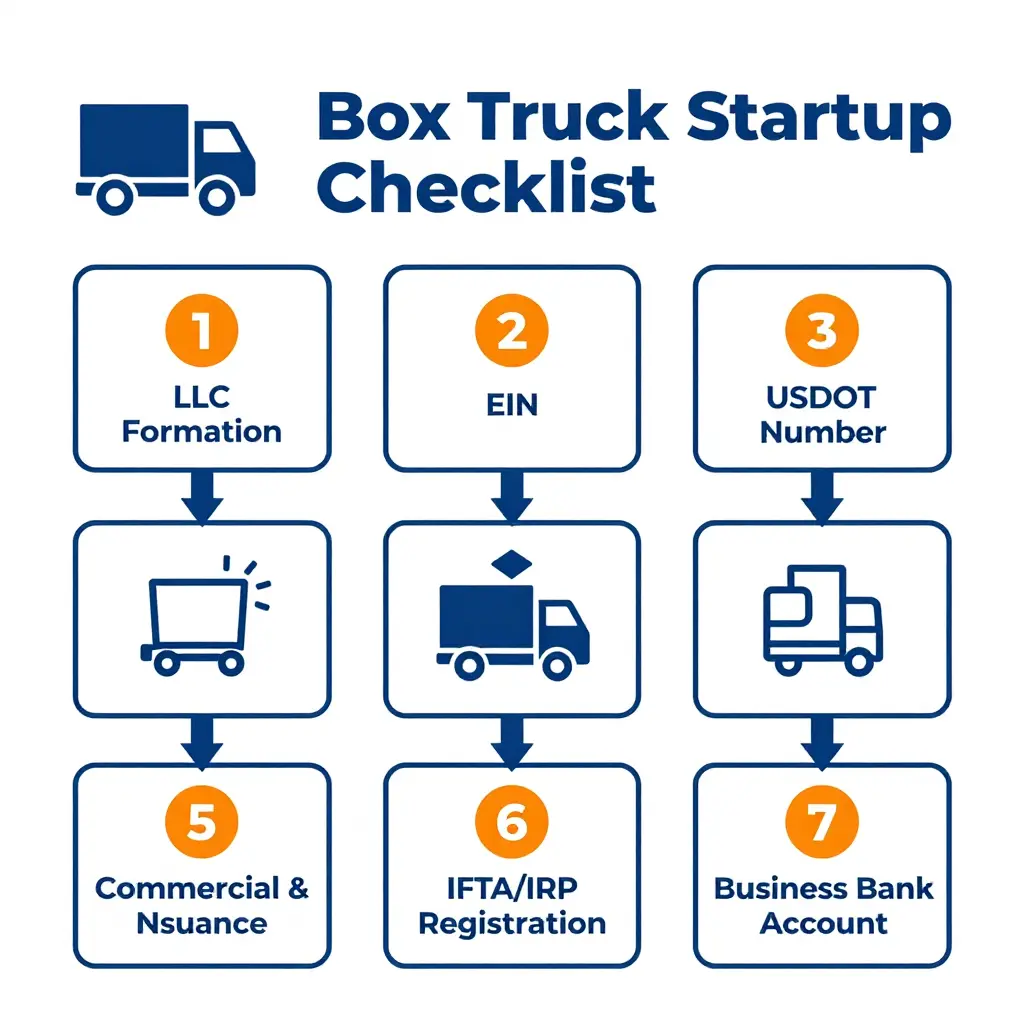
Buying a truck and finding loads is not a business yet. Work these steps in order so your owner-operator operation is legal, insured, and able to invoice. Watching the wider trucking industry’s economic and regulatory landscape also helps you plan for costs before they arrive.
-
Form your LLC. Register a limited liability company in your home state so personal and business assets stay separate. If a claim arises while your box truck is on the road, your personal finances are not exposed.
-
Get your EIN. Apply for a free Employer Identification Number (EIN) from the IRS. Your EIN keeps business taxes separate and lets you open accounts and hire without using your Social Security number.
-
Register for your USDOT number. Request a DOT number through the FMCSA when you operate a commercial vehicle across state lines. This number identifies your business for safety and compliance tracking.
-
Apply for an MC number if required. If you will haul regulated freight for hire across state lines, file for Motor Carrier (MC) operating authority. For-hire interstate carriers need it even as a one-truck owner-operator, while purely intrastate operators often do not.
-
Purchase commercial and cargo insurance. Buy commercial auto liability meeting federal minimums, then add cargo insurance to cover the freight you haul. Most brokers will not book a load without proof of cargo coverage.
-
Register with IFTA and IRP where applicable. Join the International Fuel Tax Agreement to report fuel taxes and the International Registration Plan to apportion your plates. You only need these for interstate operations, but they simplify multi-state compliance.
-
Open a business bank account. Set up a dedicated account and card under your LLC and EIN. This keeps finances clean, simplifies taxes, and helps you build business credit.
Cargo Insurance: The Coverage Your Box Truck Business Can’t Skip
Once you haul freight for paying customers, protecting that freight is part of the job. This section covers what the rules require, how limits work, and why nearly every broker asks for paperwork before releasing a load.
Why cargo insurance is required in practice
Federal rules require for-hire carriers to show financial responsibility — in practice, liability insurance — before hauling regulated freight. Cargo insurance is a separate policy: the FMCSA requires it for household goods movers, and brokers, shippers, and freight contracts require it for almost everyone else. Your operating authority depends on keeping the liability coverage in force. Most owners carry more than any legal floor because the loads they want to run demand it.
How coverage limits work
A coverage limit is the most your insurer will pay on a single claim. Most policies show two numbers: a per-occurrence limit and an aggregate limit that caps total payouts for the policy term. Cargo insurance is often written as a limit per shipment or per vehicle, so a $100,000 limit means the insurer pays up to that amount for lost or damaged freight on one load. Higher limits cost more, but they unlock better-paying freight and protect you when something goes wrong.
Primary auto liability vs. cargo coverage vs. general liability
These three policies do different jobs, and mixing them up is an expensive mistake.
| Coverage type | What it protects | Common limit |
|---|---|---|
| Primary auto liability | Injuries and property damage you cause to others with your truck | $1,000,000 |
| Cargo coverage (freight coverage) | The customer’s freight in your care | $100,000 |
| General liability | Third-party injuries and property damage away from the vehicle | $1,000,000 |
Primary auto liability responds first when your truck causes an accident. Cargo coverage, often called freight coverage, pays when the goods you are hauling are damaged, stolen, or lost. General liability handles incidents like a visitor slipping in your office or damage to a building you are loading at.
Why brokers and shippers want proof
Before offering you a load, most brokers and shippers request a certificate of insurance showing their required limits. No certificate, no load. National brokers commonly ask for $1 million in auto liability and at least $100,000 in cargo insurance before they will even quote you a rate.
The out-of-pocket risk
If your coverage falls short of a claim, you pay the difference yourself. One serious incident can erase a year of profit, especially as economic pressures reshape trucking. Get the coverage right at the start.
After the truck payment, insurance is usually the largest recurring cost a box truck startup carries. The table below lists the core policies a new owner-operator needs, what each one covers, and what it tends to cost per month.
| Coverage Type | What It Protects | Typical Minimum to Recommended Limits | Estimated Monthly Cost Range |
|---|---|---|---|
| Primary Auto Liability | Injury and property damage you cause to others in an at-fault accident (mandatory for operating authority) | $750,000 (federal minimum) up to $1,000,000+ | $400 – $900 |
| Cargo Insurance | The freight you haul against theft, damage, spoilage, or total loss | $10,000 up to $100,000 (many brokers require $100,000) | $100 – $350 |
| General Liability | Third-party bodily injury and property damage away from the vehicle, plus advertising and personal injury claims | $1,000,000 per occurrence / $2,000,000 aggregate | $40 – $150 |
| Physical Damage | Your own truck against collision, comprehensive loss, fire, and theft | Actual cash value or stated value of the truck | $200 – $600 |
| Occupational Accident / Non-Trucking | Driver injuries on the job or off-duty, plus liability when the truck is used for non-business purposes | $500,000 up to $1,000,000 | $50 – $200 |
Ranges are illustrative and vary by state, driving record, radius of operation, cargo type, and carrier. Always confirm limits with your broker before signing a lease or authority agreement.
Box Truck Startup Cost Breakdown: First-Year Expenses
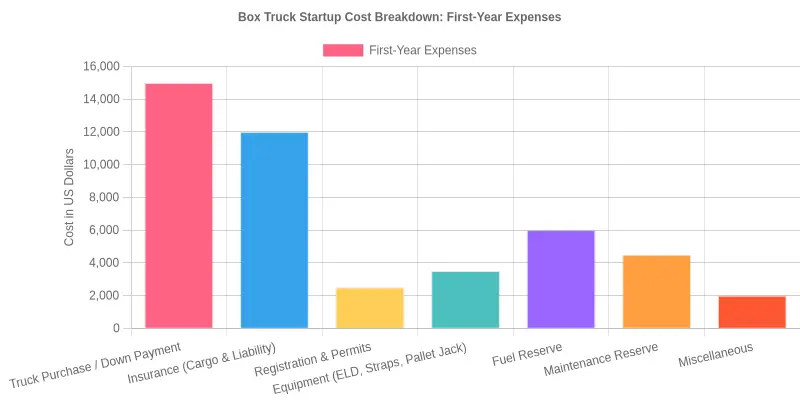
A box truck business takes money before the first load moves, and not only in the places new owners expect. The bar chart below shows typical first-year spending by category, including the costs that are easy to miss.
What the bars tell you
- Truck purchase or down payment ($15,000) – the single biggest line. A used box truck bought outright often runs $25,000-$45,000, while a financed unit spreads that into a down payment plus monthly notes.
- Insurance, cargo and liability ($12,000) – cargo coverage is the line most owners skip and the one that hurts most: a single underinsured load can wipe out a year of profit.
- Fuel reserve ($6,000) – cash you park for the first weeks of diesel before your factoring or customer payments land.
- Maintenance reserve ($4,500) – the truck will break. A reserve means a blown alternator is an inconvenience, not a shutdown.
- Equipment ($3,500) – ELD, load straps, pallet jack, and the small tools that add up fast.
- Registration and permits ($2,500) – plates, DOT-related filings, and operating authority where required.
- Miscellaneous ($2,000) – software, phone, LLC filing, and the surprise fees every owner meets.
The lines add up to about $45,500 for the first year. That total is why so many new owners underestimate their launch.
| Cost Category | Typical First-Year Amount (USD) |
|---|---|
| Truck Purchase / Down Payment | 15,000 |
| Insurance (Cargo & Liability) | 12,000 |
| Registration & Permits | 2,500 |
| Equipment (ELD, Straps, Pallet Jack) | 3,500 |
| Fuel Reserve | 6,000 |
| Maintenance Reserve | 4,500 |
| Miscellaneous | 2,000 |
| Estimated Total | 45,500 |
Numbers are illustrative estimates based on typical small-fleet box truck operations. Your actual figures will shift with truck condition, region, coverage limits, and whether you finance or buy outright. For a deeper look at how operating costs and market conditions move fleet budgets, see our breakdown of the trucking industry’s economic challenges and federal measures.
The Bills That Keep Coming After You Launch
An active DOT number and a cargo policy in force mean you are legal, not that you are done. Once the truck rolls, recurring operating costs leave your account every month. They repeat, so they belong in the budget alongside your launch costs. Budget only for startup and you will run out of cash.
Insurance premiums
Cargo insurance and commercial liability coverage are usually your largest fixed bill. Carriers often quote premiums monthly but collect them annually, so set cash aside every month to cover the lump sum.
Loan or lease payments
Whether you financed or leased the truck, the note comes due monthly. A $50,000 truck on a five-year loan can run $900 to $1,100 per month – money that leaves your account whether the truck hauls a load or sits idle.
Fuel
Fuel is your most volatile cost. At roughly 10 mpg and 4,000 miles a month, even a small swing in diesel prices can move your budget by hundreds of dollars.
Maintenance and truck washes
Oil changes, tires, brakes, and regular truck washes keep DOT inspections and customers happy. Skipping washes saves a little now and can cost you contracts later.
Cell phone and dispatch software
A phone plan plus a load board or dispatch platform runs $100 to $300 monthly. You cannot keep consistent freight without them.
Taxes and IFTA filings
Quarterly estimated taxes and Interstate Fuel Tax Agreement (IFTA) filings require meticulous records of every mile driven in every state. Miss a filing and penalties mount. Staying on top of these recurring obligations is part of surviving broader economic pressures on owner-operators.
| Cost Category | Typical Monthly | Typical Annual |
|---|---|---|
| Cargo & liability insurance | $600 – $1,200 | $7,200 – $14,400 |
| Loan or lease payment | $700 – $1,100 | $8,400 – $13,200 |
| Fuel | $1,200 – $2,400 | $14,400 – $28,800 |
| Maintenance and repairs | $300 – $600 | $3,600 – $7,200 |
| Truck washes | $80 – $200 | $960 – $2,400 |
| Phone & dispatch software | $100 – $300 | $1,200 – $3,600 |
| Estimated taxes | $400 – $900 | $4,800 – $10,800 |
| IFTA (settled quarterly) | Varies | Varies |
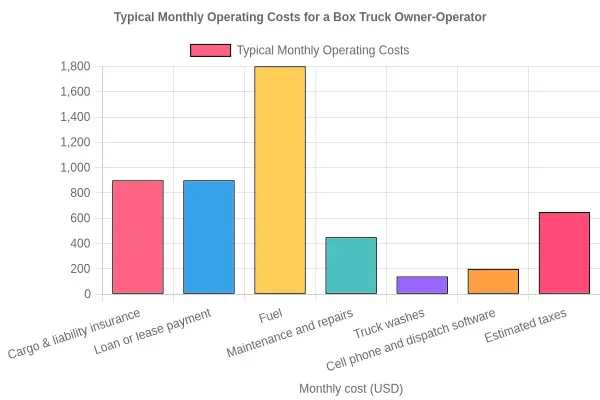
Add the lines up and a single-truck operation spends $4,000 to $6,000 a month before profit. Track each category every month and you will see problems while you can still fix them.
Where Insurance Fits in Your Monthly Overhead
The doughnut chart breaks down monthly operating costs into five buckets. The cargo and liability slice, highlighted in orange, is close to what many owners spend on the truck payment — a cost new operators routinely underestimate.
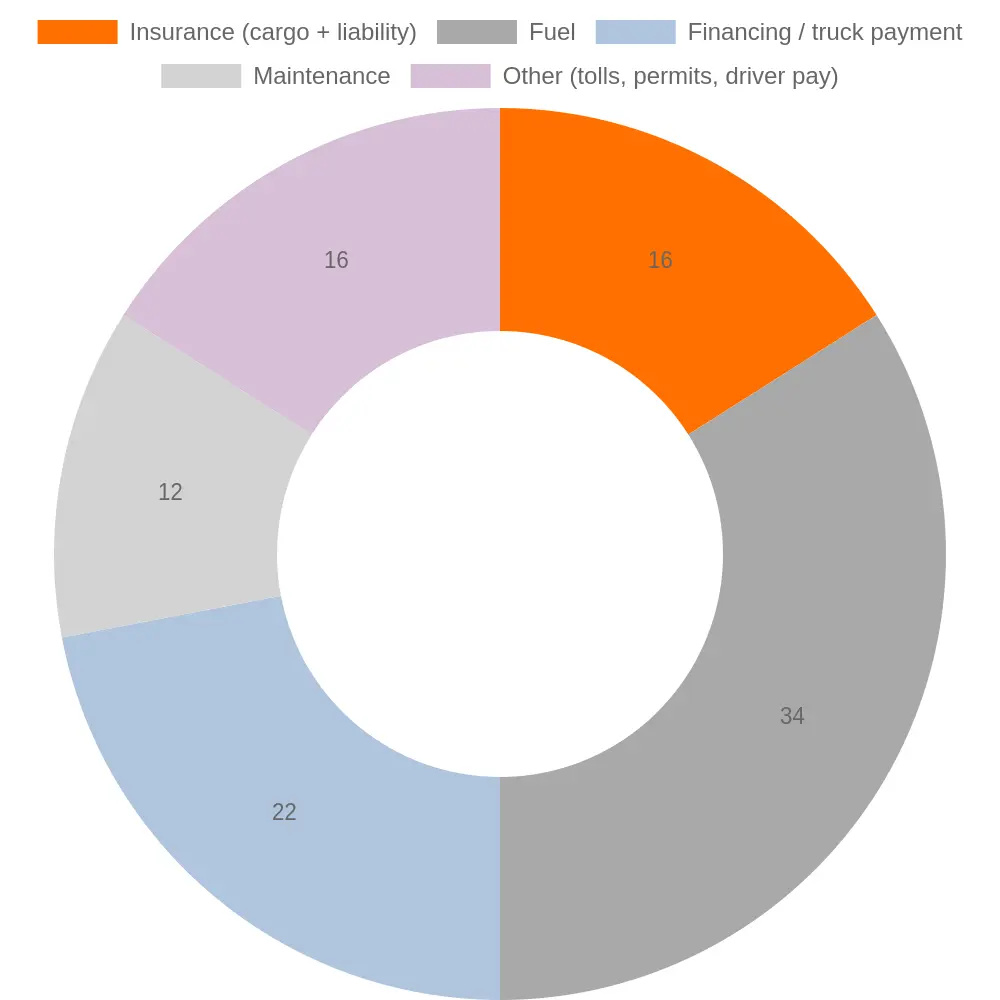
Same numbers in table form:
| Cost Category | Share of Monthly Costs | Notes |
|---|---|---|
| Fuel | 34% | Largest single line item; volatile with diesel prices |
| Financing / truck payment | 22% | Fixed once the loan is signed |
| Insurance (cargo + liability) | 16% | Required for DOT compliance and freight contracts |
| Other (tolls, permits, driver pay) | 16% | Scales with miles driven |
| Maintenance | 12% | Rises sharply as the truck ages |
Insurance works out to about one of every six dollars you spend each month before profit. Underinsuring it is one of the more expensive shortcuts a new owner can take.
Budgeting and Financial Planning for Your Box Truck Startup
You have the numbers: DOT registration, cargo insurance, and the costs most owners overlook. Now turn them into a budget you can run a business on. That starts before your first invoice.
Start with the fixed items: DOT registration, the monthly cargo insurance premium, and the loan or lease payment. Then add the variable costs — fuel, tolls, repairs — that move with every mile you drive.
Typical monthly allocation for a one-truck owner-operator:
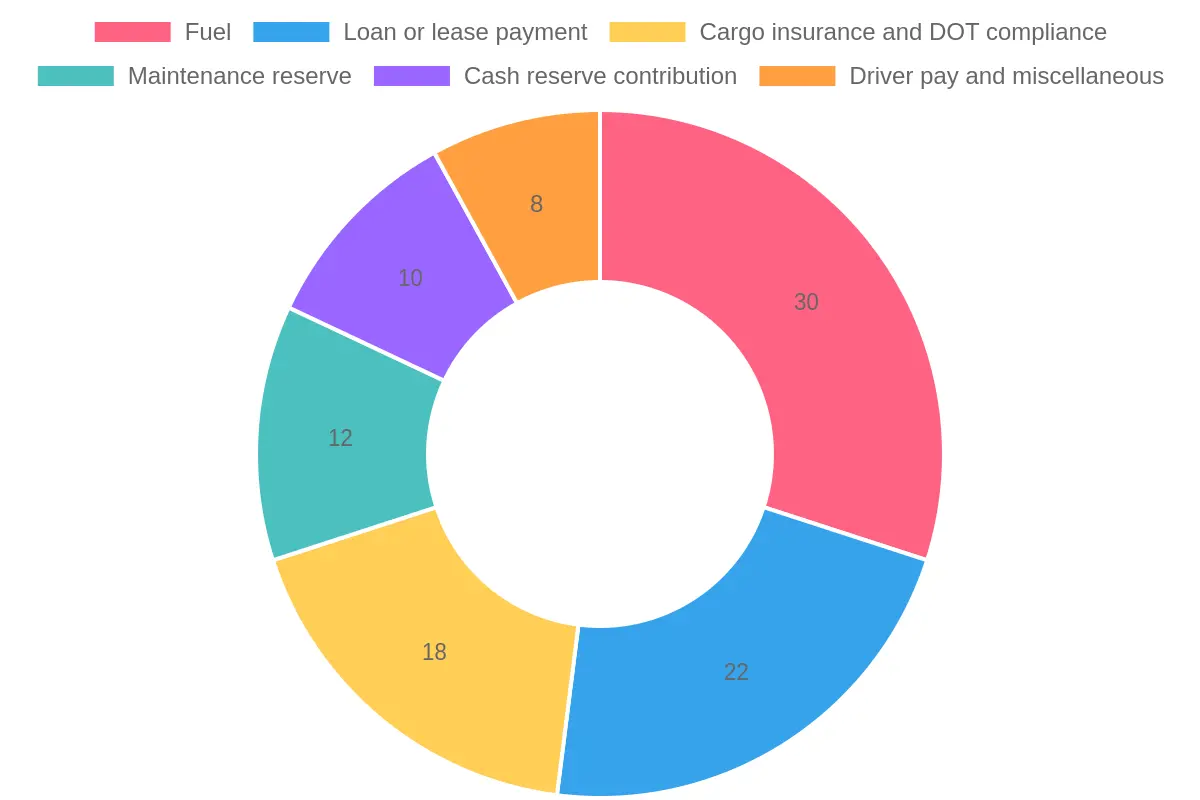
Build a Cash Reserve Before You Chase Growth
Set a reserve of three to six months of fixed expenses and do not touch it. When a slow week or a breakdown hits, it keeps the truck moving and the bills paid.
Trucking runs in cycles, so plan for lean stretches. Understanding the wider economic pressures shaping the trucking industry helps you size a buffer for the market you actually operate in.
Track Actual Versus Projected Expenses
A budget only works if you compare plan to reality every month. Keep it simple:
| Expense Category | Projected | Actual | Variance |
|---|---|---|---|
| Fuel | $2,400 | $2,690 | -$290 |
| Cargo insurance | $1,150 | $1,150 | $0 |
| Maintenance reserve | $800 | $1,320 | -$520 |
| Loan or lease | $1,400 | $1,400 | $0 |
| DOT and compliance | $250 | $310 | -$60 |
When the variances stack up, adjust your rates or routes instead of quietly absorbing the loss.
Fund Insurance and Maintenance on Autopilot
Cargo insurance and maintenance drain an owner-operator’s account faster than anything else. Set aside premium money monthly so the renewal is not a shock, and move a fixed amount into a maintenance reserve every week. Money already set aside is money that does not strand the truck.
Where This Leaves You
A budget turns your startup costs into a plan you can steer by. Build the reserve, watch your actuals, and fund insurance and maintenance first.
Do that consistently and growth becomes a decision rather than a gamble.
Related Reading
Box truck owners watch the road and the numbers at the same time, so it helps to know what is moving your costs and margins. For the pressures every owner-operator eventually meets, see how the trucking industry is navigating economic challenges and federal measures, and how the sector moved from job losses to job gains in late 2024 as demand patterns stabilized. If you are deciding whether to upgrade or add equipment, the challenges that emission regulations pose to fleet investments cover timing, compliance costs, and planning before you commit capital.
Frequently Asked Questions About Starting a Box Truck Business
A box truck startup comes with paperwork, insurance decisions, and costs that are not obvious. These are the questions new owners ask most.
Do I need a DOT number for a box truck?
Yes, in most cases. If you operate a commercial box truck across state lines and it meets certain weight or cargo thresholds, you are required to register for a USDOT number through the FMCSA. Even some intrastate operations need one, depending on your state’s rules, so check before you buy. Driving without a proper DOT number can lead to fines and out-of-service orders that stall your business on day one.
How much does cargo insurance cost?
Most new owners pay somewhere between $3,000 and $12,000 per year for cargo insurance, depending on coverage limits, cargo value, radius of operation, and your driving history. Local routes with modest coverage sit at the lower end, while long-haul or high-value freight pushes costs higher. Getting several quotes is the fastest way to find a rate that fits your budget.
What happens if I skip cargo insurance?
Skipping cargo insurance is risky and often illegal if a contract or broker requires it. Without coverage, a single damaged or stolen shipment could wipe out your savings and force you to repay the customer out of pocket. Many brokers and shippers will not even load your truck until you show proof of coverage.
How long does it take to get operating authority?
Getting your operating authority usually takes two to four weeks once your USDOT number and application are filed. Processing times can stretch longer if your paperwork has errors or if the FMCSA requests more information. Plan for delays and avoid booking loads until your authority is officially active.
What costs do new owners usually overlook?
The costs owners skip tend to be the quiet ones: commercial parking, maintenance reserves, ELD subscriptions, IFTA fuel taxes, tolls, and the downtime when your truck sits in the shop. Many entrepreneurs budget for the truck and insurance but forget that these recurring expenses add up fast. Understanding broader trucking industry economic challenges can help you build a buffer and avoid surprises.
Is a box truck startup profitable?
It can be, but margins depend on your lane choices, fuel efficiency, and how tightly you control overhead. New owners who track every cost and keep their trucks running consistently tend to see steady returns within the first year. Treat it like any small business: know your numbers and stay disciplined.
Conclusion: Three Pillars for a Profitable Box Truck Startup
Three things decide whether a box truck startup holds up, and all three come down to preparation.
The first is a DOT number and the operating authority that goes with it. Cut corners here and nothing else holds. The second is enough cargo insurance: freight is valuable, your reputation is worth protecting, and the coverage you buy stands behind both. The third is the least exciting and probably the most decisive — knowing the costs owners skip. Fuel, maintenance, tires, tolls, parking, downtime, and the slow months all belong in your numbers before you sign a lease.
Your monthly truck payment is not your cost of doing business — it is the first line of a longer list. Owners who last budget from that full list, including the costs they hope never show up, so a slow quarter does not become a crisis. Know what a mile costs you and you can price work instead of guessing.
Before the first load: confirm your DOT number and authority are active, lock in the cargo insurance your operation needs, and build a monthly budget that includes the costs most owners overlook.
Planning, not longer hours, is what separates a truck that runs from a business that lasts.

