
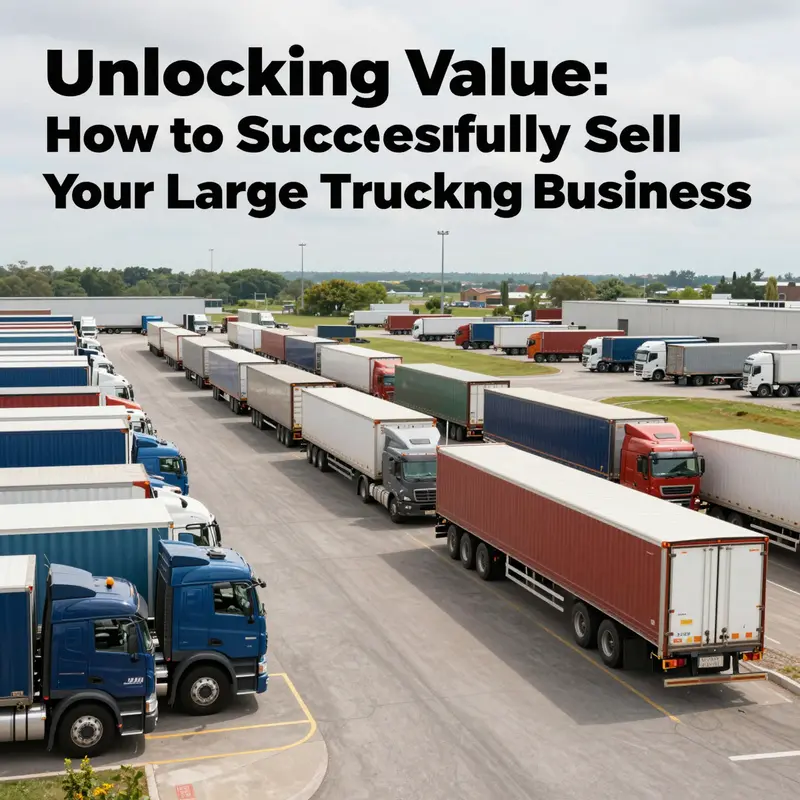
Selling a large trucking business is a multifaceted process that requires a strategic approach and meticulous planning. The logistics and freight industry, characterized by its unique challenges and opportunities, necessitates a thorough understanding of market dynamics and business valuations. From construction and engineering firms to fleet management and food distributors, knowing how to effectively manage the sale of a trucking business can significantly enhance its value. This article unfolds key chapters detailing everything from assessing your business value to successfully closing the deal, providing you with actionable insights to ensure a smooth transaction.
Valuing the Big Fleet: A Holistic Guide to Pricing Your Large Trucking Business for Sale

Valuing a large trucking business hinges on more than tallying the number of tractors and trailers. It requires reading the full story the books tell—the cash flow, the contracts, the efficiency of operations, and the future growth potential that a buyer can reasonably unlock. A holistic valuation looks through four lenses at once: financial performance, asset quality, market position, and operational scalability. When these lenses align, the price a buyer is willing to pay reflects not just what exists on the balance sheet, but what the business can reliably generate in the coming years.
Begin with financial performance, the heartbeat of any valuation. Buyers want a clear view of revenue and profitability over a meaningful horizon, typically the past three to five years. The focus is on EBITDA—the earnings before interest, taxes, depreciation, and amortization—because it normalizes for capital structure and accounting quirks. A consistent, growing EBITDA signals durable cash flow that can support debt and provide a predictable return to investors. But EBITDA alone isn’t enough. The quality of earnings matters: are there unusual one-time gains or losses, shifting fuel surcharges, or year-end adjustments that mask true operating performance? Clean, well-documented financials that separate operating results from non-operating items build buyer confidence and support a higher multiple.
Beyond the income statement, the asset base commands serious attention. The fleet, equipment, and the technology stack that runs dispatch, telematics, and maintenance must be appraised for remaining useful life, utilization, and reliability. The condition and age of tractors and trailers influence replacement costs, maintenance cycles, and downtime. A modern, well-maintained fleet reduces risk in the eyes of a buyer and can command a premium. Likewise, the value of the technology layer—telematics, routing software, fuel optimization tools, and safety systems—tends to compound with execution. A sophisticated tech backbone often translates into measurable efficiency gains and lower operating risk, which buyers price in as future savings rather than as a current asset alone.
A robust customer base and enduring contracts are another cornerstone of value. A diversified mix of shippers and long-term freight agreements reduces concentration risk and provides revenue visibility that is highly persuasive to buyers. When contracts are with credible, creditworthy customers and include favorable terms, those contracts become intangible assets with real monetary value. Buyers will scrutinize contract tenure, renewal risk, and the potential impact if large customers depart. Even behaviorally valuable data—consistent order patterns, predictable freight lanes, and seasonality management—adds intangible value by lowering the perceived risk of business interruption.
Next, market position and competitive advantage shape how a buyer interprets growth potential. A business that already occupies a meaningful share of high-demand corridors, demonstrates a positive reputation for on-time delivery, and maintains strong safety and compliance records stands out. Intangible assets such as brand trust, carrier relationships, and buyer-ready data assets carry weight. Technology adoption is particularly influential. Modern fleets that deploy real-time tracking, dynamic pricing, and efficient dispatching can reduce costs and improve service levels. Independent studies suggest that digital capability can translate into materially lower costs over a baseline industry average, underscoring how tech maturity becomes a tangible contributor to value when buyers model future cash flows. The network effect—how efficiently routes are planned, how well capacity is matched to demand, and how quickly a business can scale—adds another layer of value that is tough to replicate and therefore commands a premium.
Operational efficiency is the engine that turns potential into realized value. Driver retention and safety are not just compliance concerns; they are risk mitigators and cost savers. A low driver turnover rate reduces recruiting and training costs, stabilizes operations, and fosters reliability—qualities that buyers prize highly. Load utilization and fleet utilization metrics gauge how effectively assets are deployed. High load factors and sustained utilization lower per-mile costs and raise revenue per mile, a combination buyers view as a signal of scalable operation. The capacity to grow without proportional increases in overhead, often described as scalability, is especially important for larger buyers who plan to expand fleets, enter new markets, or broaden service offerings.
Industry trends and external factors complete the valuation picture. The freight market remains sensitive to the broader economy, energy policies, and regulatory regimes. Demand for trucking services tends to follow economic activity, while regulatory and environmental considerations shape future operating costs. Driver shortages persist as a structural challenge, making businesses with strong recruitment and retention strategies more valuable. For the large operator contemplating a sale, a favorable context—such as improving freight demand and a stable regulatory environment—can support a higher multiple, while a restrictive backdrop can compress value by heightening risk. Buyers will model these macro factors alongside the company-specific data to arrive at a present value that reflects both risk and opportunity.
Valuation methods for a large trucking business typically converge on a core principle: buyers pay for predictable, growing earnings and defensible assets. The most common framework is a multiple of EBITDA. In a market where risk profiles, growth potential, and contract stability vary, a typical range might span from roughly 3x to 7x EBITDA. A business with a strong contract base, a modern and reliable fleet, and disciplined safety and compliance practices may command the higher end of that band, while a company with higher volatility or concentrated revenue could fall toward the lower end. Another approach is asset-based valuation, useful when a substantial portion of value rests in tangible assets. This method adds up the market value of the fleet and equipment, telematics systems, and real estate, minus liabilities. Finally, the income approach projects future earnings under assumed growth and discounts them to present value, a perspective that can be persuasive when a buyer expects meaningful expansion in scale or efficiency gains from integration and synergies.
Because the value of a large trucking business arises from both cash flows and strategic assets, engaging a qualified M&A advisor or appraisal professional with sector experience is essential. They verify data integrity, perform due diligence, and deliver a formal valuation report that stands up to scrutiny during negotiations. A credible valuation not only supports a fair price but also accelerates the deal by shortening the buyer’s due diligence timeline and reducing questions about the numbers. When valuation is paired with a well-prepared confidential information memorandum and a clean set of financials, the seller projects confidence and readiness—two signals that can keep the process moving toward a smooth close.
Preparation for sale often involves more than number-crunching. A seller who wants to maximize value should proactively address operational gaps that could erode a deal. This includes formalizing driver retention strategies, documenting safety programs and CSA scores, and ensuring leases, permits, and registrations are up to date. A well-documented maintenance history and a current asset register with serial numbers and condition reports reduce friction during diligence. In practical terms, that means presenting a CIM (confidential information memorandum) that outlines strengths, growth potential, and risks in a measured, candid way. A buyer will scrutinize every assumption, so clarity and transparency are essential to securing a favorable valuation.
The art of maximizing value also extends to deal structure. Buyers often look to earn-out components tied to achieving specified revenue targets or cost savings post-acquisition. An earn-out can bridge gaps between seller expectations and buyer risk tolerance, especially when the business relies on key customer relationships or seasoned drivers whose continued performance is pivotal to post-close results. The transition phase matters, too. A credible plan for management transition, customer introductions, and operational handover reduces perceived risk and supports a higher valuation by promising continuity to the buyer.
In this landscape, the intangible value embedded in people and culture should not be underestimated. A workforce that delivers consistent service, safety, and reliability is a core competitive asset that buyers will evaluate closely. For those seeking to understand how to translate people strategy into value, one relevant resource highlights how investment in personnel aligns with long-term performance in trucking. Investing in People: Key to Trucking’s Success signals that strong human capital practices—recruitment, training, retention, and safety culture—are not a cost center but a value driver that improves margins, reduces risk, and enhances scalability. Integrating such practices before sale can yield a higher EBITDA foundation and a higher perceived risk-adjusted value for prospective buyers.
As a closing note, consider how the seller’s strategic positioning translates into buyer value. A well-articulated growth story, a clear plan for expanding into adjacent markets or lanes, and a credible pathway to productivity improvements can justify a higher multiple. Buyers will model the upside: what happens if the network is optimized further, if new lanes are pursued, or if technology investments yield additional cost savings. Presenting a thoughtful, evidenced plan for how the company can maintain momentum after the sale is as important as presenting the numbers themselves. The market rewards clarity, foresight, and demonstrated operational discipline.
For readers seeking broader context on how marketplaces and buyer networks operate within trucking, external resources provide useful perspectives on match-making and deal dynamics in the space. A practical gateway to industry buyer networks can be found at external market resources, which complement the valuation framework outlined above. https://www.truckstop.com/marketplace/
In sum, the value of a large trucking business is the synthesis of durable cash flow, asset quality, strategic market position, and scalable operations. By aligning financial performance with operational excellence and a compelling growth narrative, sellers can position their business not merely as a fleet of assets but as a well-integrated platform for continued profitability. The end goal is a credible, defendable valuation that resonates with buyers and minimizes friction through diligence, all while maintaining a transparent, professional, and well-documented process. For those who want to anchor their strategy in people and culture as a value driver, the linked resource offers a concrete framework to complement the financial and operational angles discussed here.
From Fleet to Exit: A Strategic, Value-Driven Sale of a Large Trucking Business

Selling a large trucking business is less about dispersing assets and more about orchestrating a strategic exit that preserves value, protects critical relationships, and positions the buyer to grow without unnecessary disruption. The process hinges on disciplined preparation, precise valuation, and a thoughtful choice of buyers and deal structure. When approached with rigor, the sale becomes a transformation phase for the enterprise, not a stumble into liquidation. The centerpiece is a clean, transparent picture of performance and potential, backed by documentation that removes doubt and invites confident commitments from buyers who can integrate or scale the operation within their existing networks.
Preparation begins with the numbers. A comprehensive financial audit, conducted by an independent accountant or advisory firm with experience in transportation, lays the groundwork for credibility. This audit should verify revenue streams, margins, accounts receivable and payable, and the reliability of profit across seasons and cycles. Clean books signal that the business is well managed and that the buyer is not inheriting unwelcome surprises. Parallel to financials, owners should assemble operational documentation that demonstrates control and reliability. Vehicle titles, maintenance histories, insurance policies, client and driver contracts, lease terms, permits, compliance logs, and safety records all contribute to a view of a well-governed operation. The goal is a dossier that makes diligence predictable rather than vigilant.
Another key planning lever is asset optimization. A large fleet naturally accumulates high-mileage equipment, underutilized assets, or maintenance-heavy trucks that erode the core business value. Before the main sale, consider isolating and selling for maximum value those assets that no longer fit the strategic profile of the core operation. This leaves behind a streamlined fleet with intact maintenance histories and up-to-date warranties where possible. A leaner asset base can lift the perceived and actual profitability of the ongoing business, a point many buyers will recognize when stimulating the CIM (confidential information memorandum) and valuation discussions.
Valuation itself is both science and art. A professional appraiser who specializes in transportation firms will weigh fleet size and condition, revenue diversity, contract quality, driver retention, safety metrics, and market demand. The result is a defensible, market-aware number rather than a guess. With valuation in hand, the decision on sale strategy becomes more straightforward. A private sale to a strategic buyer—large regional or national carriers looking to fold your routes into their network—often yields the best long-term value through synergies like back-office consolidation, better carrier terms, and enhanced scale. A financial buyer, including private equity, may value future earnings potential highly and offer attractive terms, but their diligence will probe management structure, growth levers, and the capacity to implement changes after closing. A broker or M&A advisor with trucking-sector expertise can accelerate the process, pre-screen potential buyers, and guard the deal against common missteps, though the cost reflects their expertise. An auction can generate competition, but the certainty of a final price may be lower, and it is typically more suitable for non-core assets or distressed situations. The choice among these paths should align with the owner’s objectives, risk tolerance, and timeline for exit.
Marketing the business effectively requires a narrative that is both compelling and credible. The CIM is the centerpiece of this narrative—a concise, professional document that outlines financial performance, fleet details, client concentration, driver quality, safety culture, and growth opportunities. A strong CIM invites buyers to see not only what exists today but what could be unlocked with an appropriate level of investment. In presenting the story, it helps to lean on the credibility of the owner’s track record: a consistent safety record, low driver turnover, and a fleet in reliable condition all signal that the business can be integrated with minimal friction.
When it comes to outreach, industry-focused networks and platforms are essential. Strategic buyers are often found through industry events, broker networks, and targeted outreach to carriers with complementary networks. Financial buyers look for stable, scalable cash flow and robust back-office infrastructure; they will be drawn to evidence of scalable operations, standardized procedures, and a plan for integration. A broker with a deep trucking network can harmonize these threads, ensuring that messaging remains consistent while widening the pool of qualified buyers. Importantly, a seller should protect confidentiality during the market phase to avoid unsettling customers and drivers or inviting disruptive rumors, while still generating meaningful interest.
Due diligence is the crucible of the sale. Serious buyers will dive into the financials, legal structure, customer agreements, fleet maintenance records, driver contracts, and safety and compliance frameworks. The seller’s role is to be cooperative but prepared, providing documents promptly and consistently. Delays or inconsistencies can erode buyer confidence and push them toward more transparent rivals. Throughout this phase, partnering with the right attorney and accountant is indispensable. They guide compliance with tax and regulatory requirements, help structure the transaction to optimize after-tax proceeds, and advise on risk allocation related to existing contracts and regulatory liabilities. A carefully considered earn-out can be a prudent element of the deal, linking a portion of the price to future performance and aligning incentives between buyer and seller during a transition period.
Structuring the close and transition demands equal care. A purchase agreement should clearly spell out the purchase price, payment schedule, liabilities assumed, and the scope and duration of any transition assistance. The transfer of vehicle ownership, title registrations, and permits requires coordination with regulatory bodies and, in some cases, DMV and FMCSA processes. A robust transition plan helps the buyer’s team ramp up quickly and reinforces customer and driver continuity. It may include training for the new leadership, introductions to key customers and drivers, and a phased handover of operational reins. The smoother this handoff, the more likely the buyer will honor post-closing commitments and retain critical personnel, which in turn sustains revenue streams during the transition.
Post-sale considerations are not afterthoughts. Tax planning becomes central as capital gains, depreciation recapture, and potential state tax implications come into play. Coordinating with a tax professional experienced in large transactions ensures that cash proceeds are maximized and compliance is maintained. For owners who envision starting another venture, the exit should be viewed as a platform for future opportunities rather than a final act. The best exits leave open doors for new ventures, whether through retained equity, consulting arrangements, or advisory roles that preserve industry influence and networks. In many ways, the value of a well-executed exit is not only the price paid but the stability and momentum it preserves for both the buyer and the broader ecosystem—the drivers, customers, and partners who will continue to rely on high-quality service.
The human element deserves sustained attention throughout the sale. Drivers, maintenance staff, and back-office teams are the backbone of the operation, and their retention often determines whether the buyer can achieve the anticipated benefits of consolidation or scale. A disciplined retention strategy—clear communication about the transition, non-disruptive shifts in responsibilities, and incentives aligned with performance—helps minimize turnover during the critical handover window. This emphasis on people echoes a broader industry truth: long-term value in trucking rests on operational reliability and workforce stability as much as on fleet economics. For readers seeking a grounded, people-centered lens on these considerations, the article on People-first strategies in trucking offers complementary insights into sustaining culture and performance during and after a sale. People-first strategies in trucking
Ultimately, the goal of selling a large trucking business is to crystallize value by presenting a credible, scalable path to continued profitability under capable ownership. A well-prepared CIM, a coherent valuation, and a strategic selection of buyers create a powerful trifecta. The process rewards patience and discipline: rushing to close can undermine price and terms, while overhasty secrecy can erode confidence. When done correctly, the sale becomes not an end but a milestone—a transition that preserves the enterprise’s core strengths and accelerates future opportunities for both seller and buyer.
For those who want to anchor their decision in established industry standards and best practices, there is value in aligning with professional networks and industry bodies that support best-in-class transactions. Industry associations, broker networks, and disciplined due diligence processes help ensure that the deal structure is fair, that regulatory obligations are fulfilled, and that the transition plan protects customers, drivers, and employees. As the market for trucking transactions continues to evolve, staying informed about regulatory developments, fleet efficiency trends, and workforce strategies will help sellers time their exit to maximize value while minimizing disruption. This alignment with industry standards and ongoing professional guidance is what ultimately differentiates a successful exit from a merely satisfactory one.
External resource: National Association of Small Trucking Companies (NASTC) provides industry standards, broker networks, and business resources to inform both buyers and sellers as they navigate complex transactions in transportation. https://www.nastc.org/
Marketing Mastery for a Lucrative Trucking Business Sale: Crafting Value, Confidence, and a Smooth Transition

Selling a large trucking business is as much about storytelling as it is about numbers. The market responds not only to a clean ledger and a well-maintained fleet, but to a compelling narrative about stability, growth potential, and a seamless handoff. In this chapter, we weave together valuation, confidentiality, and targeted outreach into a cohesive approach that elevates the perceived and actual value of a trucking enterprise. The goal is to attract serious buyers who see a clear path to continued profitability, minimize disruption to day-to-day operations during the sale, and maximize the final price while preserving the company’s legacy. At the heart of this effort is the realization that marketing a trucking business is a disciplined process that starts long before any paper hits a buyer’s desk and ends with a well-structured transition that honors both seller and purchaser.
A fundamental driver of successful marketing is presenting an accurate, professional valuation that anchors every conversation. A robust valuation report does more than assign a figure; it frames the business in the current market, clarifies drivers of value, and exposes levers for future upside. Buyers read these analyses as a map of risk and opportunity. When combined with organized financial records—up-to-date P&L statements, clean balance sheets, cash flow analyses, evidence of fuel cost management, maintenance schedules, and insurance profiles—the valuation becomes a trustworthy foundation for negotiations. Clean books and audited statements do more than impress; they reduce friction during due diligence by answering the most common questions before they arise. A credible valuation and transparent financials are signs of a well-run operation, and that perception can lift buyer confidence from the first inquiry to the final signature.
Equally important is assembling a comprehensive set of indispensable documents so the narrative is credible rather than speculative. A well-prepared set includes licenses and permits, lease agreements for equipment, customer contracts, driver employment records, safety and compliance reports, and a precise equipment list with serial numbers and purchase dates. Manufacturers’ compliance histories, CSA scores, and ELD logs—all placed in one organized package—become part of the story that buyers tell themselves about risk management and ongoing reliability. Alongside these records, a confidential information memorandum (CIM) serves as the backbone of your marketing narrative. The CIM distills strengths, growth potential, and risks into a concise, readable document that a prospective buyer can review discreetly. It aligns the buyer’s expectations with the realities of the business and helps prevent misinterpretations that can derail negotiations.
From there, the marketing plan moves into how the story is told. A strong listing communicates the company’s value proposition in a way that resonates with buyers who understand the freight and logistics space. The emphasis should be on a diversified customer base, long-term freight commitments, modern or well-maintained equipment, favorable route structures, and strong safety records. It’s essential to frame growth potential not as a vague promise but as a tangible pathway—whether through expanding lanes, upgrading to more efficient equipment, improving driver retention, or leveraging data-driven routing to increase margins. The narrative must also acknowledge any risks, yet present credible mitigation strategies, such as robust retention programs for drivers, scalable technology platforms, or diversified revenue streams that cushion against market fluctuations. This balanced, transparent storytelling strengthens trust and positions the business as a lower-risk investment.
In the realm of distribution, privately marketed campaigns are often more effective when they exploit targeted channels over broad, generic postings. A confidential marketing approach, sometimes called silent marketing, preserves key customer relationships and protects sensitive information from unnecessary disruption. This requires a controlled dissemination of the CIM to pre-qualified buyers, with structured follow-up and due diligence support. The aim is to spark serious interest while maintaining the discretion that veteran operators know is essential to avoid destabilizing revenue streams or triggering unwanted price pressures from competitors or customers during the sale process. A confidential approach is not a concession to secrecy; it is a strategic choice that preserves value by reducing buyer anxiety and preserving loyalty among operational partners.
To reach the right audience, the strategy blends traditional b-to-b marketing instincts with industry-focused outreach. Rather than depending solely on general business-for-sale platforms, the emphasis should be on industry-specific networks and private channels where serious buyers—other fleet operators, private equity-in-the-space, or strategic buyers—spend time evaluating opportunities. This requires a thoughtful, relationship-driven approach: direct outreach to potential acquirers, introductions through trusted intermediaries, and participation in targeted industry discussions where a company’s capabilities and performance are most relevant. A practical mechanism for channeling this activity is a dedicated buyer outreach path such as a focused, pre-qualified buyers channel. For access to a curated pool of pre-qualified buyers, consider the trucking-business-sales avenue trucking-business-sales. This link serves as a conduit to conversations with buyers who already understand the sector’s dynamics and who can appreciate the specifics of your fleet mix, route density, and regulatory posture.
Visibility beyond confidential channels also matters, especially for the parts of the business that can be independently verified by a buyer. A professional website or landing page dedicated to the sale, enhanced with high-quality visuals of the fleet and facilities, client testimonials from long-tenured customers, and a precise summary of economics, signals, and growth potential, helps buyers grasp the opportunity at a glance. Even with confidentiality, a well-crafted digital footprint supports a smooth due diligence process by offering a reliable first impression and a coherent storyline for the buyer’s acquisition team. Coupled with search engine optimization tailored to “trucking business sale” queries, this digital presence ensures the opportunity surfaces in relevant searches and draws interest from qualified buyers who are actively exploring this space.
Every buyer searches for a coherent, executable plan for post-acquisition integration. A critical aspect of marketing success, therefore, is outlining the transition plan. Buyers want to see how the seller will support continuity, including transitional management, customer introductions, and a staged handover of key personnel. Detailing practical steps—such as who assumes regulatory responsibilities, how customer relationships will be preserved, and how employee morale will be maintained during the change—reduces perceived risk and accelerates decision-making. The value of a well-articulated transition plan cannot be overstated; it reassures buyers that the business will continue to perform during the critical window after the closing.
In this context, the role of professional guidance cannot be overlooked. An experienced advisor or broker who specializes in transportation and logistics can dramatically elevate the marketing effort. They bring an understanding of the market’s appetite, a network of potential buyers, and the process discipline necessary to navigate complex due diligence, tax considerations, and regulatory compliance. They also help structure the deal in ways that align incentives—such as an earn-out aligned with revenue targets—so both sides can share in the future upside while managing risk. The right advisor acts as a steward of value, ensuring that the marketing materials, CIM, and lender or investor communications are consistent and compelling throughout the sale process.
This is not merely about presenting numbers; it is about validating them through disciplined, buyer-ready packaging. The seller’s memorandum, or CIM, should crystallize the business’s competitive advantages, articulate the cost structures that support margins, and demonstrate how current profitability can be sustained or enhanced under new ownership. It should translate the fleet’s day-to-day operations into a coherent growth thesis: standardized routes that deliver stable revenue, a compliant safety culture that reduces risk, and a management team capable of operating with minimal seller involvement. A buyer who encounters a well-prepared CIM is more likely to move quickly from initial interest to formal due diligence and, eventually, a signed agreement.
Beyond documents and narratives, marketing a trucking business sale hinges on credibility and timing. Prospective buyers often want to observe operational performance during a period of posturing, so it helps to present a window into performance that is realistic, yet optimistic about improvements. A demonstrated track record of stable revenue and disciplined cost management is more persuasive than aspirational projections alone. If there are opportunities to enhance margins through targeted initiatives—such as more efficient fuel management, lane optimization, or driver-retention programs—these should be quantified and included in the growth narrative. The best marketing outcomes arise when the CIM and the financials describe a future that is achievable with the right stewardship, not a distant, uncertain possibility.
As the sale progresses, the interplay between marketing, diligence, and negotiation becomes critical. A well-marketed business invites robust but orderly due diligence. Buyers will scrutinize contracts, vehicle histories, maintenance records, safety compliance, and regulatory exposure. A seller who anticipates these inquiries with a prepared, clean, and consistent set of materials will encounter fewer roadblocks and a faster closing. The result is a transaction that respects the seller’s objectives while delivering a compelling proposition to the buyer—one that translates years of operating discipline into a more favorable exit multiple.
In closing, marketing a large trucking business for sale is a multidimensional discipline. It requires precision in valuation and documentation, a disciplined confidentiality approach, a compelling narrative of current performance and future potential, and a strategic mix of traditional and industry-focused channels. It also depends on partnering with professionals who understand the transportation landscape and can guide the process with integrity and tact. When these elements cohere, the sale becomes more than a transaction; it becomes a well-executed transition that preserves value, sustains customer relationships, and provides a solid foundation for the next act in the owner’s business journey. For those seeking broader industry guidance and standards as they prepare, the National Association of Small Trucking Companies offers resources and perspectives that complement this process. https://www.nastc.org/
null

null
Closing the Large Trucking Deal: Seamless Close and Transition

Closing a large trucking business sale is a disciplined process that protects value and sets the stage for the buyer’s success and the seller’s next chapter. It is not just a handshake and a wire transfer; it is a carefully sequenced set of actions that turns months of due diligence into a functioning enterprise under new leadership. The final mile—signing documents, transferring funds, and shifting operations—must preserve customer relationships, keep drivers on the road, and maintain the reputation you spent years building. Poor execution can create gaps, regulatory risk, and post‑close disputes that erode value. The shift from sell‑side to buy‑side is a transition of trust as much as a transfer of assets.
The first pillar of a smooth close is precision in the legal and financial fabric of the deal. Before any signature, every financial statement, asset list, lease, title, and regulatory file should be current and accurate. Engage counsel with transportation‑transaction expertise and an experienced accountant to align tax implications with deal structure. The purchase agreement and related documents should clearly define price, payment schedules, assumed liabilities, and transition responsibilities. In trucking, regulatory paperwork is not decorative; FMCSA and DOT records, asset titles, and lease terms often hinge the transfer. Prepare a concise confidential information memorandum (CIM) that reflects strengths, risks, and the transition plan; this document becomes the reference through closing and the first 90 days of operation under new ownership.
Financing can shape the final timetable. If the buyer relies on external financing, coordinate with their lender to satisfy closing conditions. Appraisals, credit checks, and insurance verifications can stall a closing if not anticipated. A deliberate pace reduces last‑minute issues. Ensure funds are available on the agreed close date and that escrow holds or holdbacks are defined. Confirm contingencies—audits, title reviews, and permit transfers—are satisfied or properly sequenced so closing is not delayed after signing.
Beyond money and signatures, the transition plan is a structural asset of the deal. The buyer will want a clearly timed handover that preserves customer faith, driver morale, and operational continuity. Build a detailed calendar for transferring ownership of trucks, trailers, depots, and other assets, with a protocol for updating registrations, insurance, and FMCSA records. Communication is the backbone of this plan; inform drivers, customers, and vendors about ownership changes with transparency and reassurance. Include training sessions for the buyer’s management to learn routes, safety practices, maintenance schedules, and compliance procedures. This is a transfer of experience and culture, not a handoff to a faceless entity.
Leadership retention matters. Identify personnel essential to service quality, route stability, or safety, and address retention explicitly. Consider retention bonuses or short‑term employment agreements to smooth the transition. Clearly articulate the buyer’s post‑close vision so your team can align with it, reducing disruption and unnecessary turnover. A well‑communicated culture helps minimize ramp‑up time and accelerates realization of synergies.
Documentation and due diligence continue after closing as post‑closing diligence and transitional support. Schedule a brief follow‑up with the buyer a few weeks after the close to confirm that systems, assets, and processes have transferred and are functioning. This helps surface gaps such as software access, maintenance records, or vendor contracts that require re‑signing. The goal is a constructive partnership and a smooth post‑close handover rather than a abrupt disengagement.
Finally, address tax and risk considerations with your advisor. Revisit the tax plan to understand capital gains, depreciation recapture, transfer taxes, and state implications. If an earn‑out or performance payments are involved, define objective metrics, a transparent calculation method, and a clear payment schedule. Clear contingencies protect both sides if market conditions shift or regulatory environments evolve.
No close exists in a vacuum. The real power of a well‑executed close is the transition’s ripple effect: lasting customer relationships, a retained driver workforce, and a platform for the buyer to begin realizing the envisioned synergies without disruption. To gain external perspectives, consider referencing industry insights on closing large deals and leadership during transitions.
Final thoughts
The successful sale of your large trucking business not only hinges on accurate valuation, but also on strategically managing the sale process. By following the outlined steps, including effective marketing and thorough negotiations, you can maximize your business’s value and ensure a smooth transition for both parties involved. Empowered with insights from this guide, you’re now better equipped to navigate this complex landscape and achieve a successful sale.