
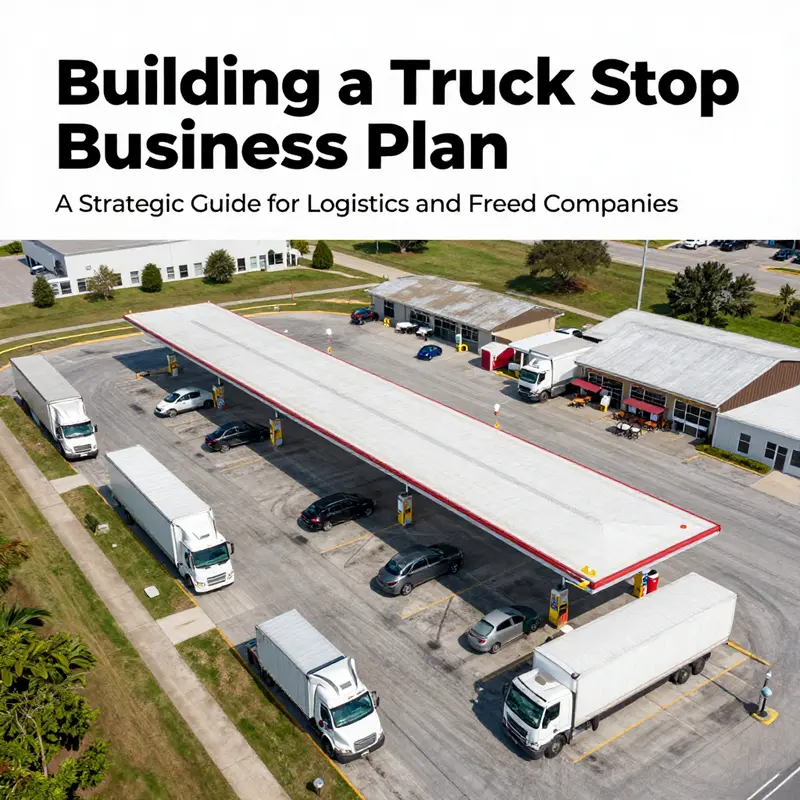
Creating a truck stop business plan is not merely a formality; it’s a strategic blueprint that directly influences the success of your operations in the logistics and freight industries. The market for truck stops is evolving rapidly, fueled by the increasing demands of long-haul trucking, fleet management, and growing supply chain complexities. This article serves as an in-depth guide for logistics and freight companies, construction and engineering firms, fleet management professionals, and food and beverage distributors looking to enter or expand within this lucrative sector. By exploring the executive summary’s critical role, understanding the company description, analyzing market dynamics, and implementing robust financial planning strategies, readers will be equipped with actionable insights for constructing a compelling business plan that meets contemporary industry demands.
Chapter 1: Framing the Vision—How the Executive Summary Keeps Your Truck Stop Plan On Track
The executive summary is the project’s compass: a concise, persuasive snapshot that orients readers to the opportunity, the plan to seize it, and the reasons the team can deliver. For a truck stop, this means explaining in clear terms what the site will offer (fuel, parking, maintenance, food, amenities), why the chosen location matters in regional freight flows, and which customer segments—owner‑operators, regional carriers, and national fleets—the site will serve.
A strong executive summary balances ambition with evidence. It highlights the core value proposition—reliable fueling, safe and sufficient parking, quick turnarounds, and amenities that reduce driver downtime—while signaling market awareness through compact, supportable claims about demand and growth drivers (freight volumes, regulatory patterns that shape driver rest needs, and fleet expectations for dependable stops).
Financial credibility is essential. Summarize capital needs, a high‑level revenue mix (fuel vs. nonfuel services), expected utilization patterns, and a realistic break‑even horizon. Use conservative assumptions tied to industry benchmarks so lenders and investors can quickly judge that projections are plausible and risks have been considered, including fuel price swings, labor costs, and permitting timelines.
Execution is the third pillar. Briefly note the timeline, key milestones, permitting and construction sequencing, and governance or management experience that will carry the project through launch and scale. A short statement about recruiting and workforce development, partnerships with fleets or payment networks, and operational controls for safety and compliance reassures stakeholders the team has an executable plan.
Signal sustainability and resilience where relevant—energy efficiency, water management, or contingency planning for fuel supply interruptions—to show long‑term cost discipline and regulatory foresight. Close with a clear ask or next step for the reader (amount of funding sought, decision milestones, or areas where partnership is requested) so the summary functions as both an orienting narrative and a call to action.
In short, treat the executive summary as the single most important page of your business plan: concise, evidence‑based, and directly tied to the market, finances, and execution plan that follow. When crafted with discipline, it invites deeper diligence and builds the trust required to move from concept to concrete.
Chapter 2: Defining the Company Identity for a Truck Stop Business Plan
The company description is more than a directory of facts; it is the narrative through which readers sense the soul of your truck stop before they ever visit the site. In a plan built to attract lenders, partners, and future operators, this section sets the tone, clarifies purpose, and translates an entrepreneurial idea into a credible organization. It should answer not only who you are and where you’ll operate, but why you exist in a broader sense. A well-crafted company description serves as a compass for every decision that follows—layout, service mix, staffing, pricing philosophy, and even the cadence of future expansions. It begins with a crisp declaration of your business’s reason for being and then threads that purpose through every operational choice. In building a truck stop, the description acts as a bridge between the demands of the road—safety, reliability, speed, cleanliness—and the long arc of business growth that investors want to see. It is the place where the vision for a bustling, well-run hub along a freight corridor takes concrete form, becoming a guidepost for leadership behavior, governance, and day-to-day discipline. The core of the description is not merely a statement of fact but a story about identity—how the company sees itself, how it treats customers and employees, and how it plans to earn trust over years of service on the highway system.
Take the mission as a starting point: a concise, actionable promise that aligns every decision with a single objective. For a truck stop, that promise might center on safety, reliability, and efficiency for long-haul drivers and fleets. It should acknowledge the realities of the road—long hours, fatigue, the need for dependable facilities, and the importance of timely, transparent pricing. A mission statement becomes a living benchmark; it invites leaders, staff, and partners to measure every action against it. Beyond the mission, a thoughtful company description also articulates a clear vision. This is not about predicting every microdetail of the next decade; it is about describing a future state your organization is actively pursuing. Will you become a regional standard for trucker wellness and maintenance readiness? Will you set a benchmark for clean facilities and secure parking that reduces incidents and paperwork friction for fleets? A compelling vision translates into a narrative about growth, scale, and measurable impact, offering stakeholders a sense of where the business intends to go and why the journey matters.
The description then situates the venture within a legal and organizational framework. Detailing the chosen legal structure—whether an LLC, a corporation, or another form—helps readers understand liability, taxation, and governance. Ownership details, including who holds strategic responsibility and how decisions are made, reinforce credibility. The leadership team in particular becomes a focal point: the people who bring logistics expertise, hospitality know-how, and compliance discipline to life in the physical footprint of a truck stop. Even in a plan that will be read by lenders and investors, the human element is central. A robust description highlights the leadership’s track record in managing complex operations, scaling services, and maintaining safety and quality standards across shifts and weather conditions. This is not a resume dump; it is a narrative of capability and stewardship.
Geography and site character are not afterthoughts but fundamental to the company’s identity. The description should convey why the chosen location—proximity to major freight corridors, distribution centers, or industrial zones—matters for traffic, service mix, and turnaround times. It should explain how the site design supports trucker needs while complying with local zoning, noise, and emissions considerations. A well-placed facility sends a signal about accessibility and reliability, two factors that echo throughout the customer experience. If the plan envisions future expansion, the description should outline how the company might replicate the model in other corridors or markets. This could involve staged growth around existing hubs, shared services between locations, or modular facility components that reduce lead times for new builds. Even when describing a new venture, readers want to trace a credible path from concept to scalable operations, and the company description is where that path begins to take shape.
A distinctive competitive advantage belongs in this section, because readers will be assessing how the business stands out in a market with established players that control access to key rest and fueling stops. The description should articulate what makes your truck stop different in meaningful ways. It could be an enhanced guest environment that prioritizes cleanliness and safety, a service mix tailored to truckers’ rhythms (for example, extended rest facilities, rapid refueling, and a dedicated maintenance lane), or a uniquely designed layout that minimizes idle time and reduces curbside congestion. It could also include sustainability commitments that align with fleet goals and regulatory expectations, such as energy-efficient pumps, recycling initiatives, or EV charging compatibility. The point is to translate these differentiators into a credible capability that turns first-time visitors into repeat customers and long-term partners into loyal clients. A transparent articulation of the competitive edge not only informs the market narrative but also guides the company’s operations strategy—how you train staff, how you schedule shifts, and how you maintain consistent service levels across the day and night cycle.
Sustainability, in particular, deserves explicit attention within the company description. Fleets are increasingly evaluating vendors on environmental performance and resource stewardship. The description should communicate your commitment to responsible operations, whether through energy efficiency, water conservation, waste reduction, or clean-energy options that support evolving regulations and corporate social responsibility goals. Even modest initiatives, such as daylighting, rooftop solar where feasible, low-water fixtures, or efficient lighting and HVAC systems, can signal a mature approach to reducing environmental impact. For readers who think long-term, the company description becomes a blueprint for how the business will adapt to regulatory shifts and market expectations. It signals that the venture intends to stay relevant as fleets evolve toward new propulsion technologies and as government programs encourage greener practices across the trucking ecosystem.
History and founding context add texture to the description. If the truck stop is already established, the narrative can recount the journey—the discovery of a market gap, the early experiments in service design, and the milestones that led to a formal plan. If this is a new venture, the description should recount the genesis: the problem you aimed to solve, the conversations that clarified the value proposition, and the timeline for liquidity, construction, and initial operations. Even in brief, the founding story helps readers understand the passion behind the plan and the discipline behind the roadmap. It also invites empathy, which is a powerful driver of investment and collaboration. The chapter should avoid overpromising while emphasizing a disciplined approach to execution. To that end, the company description should explicitly connect to the next sections of the plan. It provides the anchor for the market analysis, the services and operations plan, and the financial projections by explaining how the proposed services, site design, and staffing strategies will deliver the stated mission and enable growth.
An effective company description also acknowledges the culture you intend to cultivate. Values such as safety, transparency, and service quality influence every policy—from how you screen vendors and hire staff to how you manage parking enforcement and incident response. In a trucking hub, culture translates into predictable experiences: drivers feel safe at night, maintenance crews work efficiently, and customers sense that their time is valued. The description should therefore outline the cultural commitments that will guide performance reviews, training programs, and day-to-day interactions with customers and partners. This human-centered dimension complements the more tangible elements of location, facility design, and equipment. By weaving together purpose, structure, location, differentiation, sustainability, history, and culture, the company description becomes a living document that informs strategy across the plan and signals to readers that the venture can be stewarded with discipline and foresight.
Finally, the description should convey long-term goals and growth strategies without resorting to vague promises. It should outline how the business intends to evolve: potential additional locations, service expansions, and partnerships that could deepen market reach. Even when those plans are contingent on external factors, articulating a clear trajectory signals to lenders and partners that the organization is thinking structurally about the future. A credible growth narrative aligns with the market analysis, demonstrates a path to scale, and shows how the company will reinvest earnings to strengthen core capabilities. It invites readers to imagine what the truck stop could become if the initial concept proves durable and the market opportunities remain favorable. Throughout, the company description should avoid jargon and present a narrative that is accessible to diverse readers, from lenders evaluating risk to operators assessing daily feasibility. The goal is to present a portrait of a responsible, capable organization that is ready to translate ambition into reliable services for drivers, fleets, and the communities that support them.
To deepen the connection between people and purpose, consider the importance of leadership and workforce development in the company description. A reader should sense that the venture treats its team as a strategic asset, investing in training, wellness, and career progression that translate into better service and safer operations. This emphasis on people aligns with broader industry thinking about sustainable profitability built on human capital. For readers who want to explore the people dimension further, you can reference industry perspectives on investing in people as a cornerstone of trucking success, which offers complementary ideas about governance and culture that can strengthen the overall plan. Investing in people: key to trucking success. This linkage helps knit together the company description with broader leadership practices that improve execution across the plan.
In sum, the company description is more than a procedural checklist. It is a narrative of identity, capability, and responsibility. It communicates why the venture exists, how it will operate on a daily basis, what sets it apart from competitors, and how it will grow in a way that remains aligned with safety, service, and sustainability. When drafted with clarity and honesty, it becomes a touchstone for decisions, a source of confidence for lenders, and a convincing invitation for partners and employees to join a mission that accommodates the realities of highway commerce while advancing standards of quality and reliability on the road. As the plan unfolds in subsequent sections—the market analysis, the services and operations plan, and the financial projections—the company description acts as the throughline that keeps every element coherent. And when readers close the document, they should feel they understand not only what the truck stop aims to do but who will lead it, how it will behave, and why it matters to the broader ecosystem of freight and community life. For those building this narrative, the discipline lies in translating vision into measurable commitments, and then ensuring those commitments are lived out in every shift, every customer interaction, and every strategic decision.
External resource: For a practical template and real-world examples of truck stop planning, see this Scribd resource. https://www.scribd.com/document/589130846/Truck-Stop-Business-Plan-PDF-Cargo-E-Commerce
Finding Your Freight: Market Analysis to Build a Viable Truck Stop Business Plan
Market insights that steer your strategy
A robust market analysis converts assumptions into evidence and risk into opportunity. For a truck stop business plan, this analysis must paint a clear picture of who will use your site, why they will stop there, and how often. It must link traffic patterns to revenue, show where competitors fall short, and reveal how industry trends reshape demand. Treat this chapter as the blueprint that ties customer needs to service design, operations, and financial projections.
Start by defining your core customer segments. “Truckers” is too broad. Break the market into practical groups such as long-haul over-the-road drivers, regional carriers, local delivery fleets, and specialty operators like refrigerated or heavy-haul rigs. Each group has distinct priorities. Long-haul drivers seek reliable overnight parking, showers, and hearty dining. Regional carriers value fast turnaround, on-site repair services, and predictable fuel pricing. Local delivery and light-commercial vehicles may only need quick fuel and fast food. Specialized operators need temperature-controlled bays, secure parking, or high-capacity lifts.
Next, map routes and catchment areas. Identify the primary highways, freight corridors, and logistic nodes that feed your location. A truck stop near an interchange serving several freight lanes will draw different volumes than one on a rural stretch favored by long-haul drivers. Use traffic counts, state DOT freight maps, and company routing patterns to estimate the number of heavy vehicles passing your exit daily. Translate these counts into realistic stop rates. For example, if 3,000 heavy vehicles pass an exit daily and you capture just 3% on average, that still represents 90 potential customers per day.
Assess customer pain points. Interviews, driver forums, and mystery shopping can surface practical complaints. Common issues include unsafe or inadequate parking, unreliable shower availability, slow or inconsistent Wi-Fi, limited healthy food options, and maintenance delays. Prioritize amenities that directly address these pain points and that fit your chosen segment. For example, offering a secure parking app with reservation capability will appeal to drivers who haul high-value cargo. Investing in reliable high-speed connectivity will attract drivers who need to manage dispatch and paperwork on the road.
Competitive analysis must be exhaustive and local. Identify every facility within a 30 to 50-mile radius, including traditional truck stops, travel plazas, and fuel stations with truck amenities. For each competitor, record service mix, hours, fuel types, parking capacity, repair services, restroom quality, average fuel prices, and any visible strengths or weaknesses. Combine on-site visits with driver review sites and fleet input. This triangulation highlights gaps you can exploit. If competitors offer limited electric or alternative fuels, you can market early investments in those fuels as a differentiator. If restrooms and lounges are consistently criticized, emphasize superior cleanliness and comfort in your positioning.
Overlay seasonality and freight cycles on your competitive map. Freight volumes ebb and flow with retail seasons, agricultural harvests, and industrial activity. Understand local seasonal peaks and valleys. For example, a route that serves seasonal produce shipments will have predictable surges in truck traffic. Align staffing, inventory purchases, and promotional offers with these cycles. Use conservative projections in your financial model; plan scenarios for lower-than-expected seasonal demand and for upside during peak periods.
Industry-level trends also inform your strategy. Growth in e-commerce and tighter delivery windows raise demand for flexible fueling and quick-turn services. Regulatory shifts affect driver hours and parking needs, often increasing the value of safe, compliant rest areas. Technology is changing service expectations: drivers now expect mobile payment, real-time parking availability, and fast connectivity. Sustainability matters too. Fleets are adopting alternative fuels and electric vehicles. Incorporating EV charging, RNG, or hydrogen readiness can future-proof your site and attract forward-looking customers. These trends should shape both your service mix and your capital plan.
Translate the market analysis into measurable demand estimates. Start with traffic volume measurements, then apply stop-rate assumptions by segment. Document the assumptions and the rationale for each. For example, you might estimate that 5% of passing long-haul vehicles will stop for fuel, 2% will use maintenance services, and 1% will book a shower or private rest. Convert these estimates into daily, weekly, and monthly visit counts. Use those counts to build realistic revenue lines for fuel, store sales, foodservice, maintenance, and ancillary services like laundry or truck wash.
Price sensitivity and fuel margin strategy are central to profitability. Fuel typically drives foot traffic and remains the largest revenue source. However, fuel margins fluctuate by region and market conditions. Analyze competitor fuel prices, wholesale fuel costs, and local tax structures. Consider loyalty pricing for fleets, bulk sales agreements, and fuel-management partnerships. Your pricing should be competitive enough to attract drivers but leave room for in-store and service upsell. Document conservative margin scenarios in your financial plan and run sensitivity analyses for price swings.
Parking capacity and turnover determine non-fuel revenue potential. A truck stop with limited parking restricts opportunities for paid services like showers, diner meals, and maintenance. Estimate peak parking demand and design capacity to avoid recurrent shortages. If space is constrained, consider reservation systems or tiered pricing for preferred spaces. Secure parking and lighting are premium features that support higher rates and repeat business. Quantify how improved parking transforms revenue by linking parked trucks to average spend per truck during a stay.
Partnerships and contracts can accelerate early adoption and stable revenue. Seek bulk fuel agreements with regional carriers, service contracts with fleet maintenance programs, and foodservice partnerships for predictable menu supply. Building relationships with fleet managers reduces customer acquisition cost and increases repeat traffic. You should also consider programs that reward frequent drivers, such as a loyalty card or mobile app credit. Highlight any letters of intent or preliminary conversations in the business plan to strengthen your case to lenders.
Regulatory and zoning constraints affect both feasibility and cost. Investigate local land use rules, stormwater and wastewater requirements, and air quality regulations. Permit timelines can be long and costly. Factor compliance into project timelines and budgets. Environmental considerations, such as spill containment and fuel storage rules, must be central to site planning. Demonstrating a clear path to permitting reduces perceived risk for investors.
Driver experience drives long-term market share. Drivers choose stops that respect their time and dignity. Clean restrooms, predictable shower availability, friendly staff, and fast, reliable services build loyalty. Investing in staff training and a people-centered operational culture pays dividends. Consider workforce strategies that reflect investment in staff and driver relationships. For ideas on aligning workforce investments with improved fleet and driver outcomes, see this discussion on investing in people in trucking fleets: investing in people: a new path for trucking fleets.
Finally, document your market analysis clearly in the business plan. Present traffic data, customer segments, competitor mapping, seasonal trends, and demand estimates side by side with your service offerings and capacity plan. Show how each revenue line ties back to a measurable market input. Include a sensitivity table that models low, base, and high demand scenarios. Lenders and investors expect transparent assumptions, credible sources, and conservative forecasts where uncertainty exists.
A well-built market analysis does more than justify the project. It prescribes operational priorities, capital allocation, and marketing tactics. It tells you whether to focus first on fuel expansion, parking capacity, or driver amenities. It informs whether to invest early in alternative fuels, EV charging, or high-capacity maintenance bays. Use the analysis to create operational milestones tied to measurable customer behaviors. With that foundation, your financial projections will rest on a clear path to revenue, making funding and execution far more achievable.
For templates and examples that align with this approach, you can review a structured truck stop business plan model that includes market analysis sections and sample data. External reference: https://www.scribd.com/document/518672578/Truck-Stop-Business-Plan-PDF
Funding, Forecasts, and Controls: Building the Financial Blueprint for Your Truck Stop
Financial Blueprint for Your Truck Stop
A truck stop’s survival and growth hinge on a financial plan that is both rigorous and adaptable. Investors and lenders expect clear numbers and realistic assumptions. Operators need a living document that guides day-to-day choices. This chapter walks you through the core elements that make a financial plan credible, actionable, and resilient: startup and capital costs, operating forecasts, break-even and cash flow analysis, scenario planning, key performance indicators, and the financial systems that keep everything accurate.
Start by mapping the full scope of startup expenses. Include land acquisition or lease deposits, site development, and construction costs. Factor in fuel infrastructure such as pumps, tanks, and safety systems. Account for convenience store fixtures, refrigeration units, kitchen equipment for dining services, rest facility finishes, signage, and lighting. Don’t forget the less obvious items: professional fees for architects and engineers, environmental assessments, legal and permitting fees, and initial working capital to cover payroll and inventory until revenue stabilizes. Build a capital expenditure schedule that phases investment. Phase 1 might focus on fuel and basic conveniences. Phase 2 can add maintenance bays, truck washes, or EV chargers as revenue grows.
Operational forecasting is the backbone of credible projections. Create a detailed monthly cash flow for the first 36 months. Break down revenue streams: fuel sales, in-store retail, foodservice, maintenance and repair, parking fees, and ancillary services like laundry or showers. Use per-transaction averages and realistic throughput assumptions. For fuel, estimate average gallons per truck and per-day visit frequency. For store and food sales, model average ticket size and conversion rates. Cross-reference your estimates with competitive benchmarks in the trade area. Conservative assumptions protect your plan from optimism bias.
On the expense side, separate fixed and variable costs. Fixed costs include property taxes, insurance, lease payments, and salaried management. Variable costs cover payroll for hourly staff, fuel purchase costs, food and retail inventory, utility consumption that changes with usage, and maintenance tied to usage. Build in seasonal variation for volume and energy costs. Plan for maintenance cycles of pumps, tanks, HVAC systems, and kitchen equipment. Include a capital reserve line in operating budgets for unexpected repairs and regulatory upgrades.
Cash flow beats profit when it comes to survival. A profitable-looking P&L can still fail if receivables are timed poorly or capex needs outpace available cash. Model cash inflows and outflows with timing precision. Project monthly receipts, vendor payment terms, payroll dates, and loan repayments. Add a buffer, typically three to six months of operating expenses, held as a liquidity safety net. When courting lenders, show ability to service debt under a stress test that reduces revenue by a conservative percentage while holding fixed costs steady.
The break-even analysis clarifies the minimum volume required to cover costs. Compute break-even in terms of fuel gallons and customer transactions. Express it both in units and dollars. Present sensitivity tables that show how the break-even point shifts with changes in average transaction size, fuel margin, or labor costs. These tables help you and investors understand the levers that matter most.
Scenario planning turns your financial model from static to strategic. Build three scenarios: most-likely, downside, and upside. The downside should include plausible risks: a fuel price spike that compresses margins, a temporary road closure reducing traffic, or regulatory costs tied to emissions or safety compliance. The upside can include fleet partnerships that lock in volume, successful loyalty programs that raise visit frequency, or a phased rollout of higher-margin services like maintenance bays. Use scenario outputs to decide on covenant buffers, contingency reserves, and the timing of expansion investment.
KPIs are the language of performance. Identify a concise set of metrics to monitor monthly. Track gross margin by revenue stream, average ticket value, fuel volume per truck per day, transaction count, same-store sales growth for multi-site operators, labor cost as a percent of revenue, inventory turnover, customer retention rate, and net promoter score for service quality. Convert these into dashboard-friendly numbers. For fuel operations, monitor gallons sold per hour of peak traffic and pump uptime. For retail and food, follow shrink rates, waste, and labor productivity.
Technology supports both measurement and control. Modern POS systems integrate fuel and store sales data and can report gross margins in near real-time. Fleet management and reservation tools let carriers book parking and services, smoothing demand and increasing capture rates. Automated inventory systems reduce shrink and re-order time, freeing capital. Where possible, tie sales channels—mobile app, pay-at-pump, in-store—into a single data view. These systems also streamline loyalty programs, which in turn raise repeat visits and average tickets.
Margins in truck stop businesses often follow a pattern: fuel is volume-driven with thin gross margin per gallon, while store and foodservice yield higher margins and greater profitability per square foot. Design your pricing and merchandising strategy to maximize the customer basket. Use loyalty discounts strategically to retain high-frequency customers, while protecting margin through tiered pricing or minimum purchase rules for discounts.
Financing strategy should align with your capital plan. Consider a blended capital stack of owner equity, term loans for construction, equipment financing for pumps and kitchen gear, and possibly a line of credit for working capital. Evaluate lease-vs-buy decisions for trucks, heavy equipment, and high-cost items like EV chargers. Leases preserve cash but may cost more over time. Use tax depreciation schedules to present realistic after-tax cash flows. Include a sensitivity showing how different debt levels affect coverage ratios and return on equity.
Regulatory and macro cost pressures affect costs and margins. Budget for compliance expenses such as environmental monitoring, spill response plans, and waste management. Account for potential tariff and regulatory impacts on supply chains and equipment costs. For a deeper look at how tariffs and emissions rules can affect trucking costs, review the analysis on trucking costs from an industry perspective. trucking costs impact of tariffs and EPA regulations
Insurance and risk management deserve special attention. A fuel facility carries elevated environmental liability risk. Secure robust general liability, property, and pollution policies. Factor premium escalations into operating forecasts. If you plan to offer maintenance services, add garage keeper and professional liability coverage. Demonstrating a thorough insurance strategy calms investors and lenders.
Pricing strategy is both tactical and data-driven. For fuel, consider dynamic pricing windows that reflect wholesale purchase costs, regional competition, and local demand. Use price signaling on highways to attract pass-through traffic, but balance this with margin needs. For retail items, mix staple conveniences that drive frequency with higher-margin impulse and specialty products. For foodservice, balance labor costs with menu complexity. Use menu engineering to focus offerings that deliver the best margin per labor-hour.
Invest in measuring customer behavior. Track peak arrival times, dwell time, and cross-buy rates between fuel, food, and retail. Use this data to optimize staffing, inventory, and promotional timing. A targeted loyalty incentive can move customers from fuel-only visits to higher-margin food and retail purchases.
Finally, institutionalize regular financial reviews. Reforecast monthly during the first year and quarterly thereafter. Compare actuals to budget, analyze variances, and adjust assumptions. Use rolling 12-month cash flow forecasts to anticipate financing needs. Document decisions made from reforecasts; this historical record strengthens credibility with future investors.
A robust financial blueprint turns assumptions into actionable plans. It clarifies how much capital you need, when it’s required, and how risk affects returns. It also provides the controls to measure performance and adapt. With conservative forecasting, scenario planning, disciplined cash management, and technology-enabled oversight, your truck stop can be both a reliable service point and a durable business asset. For a practical template and further instruction on forecasting and startup costing practices, refer to a step-by-step guide that complements the tools described here: https://www.shopify.com.nz/blog/how-to-write-a-box-truck-business-plan
Final thoughts
Crafting a truck stop business plan is a complex yet rewarding endeavor that requires careful planning and strategic insight. By providing a solid executive summary, a clear company description, thorough market analysis, and robust financial strategies, stakeholders will be well-positioned to navigate the truck stop industry effectively. As logistics and freight demands continue to rise, businesses that invest time in laying out a comprehensive and responsible plan will be better prepared to meet the future challenges and opportunities of the market.