

In recent years, cargo theft has become a pressing issue in the trucking industry, with 2023 witnessing a staggering 59% increase in theft incidents compared to the previous year. In total, there were 2,852 reported theft cases, resulting in an estimated loss exceeding $331.9 million. The average value per theft soared to $188,617, and new schemes for theft, such as fictitious pickups, have emerged as serious threats to logistics operations. In this volatile environment, measures to mitigate such risks are essential.
Cargo theft does not merely affect trucking companies; it has far-reaching implications for the entire supply chain and consumers. Every stolen shipment exacerbates the competition among logistics providers, forcing companies to raise shipping rates to cover losses. This cost inevitably trickles down to consumers, inflated prices on everyday goods. Furthermore, as criminal networks evolve, the industry faces escalating risks, leading to heightened insurance premiums and compliance costs for businesses.
Digital platforms play a crucial role in this landscape, as they allow for the customization of trucks like the Mack Anthem. The Mack Truck Builder platform empowers customers to personalize their trucks, selecting from various features that not only enhance security but also improve operational efficiency and align with unique cargo needs. By allowing users to visualize and tailor their configurations, this innovative tool fosters better engagement with local dealers and expedites the ordering process.
Moreover, the anticipated serial production date for the Mack Anthem is January 2026, amplifying the urgency for effective customization solutions. As the trucking industry adapts to the realities of theft, embracing such innovations is vital not only for satisfying individual customer demands but also for fortifying cargo theft reduction strategies.
The Surge of Cargo Theft
In 2023, the trucking industry is grappling with a dramatic increase in cargo theft incidents, marking an alarming trend that has drawn the attention of industry stakeholders and law enforcement alike. According to recent data, theft events surged by 57% compared to 2022, with CargoNet reporting 582 thefts in the second quarter alone, resulting in nearly $45 million in losses. The average value of stolen cargo skyrocketed to $260,703, reflecting a shift where criminals are increasingly targeting high-value shipments such as electronics and luxury goods.
Geographically, the states most affected include California, Texas, and Florida, with Illinois experiencing an unprecedented 126% increase in theft incidents year-over-year. The most sought-after commodities comprise televisions, audio equipment, small appliances, and liquor, highlighting a trend in organized crime targeting easily resellable items.
The sophistication of the theft methods is also notable. Criminals have shifted towards more complex schemes, such as shipment misdirection attacks, which involve the use of stolen identities to redirect freight. Such strategic attacks saw a staggering increase of 430% year-over-year by the third quarter of 2023, underscoring the urgent need for enhanced security measures in the logistics sector.
Industry experts are expressing grave concerns about these trends. Scott Cornell, the Transportation Lead and Crime and Theft Specialist at Travelers, remarked, “I think we’re at an all-time high. I haven’t seen cargo theft at this level.” Barry Conlon, CEO of Overhaul, pointed out, “More criminals are turning from traditional crime, and the reason why they’re attracted to cargo theft is it’s very, very low risk and very, very high reward.”
Furthermore, Lior Ron, CEO of Uber Freight, highlighted the accelerating trend, stating, “In the first 20 weeks of 2023, we saw a 41% increase compared to the 20 weeks before that. It’s definitely accelerating.” This sentiment is echoed by Henry Hanscom from the American Trucking Associations, emphasizing that the billions of tons transported by truck have increasingly become prime targets for organized crime.
Ben Banks, President of TCW, Inc., brought attention to the financial impact on the industry, stating, “Unfortunately, we’ve reached a point where cargo theft has become a standard cost of doing business for trucking companies, with consumers ultimately footing the bill for many billions of dollars in losses. Something must be done to stop these costly crimes.”
Ultimately, the growing urgency surrounding cargo theft necessitates a strategic and robust response from the industry. Continued investment in security technologies, such as GPS-enabled locking systems and real-time tracking, is essential for mitigating these risks and protecting valuable cargo.
The role of the U.S. Department of Transportation (DOT) in mitigating cargo theft is critical as they seek to enhance collaboration with industry partners. The DOT aims to gather insights and strategies from stakeholders, facilitating a stronger response to the increasing incidents of cargo theft that have seen dramatic rises in recent years. Key quotes from industry experts emphasize the importance of this collaboration in strengthening security measures.
For example, the DOT stated, “DOT is uniquely positioned to improve coordination across modes, support data collection, and strengthen resilience by working with law enforcement, industry, industry and Federal partners.”
This highlights their proactive approach in leveraging data and resources to combat theft effectively. Furthermore, engaging with industry players allows the DOT to tailor solutions that address the specific challenges faced in the logistics sector.
Innovations in Truck Customization and Customization
In an era where personalization and efficiency define customer expectations, the Mack Truck Builder has emerged as a groundbreaking digital platform that revolutionizes the truck customization process for the Mack Anthem model. This intuitive tool allows customers to engage in real-time customization right from their devices, providing a user-friendly interface that makes the ordering journey more accessible and engaging.
One of the key features of the Mack Truck Builder is its vast array of customization options. Customers can choose from an extensive selection of cab configurations, including day cab and sleeper options, tailored to their specific needs. The platform allows users to visualize their selections, aiding them in decision-making by providing 3D renderings of their customized trucks. This capability not only enhances customer satisfaction but also fosters a deeper partnership between buyers and local dealers.
Additionally, users can select specific powertrains that best match their operational demands, whether that is a focus on fuel efficiency or raw power. The choice of advanced safety features, such as enhanced braking systems and collision mitigation technologies, ensures that customers are equipped with the latest in safety innovations. Options for interior finishes, ergonomically designed seats, and infotainment systems also allow for a personalized driving experience, catering to the comfort of the driver during long hauls.
The Mack Truck Builder not only simplifies the ordering process but also encourages customers to think critically about their trucking needs. For instance, users can also explore options for cargo configurations, ensuring that their truck meets the demands of specific freight types.
Ultimately, innovations like the Mack Truck Builder exemplify how digital platforms are reshaping the trucking industry, facilitating a more efficient customization process while ensuring that customers feel empowered and informed in their purchasing decisions. With the anticipated rollout of the new Mack Anthem, the ability to customize with such detail is set to redefine standards in the industry.
In today’s competitive trucking landscape, securing cargo becomes increasingly vital. This sentiment resonates deeply with the features embedded within the Mack Truck Builder platform. As we transition from discussing innovations in customization, it is essential to recognize that these advancements also address the urgent need for enhanced security in the face of rising cargo theft incidents.
The correlations between personalized truck features and increased engagement with customers cannot be overlooked. For instance, as customers leverage the Truck Builder to specify safety enhancements alongside practical configurations, they engage in a more informed decision-making process. This empowerment fosters loyalty and satisfaction, crucial for building lasting relationships between Mack trucks and its clientele.
Moreover, with cargo theft on the rise—with 2024 seeing a staggering 27% increase in theft incidents, costing the trucking industry an estimated $6.6 billion annually (American Transportation Research Institute)—the integration of security features within truck customization becomes not just beneficial, but necessary. By tailoring trucks specifically to their operating environments, trucking companies can better protect their assets in the face of evolving threats.
Thus, the innovative digital solutions offered by Mack Trucks do not merely represent customization; they embody a proactive approach to tackling significant industry challenges like cargo theft. As we’ve described, user adoption of the Truck Builder is not just a reflection of changing customer preferences but also an important measure in enhancing the security of shipments.
User Adoption of Mack Trucks’ Truck Builder
Since its launch in September 2024, Mack Trucks’ digital Truck Builder platform has gained significant user engagement. This innovative tool allows customers to design their ideal Mack trucks with a wide range of customization options tailored to individual preferences. Users have created millions of configurations, reflecting its popularity in the trucking community.
Customers appreciate the Truck Builder’s user-friendly interface, which simplifies the design process. For instance, a truck owner named Hagen used the platform to create a personalized truck design and shared it on social media, attracting positive feedback from his followers. This example illustrates how the platform not only enhances customization but also engages users beyond the initial design.
While specific statistics on adoption are limited, the high volume of interactions and favorable customer feedback suggest a successful reception of the Truck Builder. This platform makes the truck ordering process more straightforward and strengthens the bond between customers and Mack Trucks, contributing to greater satisfaction and loyalty in a competitive market.
As the Truck Builder evolves, it will continue to enhance customer engagement, playing a key role in Mack Trucks’ strategy for product customization and interaction.
| Feature | Traditional Truck Ordering Process | Mack Truck Builder Digital Process |
|---|---|---|
| Time Efficiency | Longer wait times for customizations and approvals | Instant customization with real-time visualization |
| Customization Options | Limited options available | Extensive selection of configurations with 3D rendering |
| Overall User Satisfaction | Mixed feedback due to lengthy processes | High satisfaction reported through user-friendly interface |
Collaborations for Cargo Theft Reduction
In the ongoing battle against cargo theft, partnerships between trucking companies and law enforcement emerge as a critical strategy for enhancing supply chain security. These collaborations are essential for facilitating information sharing, implementing preventative measures, and coordinating rapid responses to theft incidents.
Kyle Ballinger, a prominent figure in the trucking industry, has emphasized the transformative power of collaboration, stating, “Cox Automotive is uniquely positioned to be the organizer, connector, and best-in-class provider in the fleet industry.” This sentiment underscores the transformative potential of partnerships between private companies and public agencies in addressing complex issues like cargo theft.
The recent trends in cargo theft highlight the need for such alliances. Statistics denote a significant increase in cargo theft incidents, prompting organizations to prioritize relationships with law enforcement. David Galbraith noted, “Making the all-new Anthem available on our Truck Builder platform gives customers the ability to explore and customize this game-changing truck at their convenience,” shedding light on the importance of safety innovations that arise from these partnerships.
Programs such as the California Highway Patrol’s Cargo Theft Interdiction Program (CTIP) exemplify effective collaborations, as they integrate law enforcement resources with industry insights. By fostering open communication lines, the CTIP enables trucking companies to work proactively against theft, capitalizing on shared intelligence to employ more effective response strategies. This synergy grants transportation stakeholders access to critical data regarding theft trends and high-risk areas, a vital resource for routing and scheduling decisions.
Moreover, organizations like the National Insurance Crime Bureau (NICB) are pivotal in connecting law enforcement with logistics providers. NICB President David J. Glawe remarked, “Cargo theft has an incredible impact on our society. When manufacturers are forced to account for stolen merchandise, the costs are passed along to the consumer.” This highlights the broader implications of cargo theft, reminding us that partnerships play an essential role in not only combating crime but also in safeguarding the economy.
In conclusion, the importance of collaborations between trucking companies and law enforcement cannot be overstated. These partnerships not only enhance cargo theft prevention strategies but also contribute to a safer, more secure logistics environment. By working together, stakeholders can leverage shared capabilities and insights for a more effective fight against cargo theft.
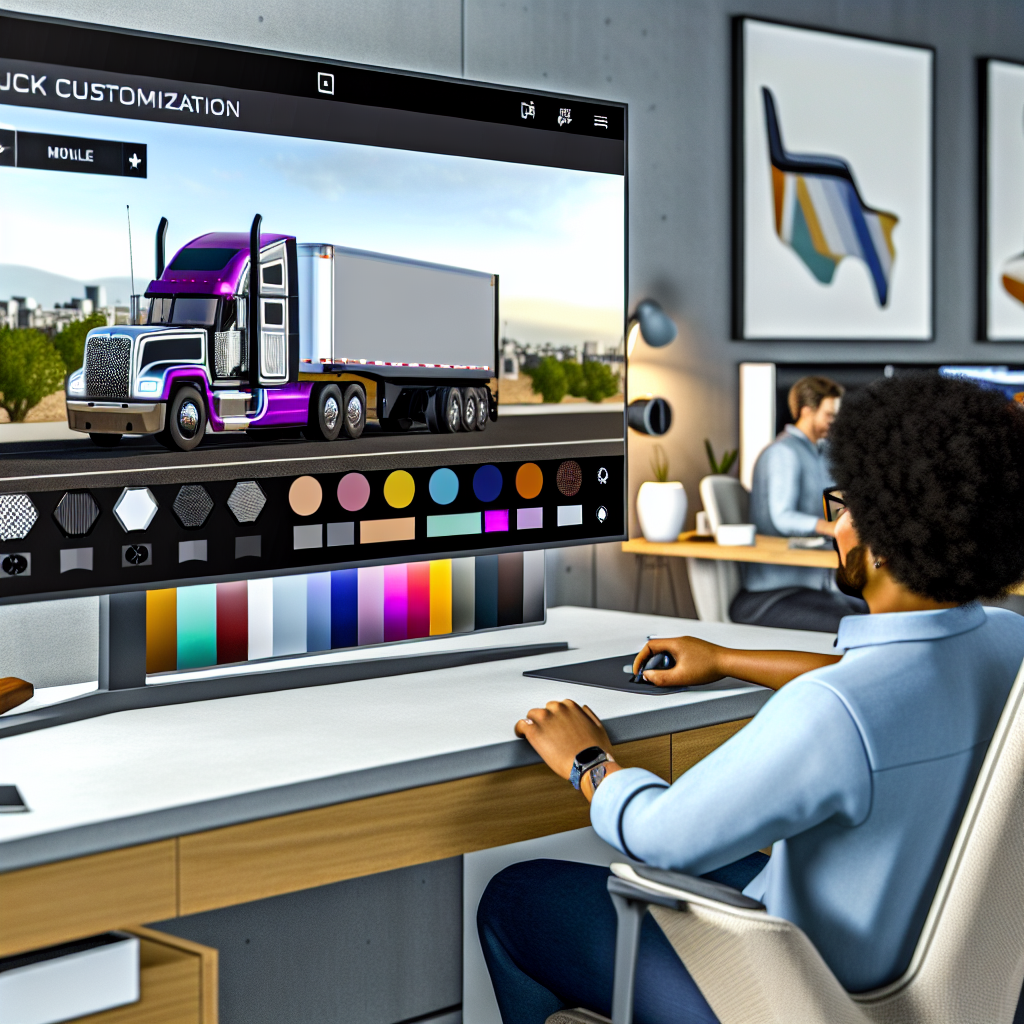
This image portrays a user interacting with the Truck Builder platform, visually customizing a Mack Anthem truck in a modern workspace setting.
Conclusion
In conclusion, the trucking industry is at a critical juncture, confronting the significant rise in cargo theft while simultaneously embracing the revolution brought about by digital platforms for truck customization. The alarming increase in theft incidents highlights the pressing need for innovative solutions that enhance security, streamline operations, and optimize customer satisfaction.
Digital platforms like the Mack Truck Builder exemplify how technology can be harnessed to provide tailored solutions to fleet operators, enabling them to customize their vehicles while also enhancing security features to combat theft effectively. These digital tools empower customers by allowing them to visualize and personalize their trucks, thus fostering a deeper connection between buyers and dealers.
Moreover, the collaborative efforts between industry stakeholders and organizations like the U.S. Department of Transportation are pivotal in developing comprehensive strategies to address the challenges posed by cargo theft. By focusing on information sharing and coordinated responses, the industry can leverage collective wisdom to fortify supply chain security.
As technological advancements continue to reshape the landscape, readers are encouraged to actively engage with these innovations and strategies. Embracing new technologies and fostering partnerships within the industry will not only contribute to a more secure logistics environment but also ensure operational efficiency in the face of evolving challenges.

