
Launching a tow truck operation in Michigan is more than acquiring equipment; it is a disciplined process that aligns regulatory compliance, risk management, and market development with the needs of modern supply chains. For logistics and freight companies, construction and engineering firms, fleet management teams, and food and beverage distributors, a successful tow operation must integrate with existing transport networks, minimize downtime, and protect assets across diverse environments. Michigan’s regulatory landscape—anchored by the Department of Licensing and Regulatory Affairs (LARA)—imposes licensing, vehicle inspections, and bonding requirements designed to safeguard consumers and ensure reliable service. Simultaneously, a robust business plan translates operational goals into real‑world capabilities: selecting the right legal structure, securing EINs for payroll and vendor relationships, and building a service portfolio that encompasses local towing, roadside assistance, and accident recovery. This guide presents a holistic, five‑chapter framework that connects strategic planning with practical execution, tailored for organizations that manage fleets, operate across multiple geographies, or rely on dependable recovery services as part of their core logistics fabric. Each chapter maps directly to the needs of logistics and industry clients who depend on timely, compliant, and cost‑effective tow support. By following this roadmap, organizations can harmonize service offerings with Michigan’s licensing standards, insurance requirements, and fleet maintenance practices while cultivating supplier networks and market development opportunities. The unified narrative—planning, structure, licensing, risk, and equipment—ensures every decision contributes to a scalable, compliant, and customer‑centric tow operation that strengthens overall supply chain resilience.
From Blueprint to Back Roads: Crafting a Robust Michigan Tow Truck Business Plan and Defining Your Services
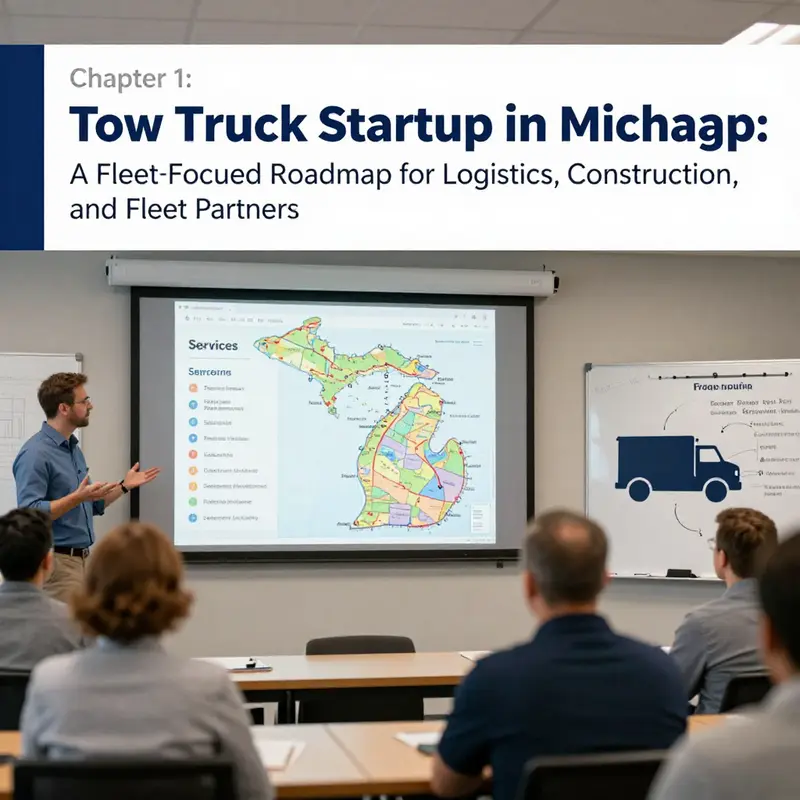
Launching a tow truck business in Michigan is more than buying a truck and slapping a logo on the door. It is a disciplined craft that blends dependable service with strict regulatory compliance, local market insight, and careful financial planning. The state’s highways and city streets carry a steady mix of stranded drivers, parking-lot mishaps, and collision scenes. Turning a simple idea into a thriving operation starts with a solid blueprint. A robust business plan acts as a navigator, outlining what services you will offer, who your customers are, how you will price work, how you will market, and how you will reach profitability. In Michigan, this blueprint should also anticipate the regulatory landscape, because tow operations exist under rules designed to protect consumers and keep roadways safe.
The planning stage centers on a clear purpose and a realistic road map. First, define your service profile with intention. Will you emphasize local towing within a tight radius to shorten response times, or build a broader network that includes roadside assistance—jump starts, tire changes, and lockout service? Accident recovery adds another layer of complexity, often requiring coordination with law enforcement and insurance carriers and the right equipment and crew training. When you outline core offerings, pair them with a realistic service area map. A few miles of congested urban traffic in Detroit or Grand Rapids look very different from a rural corridor along a state highway. Those differences matter because they shape your dispatch capabilities, equipment needs, staffing, and insurance requirements.
Next comes market positioning. Who are your primary customers? In many Michigan communities, you’ll serve residents who lock keys in cars, owners stranded in apartment complexes, and fleets that depend on dependable roadside help. You’ll also interact with local repair shops, rental agencies, and even municipal or police-related operations that require trained tow professionals to remove vehicles after an incident. Your pricing must reflect both competitive rates and the realities of operating costs—fuel, maintenance, insurance, and labor. A cautious financial projection helps prevent early overreach. The plan should include a marketing approach that goes beyond simple transactions. Build a reputation for punctuality, transparent pricing, safety, and courteous service. A strong online presence, accurate directory listings, and positive referrals from partners will be essential to growth over time.
In Michigan, the journey from plan to practice hinges on choosing the right business structure and completing regulatory steps. The business entity you select affects liability, taxes, and future growth. A sole proprietorship is simple but places you at personal risk. An LLC offers liability protection and tax flexibility, while a Corporation or S-Corp may suit more ambitious expansion. After you settle on a structure, you must register with the Michigan Secretary of State and, if you operate under a name other than your own, file a DBA with the county. An Employer Identification Number from the IRS is practical for hiring staff, opening a business bank account, and handling payroll.
Beyond structure and naming, Michigan tow operators must navigate a rigorous licensing ecosystem administered by the state. The Department of Licensing and Regulatory Affairs, or LARA, oversees tow operations to prevent abuse and protect consumers. The Tow Truck Operator License is not optional; it is the cornerstone of trustworthy service. The application process typically requires proof of insurance, a vehicle inspection, and a background check. There are fees that vary with fleet size and service area, and a bond may be required to reassure customers that the contractor will adhere to fair practices. A vehicle inspection is not cosmetic; it ensures the tow equipment, lighting, brakes, and anchor points meet safety standards for on-road operations. It is also prudent to anticipate the potential need for a Commercial Driver’s License (CDL), depending on the type of tow vehicle you plan to operate. Rules can change, and staying aligned with LARA’s current guidance is essential. For ongoing reference, the official LARA page on Tow Truck Licensing remains your most trustworthy source.
Once licensing is in place, the practical task of securing and maintaining the right equipment follows. Your tow trucks must be appropriately titled and registered in the business name, and they should reflect Michigan’s safety expectations. The equipment you choose drives service levels: faster response, safer loading, and greater recovery capability. Insurance sits alongside equipment as a foundational prerequisite. A commercial auto policy designed for towing operations should cover towing liability, damage to towed vehicles, and workers’ compensation if you hire employees. Many operators also pursue additional coverage such as cargo in transit, general liability, and garage coverage, depending on the scope of work and the risk profile of the customer base. The objective is to establish a resilient baseline that handles routine jobs and the occasional complex recovery without compromising cash flow.
Operational discipline emerged as a recurring theme in the planning stage. Pricing should reflect not just market rates but the cost of maintaining a compliant, safe operation. Standard operating procedures for dispatch, arrival times, and safety checks matter as much as the equipment itself. Training is critical—the crew should master securement techniques, winch operations, and the nuances of state and local traffic rules when working on busy roads. Documenting each service call, including fuel usage, incident notes, and driver logs, creates a reliable trail that satisfies customers, insurers, and regulatory requirements. For a sole proprietor testing the waters, the temptation to keep overhead low is real; a prudent plan, however, allocates resources for dependable dispatch software, invoicing, and routine maintenance. In the long run, those investments yield smoother operations and more predictable revenue.
A central Michigan advantage is the opportunity to anchor your business in a network of partnerships that extend beyond a single call. Consistent collaboration with local repair shops, fleet operators, rental companies, and insurers makes you part of a predictable ecosystem. To cultivate these relationships, attend regional industry events, join a local association, and demonstrate a track record of fair pricing, clear communication, and reliable on-scene performance. When you are known for doing the job right, word of mouth and formal referrals compound your growth. If you want to deepen your leadership and team-building capabilities as the business scales, consider resources focused on people as a driver of success; you can read about investing in people in trucking leadership discussions here: Investing in People: Key to Trucking’s Success.
As your plan translates into action, you will periodically revisit the balance between breadth and depth of services. A focused local-towing approach within a defined radius can yield faster response as you build a reputation for speed and reliability. Roadside assistance services, delivered swiftly and with precision, can produce steady repeat business from drivers who value a quick fix and transparent pricing. Accident recovery, while demanding, can become a signature capability if you invest in the right training, equipment, and coordination with authorities and insurers. If you pursue this path, you’ll want an operations playbook that aligns dispatch, on-scene safety, securement, and post-recovery reporting. The most sustainable growth often comes from a blend: strong local towing core, complemented by reliable roadside services, with selective scaling into complex recoveries as your fleet and credentials mature.
In closing, the journey from a garage idea to a Michigan tow operation is a careful fusion of strategy, compliance, and consistent execution. Your plan is a living document that evolves with your fleet, customer base, and regulatory landscape. Staying current with LARA’s requirements is not a one-time task but a continuous practice, because changes can affect licensing fees, bond requirements, or inspection standards. As your reputation builds, the power of partnerships grows, and the ability to respond quickly to roadside calls translates into sustainable revenue. The Michigan market rewards operators who couple predictable, transparent practices with a genuine commitment to safety and service. Approaching the launch with a thoughtful plan, a defined service proposition, and a readiness to adapt will set you on a course not merely to start a tow truck business, but to become a trusted local resource that keeps motorists moving through Michigan’s roads for years to come.
External resource: For regulatory specifics, consult the official Michigan LARA page at https://www.michigan.gov/lara/0,1607,7-145-123291233812339—,00.html
Foundations Under the Great Lakes: Building the Legal Framework for a Michigan Tow Truck Business
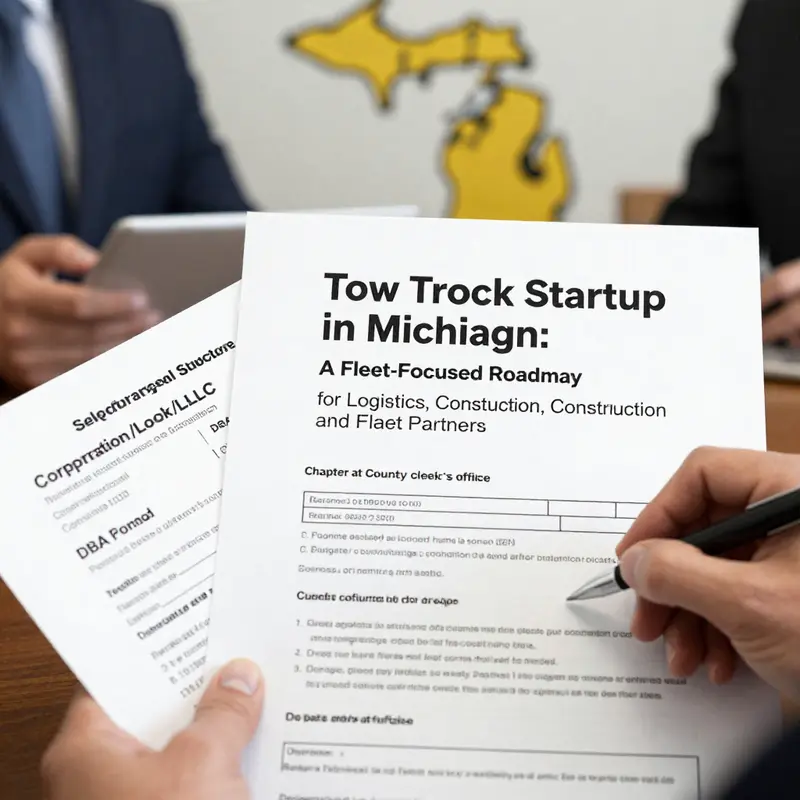
When you start a tow truck business in Michigan, the first practical steps extend far beyond painting a logo on a door or buying a truck. They begin with the legal scaffolding that will support growth, protect you, and keep the doors open in lean times. The choice of legal structure, whether you run solo as a sole proprietor, join with a partner, form an LLC, or opt for a corporation, determines how you handle liability, taxes, and daily management. In Michigan, where regulatory oversight reflects the potential for consumer harm in the towing sector, laying a solid legal foundation isn’t merely prudent. It’s essential. The decision about structure sets the stage for every subsequent action—from name registration to obtaining the right tax ID and meeting licensing expectations. A small business owner who asks the right questions up front can avoid unnecessary fees, reduce risk, and gain flexibility as client needs shift and competition stiffens along Michigan’s busy roadways and interstates.
Choosing the right structure often comes down to three core considerations: liability protection, tax treatment, and administrative ease. A sole proprietorship is the simplest path, with minimal paperwork and straightforward taxes, but it leaves you personally exposed to liabilities incurred by the business. If you anticipate working with others, or you plan to raise capital or hire employees, an LLC offers a compelling balance of protection and tax flexibility. It provides limited personal liability, meaning your personal assets are shielded from many business debts, while still allowing pass-through taxation to avoid double taxation at the corporate level. For larger operations or long-range growth plans where formal governance and potential public offerings are on the horizon, a corporation or an S-Corp structure becomes attractive. These forms introduce more formal requirements—board oversight, stricter recordkeeping, and potentially different tax treatment—but they also create clear paths for scaling and investor participation.
In Michigan, the practical steps begin with how you organize, then how you name the business you’re organizing. Once you’ve zeroed in on a structure, the next logical move is to register a name you’ll actually use in the market. If you intend to operate under a name different from your own, a DBA, or doing business as, becomes part of your legal footprint. The process is straightforward: you file a Certificate of Assumed Name with your county clerk—though the exact form and filing office can vary slightly by county. Fees are modest, generally ranging from about ten to thirty-five dollars, and they can accumulate if you run multiple DBA names or plan to conduct business across different counties. The key is to confirm the precise requirements with your local county clerk’s office and to verify name availability through the state’s name search tool. A unique, compliant DBA not only supports branding but also helps protect customers who rely on your official name to verify licensing and insurance.
As you finalize the entity choice and the DBA, the next critical piece is obtaining an Employer Identification Number, or EIN. The EIN functions as the business’s federal tax identifier, much like a social security number is for a person. An EIN is required if you hire employees, maintain payroll, or open a business bank account. It also enhances your business’s legitimacy in the eyes of lenders, vendors, and insurance providers. The process to obtain an EIN is intentionally simple and cost-free when done online. The fastest route is the IRS online application, which guides you through the necessary steps and issues your number immediately upon completion. With the EIN in hand, you can open a business bank account in the business’s name, file taxes accurately, and establish a formal framework for hiring or contracting drivers and support staff. This step, though administrative, anchors your ability to operate with credibility and to scale.
The sequence—selecting a legal structure, filing a DBA, and applying for an EIN—also influences other regulatory requirements you’ll encounter down the road. Michigan tow operators face licensing and regulatory standards designed to protect consumers and ensure safe operation. While the details of licensing sit beyond this chapter’s core focus, it’s worth noting that your chosen structure can impact how you meet those obligations. In practical terms, a properly formed LLC or corporation can simplify licensing processes and support ongoing compliance, because these entities create a clear, separable boundary between the owner’s personal assets and the business’s activities. Moreover, lenders and insurers often prefer or require an established entity with a formal structure when underwriting coverage or extending credit to a towing operation. The alignment between your business form, your DBA, and your EIN creates a coherent, professional platform from which to engage customers, partners, and regulators.
In the planning phase, consider the human dimension of your business as well. The people you bring into the operation will drive growth and service quality, and thinking about people-first strategies can influence how you structure the enterprise from day one. This forward-looking perspective resonates with the idea that a strong team underpins sustainable success in trucking-adjacent industries, where schedules, responses, and customer interactions must be coordinated with precision. To reflect that emphasis, you can view the conversation about people-first approaches as part of the broader framework of building a resilient towing business—the kind of strategy that aligns with the realities of Michigan’s road network, municipal contracts, and private fleet work. For further reading on this human-centered approach to trucking leadership, you can explore resources discussing people-first strategies in trucking, which offer insights into recruiting, training, and developing a workforce that shares a commitment to safety, reliability, and customer service.
As you navigate these decisions, remember that the legal steps are not merely gatekeeping; they are the scaffolding that supports every relationship you’ll build—from clients and repair shops to law enforcement and insurance carriers. Your registered name, your chosen entity type, and your EIN will appear on contracts, invoices, and insurance documents. They will also be the identifiers by which you are checked for licensing and compliance with Michigan’s regulatory standards. Keep a running checklist: confirm the entity type with your state, complete the DBA filing in your county, and apply for the EIN through the IRS. After you have those pieces in place, you’ll be positioned to pursue the licensure pathway more confidently, present yourself as a credible business in the marketplace, and begin to forge the partnerships that turn a startup into a dependable service provider on Michigan’s streets and highways.
The practical, day-to-day implications of this sequence extend into budgets and cash flow as well. An LLC or corporation carries different filing and administrative requirements than a sole proprietorship, which can affect annual reporting, estimated tax payments, and the way you allocate income for yourself versus retained earnings within the company. Even the choice of DBA naming can influence marketing costs, branding consistency, and the ease with which you secure client contracts. Because these decisions feed into nearly every revenue stream you plan to pursue, it’s important to approach them as strategic investments rather than mere obligations. When you look ahead to the licensing phase—the step that brings you into formal alignment with Michigan’s regulators—your established business structure, your registered name, and your EIN will serve as the core credentials that demonstrate legitimacy and readiness to operate.
Beyond the mechanics, this stage is about setting expectations for growth and about building a foundation that will bear the weight of relationships, risk, and opportunity. It’s about recognizing that the speed with which you move through structure, DBA, and EIN can translate into earlier access to customers, quicker bank setup, and smoother onboarding of drivers and subcontractors. It’s also about maintaining discipline: keep copies of filed documents, track renewal dates for licenses and registrations, and maintain clean separation between personal and business finances. As you continue toward licensing and compliance, these practices will translate into fewer headaches and more time spent delivering service on the road—whether you’re assisting stranded motorists, recovering a vehicle after an accident, or supporting other local businesses with dependable roadside assistance. The journey from a brainstorming idea to a licensed Michigan tow operation is concrete, navigable, and ultimately transformative when grounded in thoughtful structure and careful registration.
Internal link: As you map out the entity and the business name, remember to think about your team—an approach aligned with the People-first strategies in trucking.
External resource: For a detailed, up-to-date path to obtaining your EIN and understanding its role in opening bank accounts and hiring, visit the IRS EIN online application page at https://www.irs.gov/businesses/small-businesses-self-employed/apply-for-an-employer-identification-number-ein-online.
From Paper to Pro: Navigating Michigan Tow Truck Licensing, Vehicle Inspections, and Bonding Under LARA
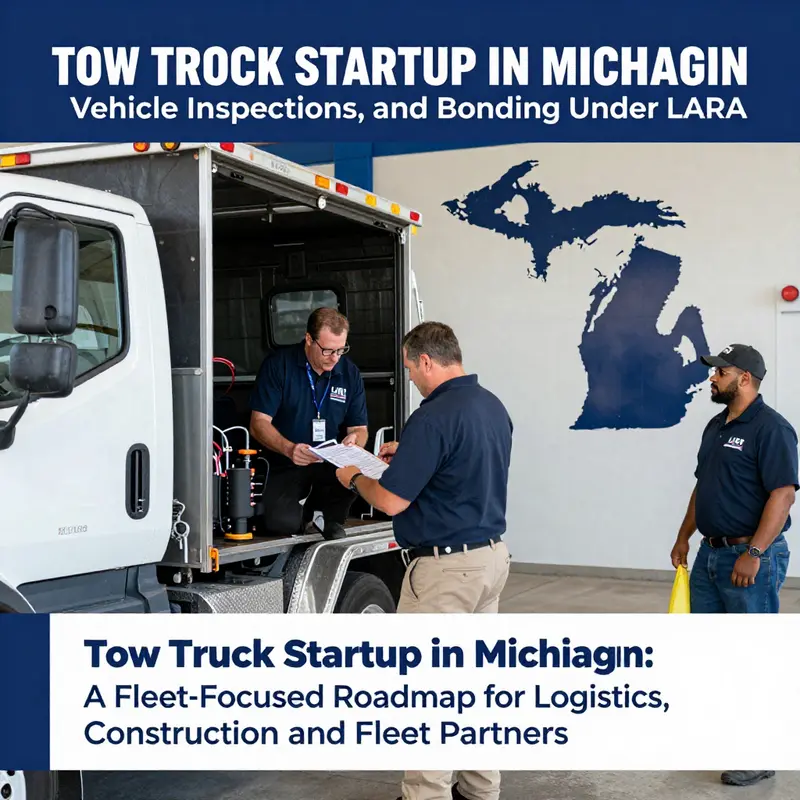
In Michigan, launching a tow truck business is as much about compliance as it is about downtime on the clock. The state regulates who may operate a tow truck, how vehicles are kept safe, and what protections are in place for consumers. This framework exists to curb abuses in a high-stakes service industry and to ensure that every wrecker on the road meets minimum standards for performance, reliability, and accountability. For an entrepreneur, the path from an ambitious plan to a fully licensed operation begins with understanding the main pillars: licensing through the Michigan Department of Licensing and Regulatory Affairs (LARA), the safety inspections that confirm a truck is roadworthy, and the bonding that offers consumer protection and trust. Together, these elements form a contiguous process that, when completed, not only legitimizes the business but also paves the way for smoother operations, better financing terms, and credible partnerships with local repair shops, insurers, and fleets.
A sound business plan can only be as strong as its compliance backbone. The licensing landscape in Michigan centers on the Tow Truck Operator License, issued by LARA’s Motor Carrier Division. To earn the right to operate, an applicant must demonstrate not just mechanical competence but also a solid grasp of the state’s towing laws and consumer protection expectations. A routine background check accompanies the licensing application, and evidence of financial responsibility is required to show that customers will be protected in the event of mishaps or disputes. The process usually begins by filing the appropriate forms, providing proof of insurance, and presenting information about the business’s structure and service area. Fees are assessed in relation to fleet size and service reach, so it is wise to map out the anticipated scale before you apply, as changes can affect ongoing compliance costs.
Documentation is the lifeblood of the licensing stage. Prospective operators should prepare before submitting anything to LARA. This includes not only personal information but also corporate details if you’re forming an LLC or corporation. If you intend to operate under a business name, you may need to file for a DBA so your branding aligns with the license and the public records. The clarity of your paperwork matters; discrepancies between the business name on insurance, the license, and the registration can slow or derail the process. Once submitted, the review period can vary, so plan around it in your launch timeline. In many cases, the licensing office requests supporting materials such as proof of a valid liability policy and a description of the service area you intend to cover. Responding promptly to any follow-up questions can help you keep momentum rather than facing delays that push your opening date back.
Vehicle inspections stand as the next major gate to entry. Michigan requires tow trucks to pass a safety inspection conducted by a certified mechanic or an inspector approved by LARA. The emphasis at inspection centers is squarely on safety-critical systems: brakes must operate reliably, lighting and signaling must be compliant with visibility standards, winches and recovery equipment must function safely, and emergency equipment should be present and accessible. A well-prepared truck will have documentation that demonstrates regular maintenance, up-to-date registrations, and a service history that can be shown to inspectors or potential customers. It helps to schedule the inspection with a reputable shop that understands the specific requirements for tow trucks in Michigan. The goal is not merely a pass but a demonstration of ongoing maintenance discipline—to show regulators and clients that the vehicle is dependable in demanding roadside scenarios.
The bonding requirement adds another layer of protection for consumers. A surety bond, often around fifty thousand dollars, provides a guarantee that the business will comply with state regulations and that customers have recourse if a recovery operation is mishandled. The bond acts as a financial backstop, reducing the risk of fraud or negligent practices and enhancing the business’s credibility with customers and lenders. The process for obtaining the bond is straightforward but important: you must select a surety and post the bond in the exact name the license will be issued under. It is common for lenders and insurers to view bonding as a signal of organizational seriousness, so including this in your pre-launch checklist can improve your procurement terms and may even influence your ability to secure lines of credit or favorable premium rates later on.
Insurance is not optional in this arena. Michigan towing operations require specialized commercial auto coverage that extends beyond standard auto liability. You will need coverage that specifically addresses towing liability, which covers damages or injuries arising from tow operations, as well as physical damage coverage for the tow trucks themselves and any towed vehicles. If you have employees, workers’ compensation is also a critical component. An experienced broker who understands the nuances of transportation and towing risks can help tailor a policy that aligns with your service offerings—whether you plan local towing, roadside assistance, or accident recovery. The right policy will reflect your expected fleet size, service area, and the types of calls you anticipate handling, from simple roadside jumps to complex winching in challenging conditions.
Acquiring and maintaining the right equipment is the practical counterpart to licensing, inspections, and bonds. Michigan’s specifications for tow trucks are not merely formalities; they ensure that the equipment deployed on the road can perform safely under load, weather, and traffic pressures. Capacity, wheel-lift versus rollback configurations, lighting, and emergency equipment all come into play. A vehicle that aligns with the state’s safety expectations is more likely to meet insurance requirements and pass inspections without difficulty. Leasing or purchasing a unit should involve a careful review of maintenance history, spare parts availability, and the manufacturer’s service network. Keeping a regular maintenance schedule is a proactive investment in both safety and reliability, reducing downtime and the risk of regulatory trouble that might arise from a failed inspection.
The practical path to launching thus weaves compliance into the everyday rhythm of the business. After outlining the service scope in the business plan, you align your licenses, your fleet readiness, and your insurance coverage. You then submit the license application, gather the needed proofs, and secure a vehicle inspection schedule. The bond is secured in advance so that once the license is approved, you are financially covered from day one. This sequence also clarifies the operational timeline: licensing may take several weeks; inspections may require booking slots that fit your planned opening date; and bonding can be completed in parallel so nothing stalls your launch. The goal is a clean, transparent setup that yields not only regulatory approval but a market-ready posture that can win contracts with repair shops, car rental agencies, and municipal or private fleets.
Beyond the mechanical steps, there is strategic value in building relationships with local stakeholders. A strong presence in the community, an established process for handling calls, and clear, customer-friendly policies contribute to reputation. Participating in industry associations, where allowed, can offer guidance on evolving regulations and best practices. And the discipline of documentation—licensing records, inspection reports, bond confirmations, and insurance certificates—serves as a practical backbone for audits, financing discussions, and negotiations with customers who want visible proof of compliance.
As rules and interpretations shift, the most reliable path is to stay informed directly through official channels. For ongoing regulatory context and to verify that your understanding remains current, consider the broader regulatory resources available to trucking professionals. Regulatory relief for trucking during winter storms is a resource worth reviewing as you scale, because it reflects how policy changes can impact operations, permitting, and scheduling during extreme weather. This kind of awareness helps you plan for contingencies and stay compliant even when the regulatory environment is evolving. For primary, authoritative guidance, you can consult LARA’s Tow Truck Operator Licensing materials and forms, which provide up-to-date instructions, fee schedules, and compliance expectations. Keeping these references handy and revisiting them whenever you adjust your fleet or service footprint minimizes risk and reduces the chance of costly missteps.
In short, Michigan’s licensing, inspection, and bonding framework is not a barrier to entry so much as a structured pathway that shields customers and elevates industry standards. If you approach the process methodically—compile your business and insurance documents, prepare for a rigorous vehicle inspection, secure the bond, and maintain ongoing compliance—you will cultivate a credible operation from day one. Your ability to demonstrate responsible stewardship of equipment, financial responsibility, and adherence to state law will translate into smoother operations, better partnerships, and a stronger competitive position in a busy market that rewards reliability as much as speed. The road to a legitimate, thriving tow truck business in Michigan begins with attention to these details, and with the discipline to keep them current even as the business grows.
External resource for further guidance: https://www.michigan.gov/lara/0,1607,1-142-293829392940—,00.html
null
null
From Road Readiness to Market Reach: Building Michigan’s Tow Truck Startup Through Equipment, Maintenance, and Relationships
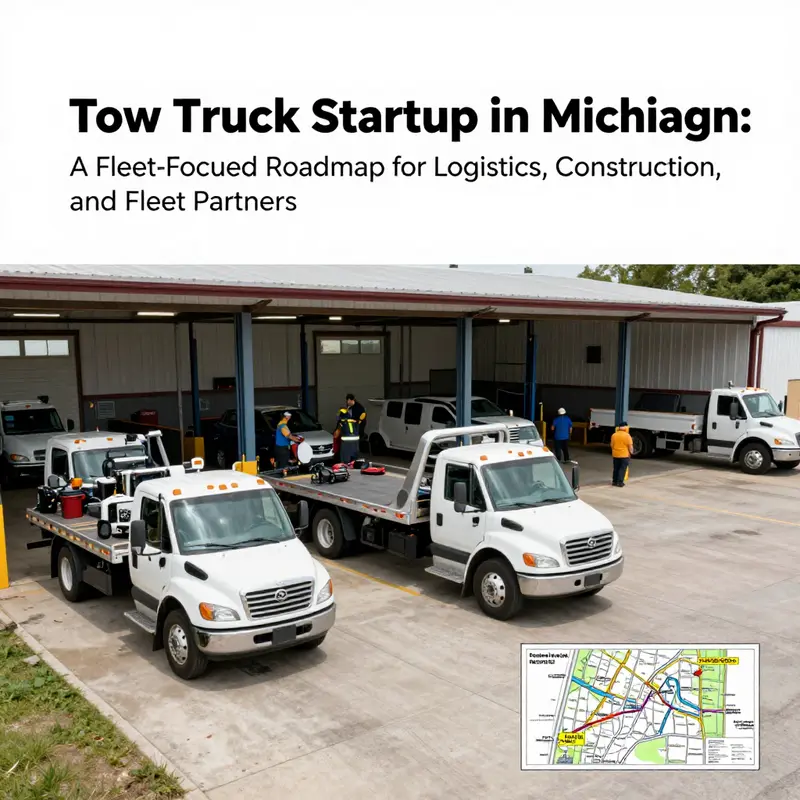
A tow truck business in Michigan does not begin with a flashy sign or a loud advertisement. It starts with the quiet discipline of picking the right tools, creating a maintenance cadence that minimizes downtime, and cultivating a network that turns incidents into dependable revenue. In a state where winter can freeze roads, slow down traffic, and test even the most prepared operators, the path to profitability runs through three closely linked lanes: acquiring equipment, keeping that equipment in peak condition, and actively developing a market that values reliability as much as speed. When these lanes align, a small startup can grow into a trusted partner for shops, insurers, and agencies that depend on swift, professional recoveries and towing service.
Equipment selection is the first critical fork in the road. Your core fleet should be shaped by the services you intend to offer and the markets you expect to serve. The most common platforms are flatbed, wheel-lift, and recovery units, each with clear advantages and tradeoffs. Flatbeds provide versatility for a wide range of vehicle types and sizes, which makes them appealing for shops and insurers that want a single partner capable of handling varied recoveries. Wheel-lift units excel in controlled environments like parking lots and light highway incidents, where quick turnaround and precision matter. Recovery vehicles are built for heavier loads, difficult terrain, and long-distance recoveries, where the extra capability reduces the need for multiple trips. The decision often comes down to target clients, service areas, and the budget you can responsibly allocate. Michigan’s geography, with dense urban corridors and sprawling rural stretches, means a well-balanced mix can reduce downtime and broaden your call-conversion rate.
Alongside capability, you must weigh resilience against cost. The winter season amplifies the importance of payload stability, braking performance, and traction. A truck that handles slick surfaces, ice, and snow is not a luxury; it’s a core operating condition. Capacity planning matters too. You should estimate peak call volumes, then scale the fleet to cover several concurrent incidents without leaving customers waiting. In addition, plan for safety and compliance from the outset. Each vehicle should be equipped with the necessary safety gear, and all units must pass state compliance checks before they hit the road. Ownership versus leasing is another practical choice. Leasing can offer flexibility during market entry and pilot phases, while ownership builds equity and reduces long-term per-unit costs once demand stabilizes. Regardless of path, you want titles, registrations, and insurance aligned to the business name to avoid complications during audits or inspections.
Maintenance is the other backbone of reliability. A predictable maintenance calendar should blend daily pre- and post-shift checks with longer, more systematic inspections. Start with a simple daily checklist that covers brakes, lights, tow gear, hydraulics, and tire condition. Then build monthly and quarterly inspections that rigorously test winch performance, hydraulic systems, anchor points, and safety equipment. In Michigan’s climate, corrosion caused by road salt, rust-prone undercarriages, and cold-start stress can accelerate wear. Plan for rust prevention, battery health checks, and brake system integrity, especially after heavy snow events and ice storms. Document every service in a centralized log. This history becomes a powerful tool for forecasting parts replacement, validating insurance premiums, and proving compliance during regulatory audits. For many operators, the most effective path blends experienced mechanics with digital tools that trigger timely maintenance reminders, track fuel consumption, and log repair histories in an accessible, auditable format.
A modern fleet benefits from integrating knowledge with process. Digital fleet management tools, when used well, turn scattered maintenance notes into actionable insights. They can help you time oil changes to the moment the engine runs hottest, schedule tire rotations before tread wear becomes a safety issue, and flag hydraulic leaks before a tow is needed at 2 a.m. beyond a sleepy town. These systems also illuminate dispatch efficiency, revealing which trucks are best suited for particular lanes or weather conditions. The goal is to minimize breakdowns and maximize uptime, while keeping costs predictable enough to support steady pricing negotiations with insurers and repair networks. For operators seeking a structured perspective on how fleet management intersects with human capital and organizational practice, see Transforming Fleet Management: The Case for Investing in Human Capital. It offers a framework for building a team and a process that can scale as your Michigan operation grows, without losing the hands-on, reliability-driven ethos that defines successful tow services.
Market development in Michigan hinges on three intertwined activities: relationship-building, visibility, and service diversification. A credible marketplace presence begins with strong, professional branding, a clean online profile, and clear service descriptions. A website with online booking and transparent pricing reduces friction for shops and customers alike and earns trust in a busy market. Beyond the digital storefront, the real work happens through relationships. Local auto repair shops are a primary feeder for towing calls; insurers, including adjusters handling accidents, rely on a dependable partner to manage the recovery and transport process. Law enforcement agencies and roadside assistance programs also represent high-value referral streams, particularly during winter when incidents spike. Establish a routine for outreach: participate in local business networks, attend community events, and offer introductory terms that demonstrate reliability and responsiveness.
A well-structured market approach also means differentiating your service with value-added capabilities. Consider offering 24/7 roadside assistance for a fixed geographic area, rapid response for minor incidents that require quick clearance, or towing partnerships with rental car companies to streamline the transition from accident scene to mobility. These offerings transform a one-off tow into a recurring, mutually beneficial partnership with predictable revenue. Building a network of trusted partners—auto dealerships, repair shops, insurance adjusters, and even municipalities—reduces the cost of customer acquisition and raises the likelihood of repeat business. In Michigan, where weather can abruptly shift demand, scheduling flexibility matters. Having the ability to dispatch multiple units in a short window can be a differentiator when storms affect major corridors or when holidays drive unusual traffic patterns.
To sustain this market momentum, many operators benefit from joining industry associations that provide standards, advocacy, and referral ecosystems. Organizations like the National Towing Association and state-level recovery groups offer training, credibility, and opportunities to connect with potential clients who prefer working with vetted providers. Networking isn’t a one-time activity; it’s a discipline that pays dividends as you demonstrate reliability through consistent on-time pickups, careful handling of vehicles, and transparent communication with customers and partners. In parallel, monitor demand patterns across seasons. Winter storms, spring thaw periods, and summer roadwork can shift call volumes and the mix of services requested. A disciplined scheduling and dispatch plan, aligned with real-time weather insights, helps ensure you have the right people and trucks available when demand peaks.
The culmination of these efforts—equipment readiness, maintenance discipline, and strategic market development—creates a robust platform for growth. It’s not enough to own good trucks; you must operate them as a system. That means standard operating procedures, regular training for drivers on safety and customer communication, and a feedback loop that captures lessons from every call. When customers experience calm, competent handling of a tow, they become advocates who drive word-of-mouth referrals and repeat business. As you scale, keep your regulatory footing solid. Always verify licensing and compliance requirements with the state authorities and ensure your fleet remains fully registered and insured in the business name. For current licensing and compliance details, consult the official Michigan LARA Tow Truck Licensing page: https://www.michigan.gov/lara/0,4670,5-135-2981_5686-,00.html. This step protects you, your clients, and the communities you serve, and it keeps the focus where it belongs—on reliable, professional service on Michigan streets and highways.
In short, a successful tow truck startup in Michigan rests on three interlocking pillars: the right equipment calibrated for local realities, a maintenance regime that minimizes downtime and maximizes safety, and an active, value-driven market strategy that turns every call into a trusted relationship. When you align these elements, you turn a modest fleet into a dependable lifeline for drivers, shops, insurers, and agencies across the Great Lakes state. The journey from first truck to steady, scalable revenue is not a sprint; it is a disciplined, consistent build—one maintenance log, one referral, and one reliable response at a time. And as you grow, your brand becomes the promise that, whatever the road throws your way, you will be there with professionalism, readiness, and integrity.
Final thoughts
In Michigan, launching a tow truck operation that serves logistics and industry partners requires a disciplined, end‑to‑end approach. By first anchoring your venture in a solid business plan and clearly defined services, you set expectations with fleet customers and service providers. Aligning this with the right legal structure, an effective DBA strategy, and an EIN creates a compliant, scalable foundation that supports growth. Navigating LARA licensing, inspections, and bonding ensures your fleet remains in good standing and your customers trust your capability. Securing robust insurance and implementing risk management reduces exposure while preserving service levels for critical operations. Finally, strategic equipment selection, maintenance discipline, and deliberate market development turn a tow operation into a dependable component of the broader logistics ecosystem. With these elements integrated, your Michigan tow business can reliably support freight networks, construction projects, and distribution channels, delivering consistent value and resilience in a dynamic market.