
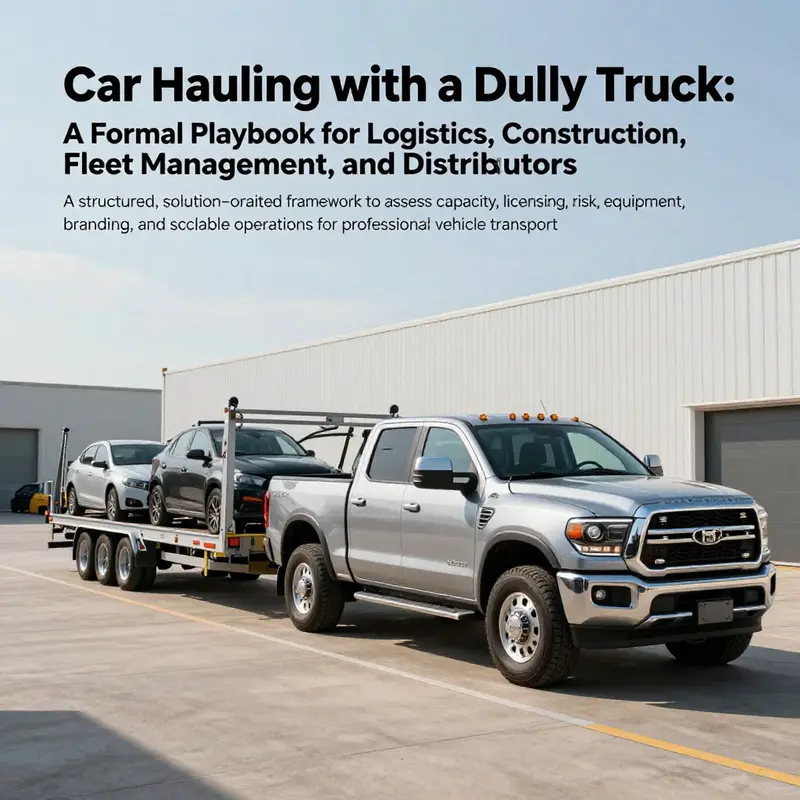
In complex supply chains, the ability to move vehicles reliably and safely is a strategic differentiator. A dually truck increases towing stability and payload capacity, enabling a broader range of car-haul projects for logistics operators, construction and engineering firms, fleet managers, and food and beverage distributors that rely on dependable equipment movement. This guide provides a formal, approach-driven pathway to start and scale a car hauling operation using a dually truck, with explicit focus on capacity assessment, regulatory compliance, risk management, equipment selection, and scalable business development. Each chapter builds on the prior, culminating in a structured SOP framework and technology-enabled processes designed to improve reliability, reduce risk, and enhance profitability for enterprise customers and commercial partners.
null
null
null
null
Insurance and Risk Management for a Dually-Powered Car Hauling Business: Securing Your Load and Your Future
Securing the road ahead begins with what protects you when things go wrong. Insurance is not a legal afterthought in car hauling; it is the foundation that makes permits, routes, and growth possible. A dually pickup with a properly matched trailer can deliver stability and payload capacity that far surpasses lighter rigs, but this advantage only matters if you are protected against the financial fallout of accidents, cargo loss, or lawsuits. Personal auto policies don’t cover commercial activity, nor do they cover the value of the vehicles you’re moving or the risk of damage to those vehicles. The right commercial auto liability policy, cargo coverage, and physical damage protection establish a safety net that aligns with the high-value nature of the loads you handle. Cargo insurance specifically addresses the risk that the car you are transporting could suffer damage en route, while physical damage coverage shields your own equipment from the consequences of collisions or theft. For a start-up, this triad—liability, cargo, and physical damage—often represents the core of an insurability strategy, with endorsements that reflect the specifics of your operation, from loading practices to the types of loads you expect to haul. A practical approach is to engage a broker who specializes in auto transport, because they understand how cargo exposure, haul routes, and vehicle type shape pricing, coverage terms, and the fine-print endorsements. They can help you tailor a policy that fits your planned activity, whether you are anchoring a regional business around dealer transfers or pursuing longer cross-state shipments for private clients. The goal is clarity in the certificate of insurance, with explicit confirmation that vehicle transport is a covered activity and that you have the right cargo limits in place for the typical loads you intend to carry. In addition to liability and cargo, you should consider hired and non-owned auto (HNOV) coverage, which protects your business when using the dually for client transports without a dedicated vehicle under your own policy. If you intend to hire employees or subcontractors, workers’ compensation becomes another piece of the puzzle for people safety and financial protection. Across these layers, set minimums that reflect the realities of the market—many shippers and dealers expect liability limits of around one million dollars, with cargo and physical damage tailored to the expected value of the loads. Exact figures vary by state, load type, and contract terms, so a careful, contract-aware approach is essential. The underwriting process will stress your maintenance records, driver qualifications, and safety systems, because insurers want proof that risk is actively managed on a day-to-day basis. Endorsements are equally important. They can address specialized cargo, oversized shipments, or specific loading and unloading operations that you perform. Each endorsement adds a layer of protection that can prevent a claim from becoming a costly, protracted dispute. While insurance protects the balance sheet, risk management keeps you out of trouble in the first place. A formal safety program becomes the backbone of your operation. It should start with a robust maintenance schedule that covers both the truck and the trailer, including brakes, tires, lights, and suspension, plus a systematic inspection routine before and after every load. Driver safety is equally critical. You’ll want a clear set of driver standards, background checks, and ongoing training focused on secure loading techniques, weight distribution, and the specifics of tying down vehicles so they stay put under highway conditions. The use of technology can magnify safety gains; telematics provide real-time feedback on speed, harsh braking, and route risks, while electronic logs help ensure compliance with hours-of-service rules and reduce fatigue-related risk. In practice, you combine policy, procedures, and practice. You document the expected step-by-step processes for loading, securing, transporting, and unloading vehicles, then audit adherence to those SOPs with periodic reviews. A simple incident response plan matters as much as the policy itself. In the event of an accident or cargo claim, rapid notification, clear communication with the insurer, and a documented incident timeline can shorten response times and limit liability exposure. The SOP should integrate a vehicle condition checklist and a client sign-off on the vehicle’s pre- and post-delivery condition. This signature process not only protects you contractually but also strengthens your position in any claim discussions. Even with a strong safety framework, external forces matter. Weather events, road closures, and regulatory changes can alter risk overnight. A proactive rule is to strengthen your contracts and communications so shipper expectations align with reality. Acknowledge that delays happen and that contingency plans—such as alternative routes, updated delivery windows, and transparent customer communication—reduce the cost of risk. As your operation scales, the risk profile changes. When you add more trucks or expand service areas, you multiply exposure to accidents, equipment failures, and contractor risk. The discipline of risk management then extends beyond your own fleet to the networks you rely on: drivers, subcontractors, and partner logistics firms. Vetting subcontractors with safety audits, insurance verification, and performance benchmarks becomes a necessary discipline. It is not enough to own a dually with a capable trailer; you must ensure that every link in your operation upholds safety and compliance standards. In this sense, insurance and risk management are not merely protective tactics but strategic levers that enable growth. They give lenders and shippers confidence, shorten onboarding times for new contracts, and create a predictable operating environment that supports price discipline and reliability. For those navigating the regulatory landscape, practical guidance exists to help you translate policy language into everyday practice. If you encounter uncertain or extreme regulatory situations, consider reviewing resources on regulatory relief for winter storms trucking, which can illuminate contingencies and permissible flexibilities during severe conditions. This kind of guidance, while not a substitute for robust insurance, complements a well-structured risk framework by ensuring your team can respond calmly and compliantly when the weather or the road throws a curveball. To connect these ideas with your broader plan, keep in mind the standards and requirements that govern interstate operations: a USDOT number, an MC authority, and compliance with hours-of-service, inspections, and documentation. You will also need to maintain current UCR registrations and a structured driver qualification file to satisfy both regulators and shipper partners. The discipline you cultivate around insurance and risk management will ripple through every aspect of your business—from the way you verify loads to how you price services and how you negotiate contracts. It will also influence your hiring practices and the way you communicate with clients. A well-protected operation is a credible partner, capable of delivering high-value loads with consistent reliability. For readers who want a more formal route to compliance, the FMCSA site offers detailed licensing and regulatory guidance, including motor carrier licensing and safety requirements. External resource: https://www.fmcsa.dot.gov/licensing/overview-motor-carrier-licensing
The Dually-Driven Road to a Car Hauling Startup
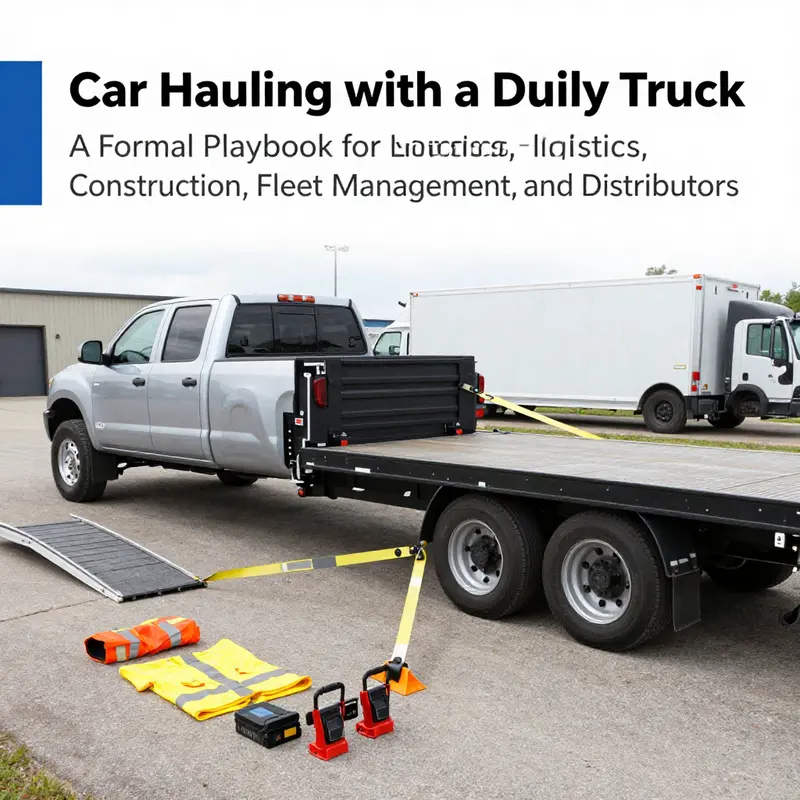
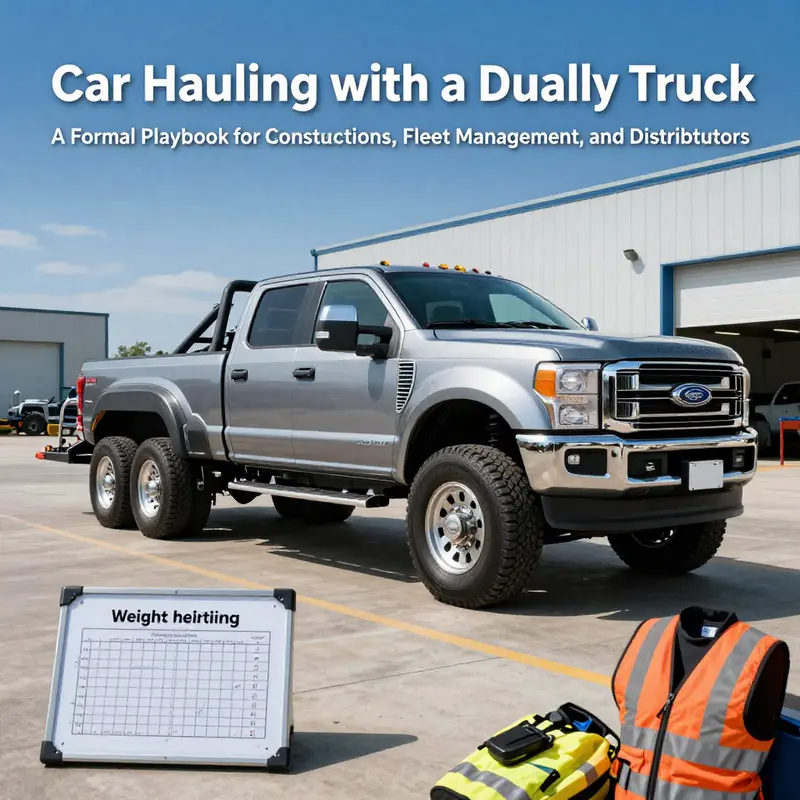
A dually pickup is a cornerstone of a car-hauling operation built for reliability, efficiency, and growth. The dual rear wheels offer payload and traction, but must be paired with disciplined loading, legal awareness, and careful safety practices.
Begin with capacity: confirm the gross combination weight rating (GCWR) and the trailer’s GVWR, and ensure the chosen trailer type, deck length, and load distribution keep you within legal limits on your expected routes. The choice between an open deck and an enclosed trailer affects weather exposure, security, and cost, while gooseneck or fifth-wheel connections tend to deliver stability and payload efficiency for multi-vehicle configurations. Align the hitch strategy with your truck and with your planned loads to maintain smooth weight transfer and predictable braking.
Loading and securing are core competencies. Design wide, reinforced ramps with non-slip surfaces, and provide ample, well-distributed tie-down points. Use rails or floor-mounted anchors to accommodate different vehicle profiles, and implement a tie-down plan that resists forward, backward, and lateral movement with redundancy and verification before departure.
Safety gear and pre-trip discipline are non-negotiable. Pack a robust toolkit, a tire inflator, a working brake controller, wheel chocks, a fire extinguisher, high-visibility vests, and reflective devices. Perform a ritual pre-trip inspection that covers tires, brakes, lights, and the trailer’s breakaway mechanism, then document the load with photos before and after transit.
As you scale, balance equipment choices with your service model and regulatory requirements: obtain the necessary business licenses, register for interstate authority if needed, secure cargo insurance, and implement a documented SOP that your team can follow. Track performance metrics such as miles driven, loads completed, and profitability per mile to guide disciplined growth.
Viewed as a foundation for a scalable business, the dually becomes a turnkey platform when paired with reliable equipment, clear processes, and a culture of safety and communication.
Brand, Clients, and the Road Ahead: Scaling a Dually-Powered Car Hauling Business with SOPs and Smart Tech
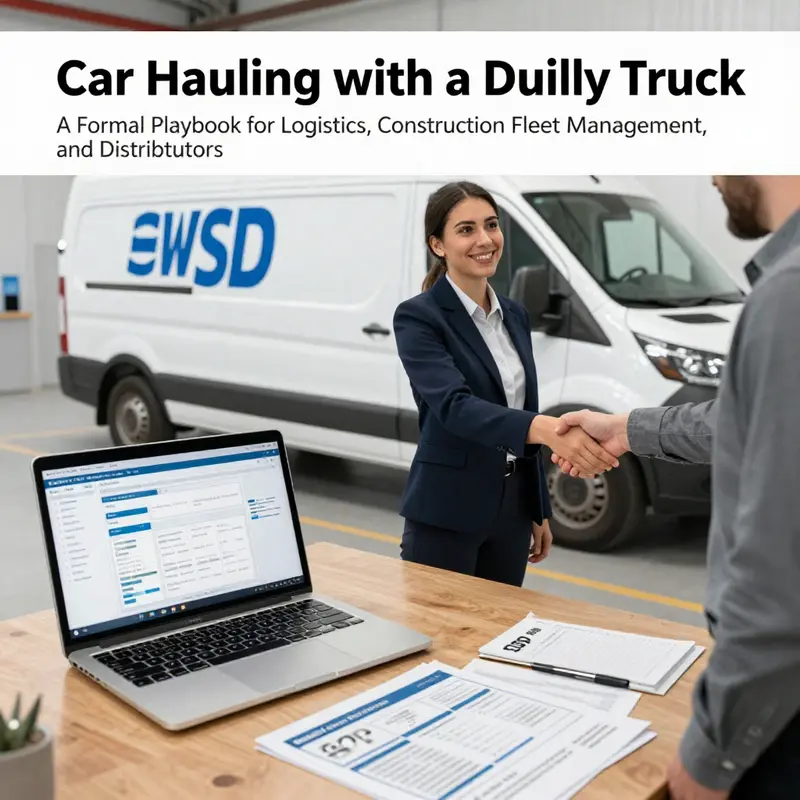
When you commit to starting a car hauling business with a dually, you’re choosing more than a truck and trailer. You’re choosing a discipline of reliability, a promise of care, and a path to steady growth. The dually isn’t just a workhorse; it’s a branding asset. It signals strength, stability, and the capacity to handle demanding loads. The way you present that capability—through branding, client relationships, documented processes, and the right technology stack—will determine whether you win repeat business from dealers and auctions or chase sporadic gigs. A coherent strategy begins with a clear identity and a transparent value proposition. Your brand should communicate three things at a glance: safety first, on-time delivery, and professional handling of every load. That clarity helps you stand out in a market where trust is everything and damage or delays carry long tails in customer satisfaction and referrals. Create a name, a logo, and a color palette that evoke security and efficiency. Your website should echo this mindset with service descriptions that spell out what you haul (open versus enclosed transport, door-to-door versus terminal-to-terminal), how you secure loads, and what customers can expect in terms of communication and documentation. The branding is not just decorative; it’s a signal to dealers, fleets, and individual clients that you take compliance and care seriously from the first quote to the final handoff.
Branding also anchors your market positioning. In markets saturated with independent owners and small fleets, the advantage goes to operators who are explicit about licensing, insurance, and procedural rigor. You should display your licensing disclosures prominently and provide easy access to insurance certificates for prospective customers. A well-articulated service ladder—standard open transport, with premium options such as enclosed transport or expedited delivery—gives you room to up-sell while preserving a lean core offering. The service levels also help you optimize capacity: you can price and schedule with clarity, reducing back-and-forth and misaligned expectations. This is where a strong SOP backbone blends with branding. When customers see that you have a formal process for loading, securing, and delivering, they’re more likely to trust the price and commit to a booked slot.
Branding should extend into a practical online presence. Local search optimization, thoughtful content, and transparent pricing become a storytelling device for your reliability. A blog or resource hub that addresses common questions—how to prep a car for transport, what to expect during loading, and what the insurance covers—builds credibility and helps your site rank for regionally relevant queries. A crucial part of this is social proof. Testimonials from dealers, fleets, and individual clients reinforce your claims about safety and on-time performance. Beyond the consumer-facing side, a professional LinkedIn presence aimed at dealerships and fleet managers can unlock B2B partnerships that deliver steady lanes of work. In this mix, a direct referral program with dealers and auctions can matter as much as any paid ad. It’s the kind of word-of-mouth that scales when your SOPs translate into predictable outcomes.
As you establish branding, you should integrate the human element into your growth mindset. The branding message is reinforced by how you invest in people. For a deeper perspective on building a people-centric trucking operation, see the discussion on investing in people as a key driver of success. Investing in People: Key to Trucking’s Success. That article is a reminder that the best systems fail if your team isn’t prepared and supported. A strong dispatch culture, transparent communication with drivers and clients, and ongoing safety training are not optional add-ons; they are the spine of customer trust and operational efficiency. This is why a compact team—owner, dispatcher, driver, and a lean admin—can scale more cleanly than a large, poorly aligned workforce. You can then expand roles as you grow, but the core principle remains the same: people deserve clear expectations, robust training, and visible safety standards.
Turning to customers, you’ll find success by targeting three primary segments: individual customers relocating or selling a car long-distance, dealerships and auto auctions that require regular transport, and fleets that need periodic relocations. Start regionally to build a reputation for reliability and damage prevention. Your marketing mix should include inbound channels—SEO-anchored service pages, a straightforward quote calculator, and Google Business Profile optimization—and outbound strategies, such as direct outreach to dealers and auction houses and attendance at local industry events. A balanced approach that reduces dependency on brokers protects margins, while still leveraging brokers where they add value. In practice, you’ll build a simple CRM-driven lead workflow: capture inquiries, provide quotes, schedule loads, and send ETA updates. This is where technology aligns with branding to deliver a consistent customer experience.
The equipment and operations foundation is inseparable from the brand promise. A sturdy dually paired with a capable trailer must be paired with a thoughtful selection of load-securing gear. You’ll typically lean toward a tilt-bed or a two-car tilt-bed that accommodates most sedans and compact SUVs. Tie-down strategies, edge protection, and wheel nets are not merely operational details; they’re client-facing assurances that the vehicle will be secured with care from pickup to delivery. The safety culture here is the branding you want your customers to remember. A pre-load inspection, a securement checklist, and a post-delivery sign-off all contribute to a clean safety record and a transparent claims path if ever there’s a hiccup. These elements, documented and consistently applied, transform a one-time transport into a referenceable case study for future business.
To scale responsibly, you’ll rely on a technology stack that makes operations legible and predictable. A transportation management system (TMS) tailored to small fleets is invaluable for dispatch duties, route planning, and ETA calculations. GPS tracking and geofencing keep the load visible, while a customer-facing portal or simple confirmations keep clients informed. A lightweight CRM helps you manage quotes and relationships, and digital contracts eliminate back-and-forth paperwork. For payment and documents, digital proofs of delivery and secure invoice delivery simplify cash flow and improve collection times. As you add more trucks, a scalable routing and dispatch approach—paired with analytics—lets you identify the most profitable lanes, utilization patterns, and service levels that customers respond to most positively. This is the point where branding and technology intersect: a reliable, tech-enabled operation that can demonstrate real-time updates and transparent pricing becomes a defensible competitive edge.
If you’re considering growth beyond a single-owner operator, the roadmap is steady: invest in people, systems, and capital reserves. Staffing begins with the core trio and an admin helper as needed. As volumes rise, add a second dispatcher to cover more hours and a maintenance resource to keep the equipment in peak condition. Financial discipline accompanies growth: track utilization, per-load margins, and days sales outstanding with simple dashboards and regular reviews. The ultimate objective is a repeatable, scalable process that preserves the brand promise even as you broaden your geographic footprint. A robust SOP library underpins this: pre-trip inspections, load securement, delivery handoffs, incident responses, invoicing, driver onboarding, and maintenance scheduling all feed the same operational engine. You’re not layering complexity for its own sake; you’re building a reproducible system that can scale without eroding safety, trust, or profitability.
The growth milestones you set should be concrete and time-bound. Phase one focuses on cracking licensing, acquiring dependable equipment, and launching branding and a local market push. Phase two brings a second trailer and a second driver, plus formal dealer and auction partnerships. Phase three aims at a small fleet with dedicated dispatch and a more expansive marketing footprint. Throughout, keep a pulse on the customer experience: quick quotes, accurate ETAs, proactive updates, and a transparent claims process. The road ahead is not merely about distance; it’s about delivering a consistently high-quality experience that reinforces your brand with every mile.
For readers who want a regulatory anchor as you build out, consult official guidance on starting and operating a transportation business. The FMCSA provides foundational resources and registration steps that complement this strategic blueprint and ensure you stay compliant as you scale. External reference: https://www.fmcsa.dot.gov/industry/start-a-business
Final thoughts
A dually-equipped car hauling operation can deliver reliable, scalable service for enterprise customers when capacity is validated, regulatory requirements are met, risk is mitigated through robust insurance, correct equipment is deployed, and professional branding plus technology-driven processes are implemented. By treating capacity, compliance, safety, and growth as interconnected pillars, fleets and industrial buyers gain predictable transportation outcomes, reduced downtime, and improved total cost of ownership. The resulting competitive advantage comes from consistency, documentation, and a disciplined approach to scale.