
Efficient cost management is a top priority for fleets, construction teams, and distributors that rely on trucks as essential assets. Properly writing off a truck as a business expense can meaningfully reduce current taxes and improve total cost of ownership when usage, documentation, and reporting are aligned with tax rules. This guide delivers a disciplined, industry-focused approach for Logistics & Freight Companies, Construction & Engineering Firms, Fleet Management Providers, and Food & Beverage Distributors. It outlines how to determine whether a truck qualifies based on business use, contrasts deduction methods that maximize cash flow, details the operating costs that are deductible, and reinforces the procedural discipline required for IRS compliance. Each chapter builds on the previous one, translating regulatory requirements into actionable steps that fleets can adopt across multiple sites and operations. By integrating use tracking, accurate cost accounting, and timely reporting, organizations can optimize tax outcomes while sustaining operational efficiency in demanding logistics and capital-intensive environments.
Miles That Matter: Proving Business Use and Navigating Truck Expense Rules

Deductions for a truck used in a business don’t hinge on a single receipt or a tax loophole. They depend on how much of the vehicle’s use serves the business. The IRS treats the truck as a business asset when its primary purpose is business. Track the business use with a clear log of dates, destinations, trip purposes, and odometer readings so you can defend the business-use percentage if needed. If you drive 15,000 miles in a year and 12,000 are for business, about 80 percent of the vehicle costs may be deductible. A well maintained log ties daily operations to the tax rules and supports your deductions.
Once you establish business use, you can choose a path for deducting the truck costs. Section 179 allows an immediate deduction of the purchase price in the year the vehicle is placed in service, subject to limits. For 2026, Section 179 is capped at around 1.22 million with a phase-out beginning after about 3.1 million in asset purchases. Vehicles that qualify include light trucks up to 6,000 pounds GVWR and heavier trucks used mainly in business. If Section 179 is too aggressive or you want more flexibility, MACRS depreciation spreads the cost over a five-year period for most trucks under the GVWR limit, using a 200 percent declining balance method that switches to straight line later. Leasing is another option; lease payments are deductible as a business expense if the use remains primarily for business.
Regardless of method, operating costs such as fuel, insurance, maintenance, and parking can be deducted in proportion to business use. If you use the standard mileage rate, the deduction is simplified; with the actual-expense method you must keep receipts for all costs. Documentation is essential. The Form 4562 is your record for depreciation or Section 179, while a mileage log with dates, purposes, and odometer readings underpins your numbers. Personal use should be excluded from deductions, and commuting is generally not deductible. Bonus depreciation may apply to qualifying new vehicles placed in service before the end of 2026, accelerating first-year deductions.
A disciplined approach combines a precise log, careful method selection, and thorough recordkeeping. This is not just about lowering taxes; it is about understanding how the truck fits your cash flow and strategic plan. For official guidance, consult the IRS resources on vehicle expenses, travel, and depreciation, such as IRS Publication 463.
Choosing the Right Path to a Truck Write-Off: Section 179, MACRS, and Leasing
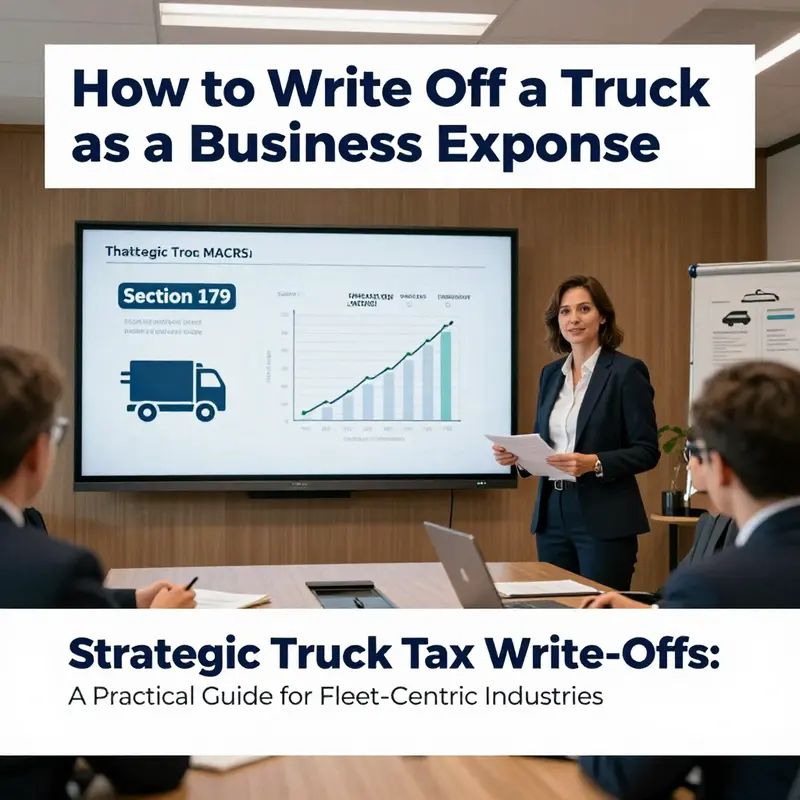
Choosing the Right Path to a Truck Write-Off is about matching a strategy to a business model, cash flow, and the way the vehicle will be used day to day. For many operators the question is not simply can I write off the truck but how much of the year the vehicle will serve business needs and how fast the tax relief should arrive. The answer hinges on three main routes offered by the tax code: Section 179 for purchased vehicles, MACRS depreciation for long term recovery, and leasing for those who value flexibility over ownership. Each path has its own rhythm, and the best choice often depends on profitability, borrowing capacity, and how quickly the business wants to recover the vehicle’s cost. A well executed plan aligns the truck with the company’s broader cash flow and growth strategy, so the decision feels less like a tax hack and more like a strategic asset allocation.
First determine how the truck will be used. The IRS requires that the vehicle be used primarily for business. If the truck is used more than 50 percent for business, you can deduct expenses. If it is used for business less than half the time, only a portion of the expenses may be deductible. A practical example helps illuminate the logic. If the truck logs 18,000 miles in a year, with 12,000 miles spent on deliveries and 6,000 on personal errands, business use is 67 percent, and roughly two thirds of eligible costs can be attributed to the business activity. Keeping a logbook that corroborates these miles, destinations, and purposes is essential. It turns a potentially vague deduction into a credible, auditable claim and reduces the chance that personal use balloons into a red flag for tax authorities. The discipline of accurate tracking also matters for operations planning, since it clarifies how much revenue is associated with each truck and how the vehicle choice affects profitability over time.
When the decision is about the immediate tax relief versus ongoing depreciation, three pathways emerge. The Section 179 deduction allows an immediate expensing in the year the truck is placed in service, but it comes with limits. For 2026, the total amount of qualifying costs that can be expensed under Section 179 is up to 1,220,000, subject to phase-out if total asset purchases exceed 3.1 million. Vehicles that qualify typically include light trucks up to 6,000 pounds gross vehicle weight rating (GVWR) and, in appropriate cases, heavier trucks used for business purposes. The practical advantage is clear: a large upfront reduction in taxable income that can substantially shift cash flow at the time of purchase. Yet there are caveats. The deduction cannot exceed the business’s net income for the year, and the vehicle must be placed in service in the eligible year. This means a strong current-year tax position can amplify benefits, while a lean year could limit the amount you can deduct under this method.
If Section 179 is too aggressive or the business prefers to spread relief over several years, MACRS depreciation provides a reliable, predictable path. Under MACRS, the truck is depreciated over its recovery period, which for most trucks under 6,000 pounds GVWR is five years. The MACRS framework uses a 200 percent declining balance method, switching to straight-line depreciation when advantageous. This approach does not front-load the entire deduction; instead it yields a steady cadence of deductions across the asset’s life. In the 2026 landscape, you can also take first-year depreciation under MACRS, which is often around 20 percent of the cost if you are not electing Section 179. An additional lever is bonus depreciation, which remains available for qualifying new vehicles placed in service before the end of 2026, potentially delivering up to 80 percent of the cost in the first year. This creates a tantalizing option for owners who want substantial early relief while still maintaining the future depreciation schedule on the remaining basis. The interaction between Section 179 and MACRS matters: taking a Section 179 deduction reduces the depreciable basis, which in turn reduces future MACRS deductions. The timing and magnitude of these interactions should be mapped out in advance to avoid surprises at year end.
A third route, especially for entities and individuals who do not own the truck, is leasing or rental. Leasing offers a straightforward path for deductible expenses without ownership risk. Lease payments are generally deductible as ordinary and necessary business expenses in the year they are paid, provided the lease is structured as a true lease and not a disguised loan. Leasing can be appealing when cash flow is tighter, when you wish to avoid the capital commitment of buying, or when vehicle technology or needs are likely to change in a few years. An end-of-lease buyout option can complicate the decision, but if the price reflects reasonable market value and aligns with long term plans, leasing can deliver both flexibility and manageable tax outcomes. The critical caveat is that you do not own the vehicle through a lease, so you forgo depreciation benefits and equity built through ownership. Leasing also requires careful documentation of the lease terms, maintenance responsibilities, and end-of-term options to ensure the deductions map cleanly to the actual economic arrangement.
Across these routes, operating expenses continue to ride alongside the vehicle cost as the core of the deduction framework. Fuel, tolls, maintenance, insurance, tires, and even parking fees tied to business trips are deductible when they are ordinary and necessary for the transportation of goods or clients. The key is precise categorization and substantiation: track actual fuel costs against miles driven, keep toll receipts, and allocate maintenance costs to the vehicle’s use. A common practice is to allocate a portion of mixed-use expenses to the business side based on the business-use percentage established by the mileage log. Insurance for a commercial auto policy is deductible if the policy is required for business operations, and even items like tires or parts replacements can be treated as repairs or maintenance depending on their nature. In practice, robust recordkeeping makes these line items nearly automatic deductions rather than vague credits. The most effective approach blends mileage data with receipts and aligns each expense with the corresponding vehicle activity. This level of documentation becomes the backbone of an audit-proof claim and a reliable basis for comparing ownership versus leasing in a given year.
From the accounting perspective, the mechanics behind the scenes matter just as much as the year you place the vehicle in service. For a business owned truck, the basic journal entries illustrate how the purchase and the deductions flow through the books. When a truck is purchased and a Section 179 election is elected, you record the asset at cost and reduce cash or increase liabilities for the same amount, then immediately record Section 179 expense against income, with a corresponding increase in accumulated depreciation over time. Monthly fuel expenses are recorded as operating costs with a corresponding cash outflow, and tolls and transportation expenses are categorized in line with whether they are tied to general operations or to the cost of goods sold. The ongoing discipline of logging mileage and receipts ensures the numbers line up with the tax reporting that follows. The year you decide to deploy Section 179 or MACRS will influence the future depreciation schedule and the way earnings are reported, so coordinating with a tax professional during the planning phase helps prevent mismatches that could complicate returns or trigger reviews. Tax compliance is not a once a year moment; it is a continuous alignment of the vehicle strategy with cash flow management and financial reporting.
As you weigh the options, a practical framework emerges. If your objective is to maximize upfront relief and you have confidence in strong current year profits, Section 179 remains a compelling choice, provided you stay within the annual limit and the broader investment threshold. If you prefer to spread relief, maintain a predictable deduction path, and manage deductions alongside other depreciable assets, MACRS offers a disciplined schedule that can be tuned with or without bonus depreciation depending on the year and the vehicle’s cost. If certainty and simplicity trump ownership and you anticipate shorter-term needs or frequent changes in fleet composition, leasing delivers transparent annual deductions and a lower capital commitment. In many situations, the decision is not a single runway but a runway plan that blends the three methods to optimize tax outcomes while preserving operational flexibility.
To connect practical strategy with real world guidance, consider how a broader view of business resilience informs the truck write-off decision. The same discipline that underpins a robust fleet management program also benefits human capital. For a thoughtful perspective on leadership and people within trucking operations, see the discussion on investing in people key to trucking’s success investing in people key to trucking’s success. This link signals that a finance decision is most powerful when it supports the broader capacity of the business to execute changes, train teams, and sustain growth, not when it only trims tax liability. The road to a truck write-off is thus a road that ties capital decisions to managerial capability and to the company’s longer term ambitions.
Whatever path you choose, the accounting and tax outcomes hinge on use, documentation, and timely planning. The most successful results come from an clear map that aligns the vehicle strategy with current profits and future growth while keeping options open for the next cycle. The tax code offers several legitimate routes, but the right choice depends on how much you want to accelerate relief now, how steady you want the depreciation stream to be, and how much you value ownership versus flexibility. This is not about a one size fits all solution; it is about building a strategy that keeps your fleet moving, your cash flow stable, and your compliance intact year after year. The ultimate objective is to maximize value from the asset without sacrificing clarity in reporting or the ability to adapt to a changing business landscape.
External resource for deeper guidance on depreciation methods and the sections discussed is the IRS publication on depreciation. External link: https://www.irs.gov/publications/p946#enUS2024_publink1000187444
From Purchase to Profit: Mastering the Truck Write-Off as a Business Expense
When a business buys a truck, the decision carries more weight than just a line item on the balance sheet. A truck is a capital asset that will shape your tax picture for years, so the way you account for it—and the way you track its use—can influence the bottom line well beyond the year of purchase. The overarching idea is simple in theory: you capitalize the cost when you acquire the vehicle, then allocate that cost over time through depreciation or, in the right circumstances, take an immediate deduction under the Section 179 provision. But the details matter. They determine how much you can deduct in the first year, how much you recover each year through depreciation, and how your expenses align with the actual business use of the truck. The journey from purchase to profit hinges on careful planning, precise documentation, and disciplined recordkeeping that stands up to scrutiny from the IRS.
First, consider the nature of the purchase. A truck bought for business use is a capital expenditure. It belongs on the fixed assets side of the books, not as a simple expense on the income statement. The capitalization step is straightforward in concept: record the full cost, including the price, sales tax, title fees, and delivery charges, into a Fixed Assets account. The practical effect is that you do not deduct the entire purchase price in the year of acquisition by default; you place the asset on the books and begin to recover the cost over its useful life through depreciation. For many small to mid-size trucking operations, a five-year recovery period is typical for trucks under a certain weight threshold. If the vehicle is heavier or used more intensively in the business, the depreciation method and recovery period may differ, but the core principle remains: you spread the cost over time rather than expensing it all at once.
In a typical scenario, you might record the initial purchase with entries that resemble the following: Debit Fixed Assets – Truck for the full purchase amount, Credit Cash/Bank for the same amount. The effect is a balanced entry that places the asset on the books. Once the asset is placed in service, depreciation begins. You have choices here. MACRS—The Modified Accelerated Cost Recovery System—allows you to recover the asset’s cost over five years for many trucks, using a 200% declining balance method that switches to straight-line at the most advantageous point. If you wish for a quicker recovery in the first year, you can turn to Section 179, an election that allows you to deduct the full cost in the year the truck is placed in service, up to applicable limits and subject to phase-outs. This is where the year’s tax planning starts to bend toward the bottom line.
The Section 179 deduction is potent, but it comes with caps and eligibility criteria. For 2026, the total amount of cost you can elect to deduct under Section 179 is up to $1,220,000, with a phase-out that begins as asset purchases approach $3,100,000. The vehicle itself must be used more than 50% for business, and the truck must be placed in service in the year you elect the deduction. A light truck with a gross vehicle weight rating (GVWR) up to 6,000 pounds often qualifies under the Section 179 rules, but heavier trucks may qualify only under MACRS or other provisions. The key takeaway is that you can shift a substantial portion of upfront cost into the current year’s deduction if your fleet strategy aligns with the eligibility criteria, and you have the tax appetite to manage the cap and phase-out. In practice, many operators combine Section 179 with bonus depreciation for the first year, further accelerating the deduction if the vehicle is new or qualifies as a used vehicle under the current rules.
If you do not elect Section 179, MACRS remains the backbone of long-term cost recovery. Under MACRS, the five-year recovery period reflects the asset’s expected useful life and the pattern with which you reap the benefit of the deduction. The depreciation is recorded annually, often with a 200% declining balance method that switches to straight-line to optimize tax outcomes over the asset’s life. In many cases, first-year depreciation under MACRS alone is modest; however, bonus depreciation rules—still in effect for vehicles placed in service before the end of 2026—offer a generous first-year deduction for qualifying new vehicles, potentially up to 80% of the cost in the year placed in service. When combined with Section 179, the taxpayer can tailor the earliest possible tax relief to their cash flow realities and profitability goals. The interplay of these options makes the decision not purely technical but strategic, requiring an honest estimate of business use, anticipated mileage, and the impact on year-end tax liability.
Beyond ownership structures, leasing is a common route for many operators, especially those whose business model treats the truck as a service rather than an owned asset. A lease or rental agreement, when properly documented, yields deductible monthly lease payments as a business expense. The deduction is straightforward: the ongoing lease payments are fully deductible in the period they are incurred, provided the truck is used for business purposes. The critical caveat here is accurate documentation and the existence of a formal lease or rental agreement. For drivers operating under contractor or independent status, leasing can align with how they administer the vehicle and the business’s tax position. In each case, the decision between Section 179, MACRS, and leasing is not simply about accounting preferences; it’s about optimizing after-tax cash flow while ensuring compliance.
As the asset moves from purchase or lease into daily operation, the ongoing costs—the fuel that powers the miles, the tolls that keep the wheels turning, the maintenance that preserves value, and the insurance that protects operations—all accumulate as deductible business expenses. The IRS allows these operating costs to be deducted as ordinary and necessary business expenses, but you must tie every dollar to business use. If the truck is used for personal trips, the personal portion is not deductible. This requires a precise method for measuring business use, typically through a log maintained with diligence. A daily logbook that captures the date, destination, purpose, and miles driven is indispensable. Mileage itself is a powerful support tool: it substantiates the business use percentage, which then scales the deductibility of fixed costs like depreciation or Section 179, as well as variable costs like fuel and maintenance.
Consider the nuance of allocation. If the truck is used 75% for business and 25% for personal purposes, only 75% of the operating costs are deductible, and only the business-use portion of depreciation or Section 179 deduction applies. The precise arithmetic matters, because misallocation can invite penalties or an IRS rewriting of the deduction. The log is not a mere formality; it is the backbone of credible documentation that shows business purpose and substantiates the ratio of business miles to total miles. In addition to the log, maintain receipts for fuel, maintenance, insurance, tires, and other consumables, and collect invoices for repairs and services. The combination of logs and receipts provides a granular trail that demonstrates the link between each expense and the truck’s business use.
On the accounting front, the entries for a truck purchase under Section 179 and the subsequent annual depreciation illustrate the practical mechanics. A purchase might begin with a debit to the Truck asset account and a credit to Cash. If you elect Section 179 for the full cost, you would record a debit to Section 179 Expense and a credit to the Truck asset or to Accumulated Depreciation, depending on the exact accounting approach your organization follows. For ongoing expenses, you would debit Fuel Expense, Maintenance Expense, Insurance, or other appropriate expense accounts and credit Cash or Accounts Payable as the cost is incurred. These entries become the daily rhythm of fleet accounting, a rhythm that supports accurate financial statements and clean tax reports. The rigor of these records matters when you prepare Form 4562 to claim depreciation or Section 179 deductions. The form captures the details of the asset, the cost basis, the depreciation method, the lives, and the calculations behind the deduction. The form also requires the business to log the use of the vehicle and its business purpose, again underscoring the link between use and deduction.
A practical lens on the decision framework helps bring these concepts into focus. If your fleet strategy emphasizes rapid growth or a high-mileage profile, Section 179 can yield a dramatic up-front tax relief, provided you have ample taxable income to shelter. If you anticipate year-to-year variability in earnings, MACRS offers a steadier, more predictable depreciation stream that aligns with the asset’s actual wear and tear. If your operation prefers renting the asset or avoiding ownership risk altogether, a lease can simplify annual deductions and align costs with the period’s business activity. In all cases, the business-use percentage remains the fulcrum. The more you use the truck for business, the greater your legitimate deduction potential, but the more critical your documentation becomes. A rigorous approach to mileage tracking and receipts is not optional; it is the price of confidence in your tax position and the reliability of your financial statements.
To make this more tangible, imagine a company purchases a truck for $100,000, with a plausible business-use rate of 70%. If Section 179 is elected and fully utilized for the year, the company can reduce its taxable income by up to $70,000 based on the business-use portion, subject to the cap and eligibility. If Section 179 is not elected, MACRS depreciation would apply, with the first-year deduction typically noticeable but less aggressive than a full Section 179 election, possibly enhanced by bonus depreciation for qualifying vehicles. If the truck is leased instead of purchased, a simple, clean monthly deduction in the lease payments would occur, provided the lease arrangement is formal and properly documented. Regardless of the path, the subsequent years will involve annual depreciation (or continued lease deductions) and ongoing operating expense deductions that reflect the actual miles driven for business, the costs incurred to operate, maintain, and insure the vehicle. The cumulative effect can be substantial, particularly when you align the numbers with a clear business plan that anticipates mileage, maintenance needs, and the expected useful life of the asset.
Documentation is not merely procedural; it is the shield that protects these deductions from dispute. The IRS expects a vehicle logbook showing daily business use and miles, receipts for fuel and maintenance, insurance records, and proof of ownership or lease. The annual tax return will rely on Form 4562 to report depreciation or Section 179, and, if you use Section 179, you must meet the vehicle-specific eligibility criteria and report the election consistently. The discipline of documentation pays dividends not only at tax time but also in the reliability of financial reporting, helping leadership teams—owners and managers alike—make informed decisions about capital allocation and cash flow. In a broader sense, this disciplined approach to asset management and expense tracking aligns with good governance, risk management, and strategic planning for a fleet that aims to balance growth with prudent financial stewardship.
For readers who want to connect the mechanics of truck write-offs to a broader view of fleet strategy, consider the idea that asset investments also involve the people who use and manage those assets. The human element—the drivers, maintenance teams, and asset managers—plays a crucial role in ensuring that the truck delivers value over its life. A fleet that treats people as a strategic asset alongside equipment often performs better in terms of reliability, maintenance scheduling, and cost control. This perspective is echoed in industry discussions about building robust, people-centered approaches to trucking operations. See this resource for a perspective on investing in people as a central component of trucking success: investing-in-people-key-to-truckings-success.
All told, the journey of writing off a truck as a business expense blends sound accounting with disciplined operations. It starts with the right decision about Section 179, MACRS, or leasing, moves through meticulous tracking of business use and operating costs, and culminates in precise, compliant tax filings. The goal is not just to minimize taxes in the current year but to build a sustainable financial model that reflects the true cost of moving goods and people from point A to point B. When the asset life is measured, the miles are logged, the receipts are organized, and the tax filings reflect the actual economics of the fleet, you can see how a single vehicle can influence cash flow, profitability, and strategic decision-making for the entire business.
For those who want a formal reference to the rules that underpin these practices, the IRS provides comprehensive guidance on vehicle expenses, depreciation methods, mileage logs, and required documentation. See IRS Publication 463 and the related materials for authoritative, up-to-date information on travel, entertainment, gift, and car expenses as they apply to business use of vehicles. The publication offers detailed examples, thresholds, and documentation expectations that complement the practical approach outlined here and help ensure compliance across a growing fleet.
External resource: https://www.irs.gov/pub/irs-pdf/p463.pdf
From Miles to Deductions: A Practical Path to Writing Off a Truck as a Business Expense
A truck used for business activity is more than a vehicle; it is a source of potential tax relief, a tool for operating efficiency, and a ledger line that ties daily work to annual compliance. The central idea is straightforward: if the truck is used primarily for business, many of its costs can become deductible. But the path from miles driven to a legitimate write-off is defined by specific rules, careful recordkeeping, and a disciplined approach to accounting. The journey hinges on two pillars: determining the level of business use and choosing how to claim the deduction. First, the business-use threshold matters. The IRS requires that the vehicle be used primarily for business to qualify for deductions. In simple terms, if the truck is used more than half the time for business, your deductible expenses can reflect that proportion. If business use falls below 50%, only a portion of expenses is deductible. Consider a truck that travels 18,000 miles in a year, with 12,000 miles for business and 6,000 for personal use. That yields a 67% business use rate, which translates to 67% of eligible expenses being deductible. This is not a mere arithmetic exercise; it is a test of how you track use, document purposes, and demonstrate the split in your records. The line between business and personal miles must be supported with a robust log, one that links a trip to a concrete business objective—delivery, service, or customer visit—so that the deduction can weather IRS scrutiny. The log becomes the backbone of the claim, guiding not only the daily accounting but also year-end tax reporting. When the miles or the purposes are murky, the deduction weakens, and the audit trail grows heavier. Therefore, the narrative of each trip matters as much as the numbers themselves. After establishing business use, you must decide how to capture the expense. Here the spectrum widens. You can pursue immediate expensing under Section 179, or you can spread the cost through MACRS depreciation. You can also opt to lease the vehicle, in which case lease payments become deductible as operating expenses. Each path has trade-offs, and the choice can impact cash flow, tax liability, and long-term asset strategy. Section 179 is designed for businesses that purchase and place in service qualifying property in a given year. For trucks, the 2026 threshold allows a total cost deduction up to $1,220,000, subject to phase-outs if total asset purchases exceed $3,100,000. The vehicle must be owned by the business and placed in service in the same year, and eligible trucks generally include light trucks with a gross vehicle weight rating (GVWR) up to 6,000 pounds, with heavier trucks possible if used for business purposes. The benefit is striking: the full cost of the vehicle can be written off immediately, slashing taxable income in the year of acquisition. This is especially valuable for fleets and owners who need to accelerate cash flow or shift tax liability into the current year when profits are strong. Yet Section 179 is not a blank check. It begins with use and ownership—your truck must be in service and used predominantly for business—and it sits within a broader perimeter of limits designed to prevent over-application in large-scale asset acquisitions. If a business decides not to take Section 179, MACRS offers an alternative. Under MACRS, the truck is depreciated over its useful life, typically five years for trucks under 6,000 pounds. The method is a 200% declining balance that switches to straight-line depreciation partway through the recovery period. The first-year depreciation is often around 20% of cost in 2026, with subsequent years following the MACRS schedule. The result is a steady, year-to-year deduction that reduces income over time, smoothing tax obligations across multiple years instead of a single, dramatic write-off. The choice between Section 179 and MACRS hinges on current and projected profitability, the desired pace of tax relief, and the company’s ability to absorb large deductions in the present year. The third option—leasing or renting the truck—serves businesses that prefer to convert fixed ownership costs into operating expenses. A lease can provide predictable monthly payments and simplified maintenance arrangements, and the lease payments are deductible as business expenses. Leasing is common when ownership is uncertain, when the cash outlay for a purchase would be prohibitive, or when the user operates under a contractor model where ownership may be less clear. When the truck is leased, the business must maintain a formal lease agreement, and the payments must reflect actual use and business necessity. Even with leasing, the business must still track how the vehicle is used to ensure the deduction aligns with business activity and to separate any personal miles from business miles. Beyond the choice of deduction method, ongoing operating costs demand careful attention. Fuel costs, tolls and other electronic toll collection (ETC) fees, maintenance and repairs, insurance (especially commercial auto insurance), tires and parts, and parking expenses incurred while conducting business are all deductible to the extent they can be tied to business use. The receipts and invoices must be preserved, and the connection to business use must be documented. For fuel, you can deduct the actual fuel cost tied to business miles, which means combining mileage logs with receipts. Tolls and ETC may be deducted as part of transportation expenses or as business travel costs, but they must be incurred for business trips. Maintenance and repairs—oil changes, brake jobs, tire replacements—are deductible as incurred, reflecting the wear and tear of regular operation. Insurance is a fully deductible business expense if it is required to operate the vehicle for business purposes. Tires, parts, and other replacements reflect the ongoing maintenance of the asset. Parking fees incurred while performing business duties are deductible as well. The thread binding these costs together is meticulous documentation. A detailed logbook is not just a suggestion; it is a requirement to support the deduction in the face of an audit. The log should capture the date, destination, purpose, and miles driven for each business trip, and it should be consistent with tax filings. In conjunction with the miles log, keep receipts for fuel, maintenance, insurance, and other expenses with notes linking them to business use. The IRS emphasizes that personal use must be clearly separated from business use, with personal miles excluded from business calculations. The accounting entries that reflect these activities provide a practical bridge between daily operations and annual tax reporting. For a business-owned truck using Section 179, a simplified illustration might look like this: you purchase a truck for $100,000 in the year you elect Section 179. You would record the asset with a debit to Truck and credit to Cash for the purchase, and then record a Section 179 deduction against that asset, typically debiting Section 179 Expense and crediting Accumulated Depreciation to reflect the immediate deduction. Monthly fuel expenses, for example, are recorded as a debit to Fuel Expense and a credit to Cash or Bank. Toll expenses are recorded similarly under Transportation Expense. These entries, while basic, ensure that the financial statements reflect the real costs of operating the truck and the tax relief that results from those costs. The practical path to compliance is not limited to numbers. It includes strict adherence to IRS rules and the maintenance of robust records. The Form 4562 becomes essential whenever you claim depreciation or a Section 179 deduction. A daily or at least periodic vehicle logbook is required for substantiating business use. Any personal use must be clearly identified and excluded from deductions. The IRS continues to offer bonus depreciation, which can be particularly advantageous for qualifying new vehicles placed in service before the end of 2026, with substantial percentage allowances. This bonus depreciation can significantly accelerate the tax relief from a new asset, complementing Section 179 where applicable. The overarching imperative is to align your recordkeeping and reporting with the year’s business activity and the asset’s lifecycle. Publication 463, Travel, Entertainment, Gift, and Car Expenses, provides a detailed guide for travelers and vehicle operators on how to apply these rules consistently. It covers the interplay between travel and car expenses, how to allocate costs between business and personal use, and the documentation required to support deductions. For anyone keeping a fleet or managing a single company truck, the combination of precise miles logging, careful expense categorization, and disciplined reporting forms the backbone of sustainable tax strategy. This approach reduces the risk of over- or under-claiming and gives a clear financial view of how a truck contributes to the business’s bottom line. Alongside the internal practice of logging and tracking, it can be valuable to remain aware of broader regulatory considerations that influence fleet operations during disruptions. For example, one resource addresses regulatory relief specific to winter storm conditions in trucking, which can affect routing, fuel use, and schedule changes—factors that indirectly shape how you document business use and expenses. You can explore this topic at the following link: Regu-latory relief for winter storms trucking. regulatory-relief-winter-storms-trucking. As you prepare for year-end filings, remember that the rules can evolve, and staying aligned with IRS guidance remains essential. In addition to internal controls and documentation, consult the official sources for the most current forms and instructions. For authoritative reference, see the external resource linked at the end of this chapter, which provides comprehensive guidance on vehicle expenses and travel-related deductions: https://www.irs.gov/pub/irs-pdf/p463.pdf. This combination of disciplined recordkeeping, prudent method selection, and formal reporting can transform a truck from a fixed cost into a strategic tax asset, enabling a business to leverage its mobility without sacrificing compliance. If you’re building a next chapter that dives into the practical mechanics of an expense tracker, you’ll find the journey begins with a solid foundation of miles, receipts, and a thoughtful method—and ends with a clear, auditable trail that supports every deduction claimed.
Final thoughts
A disciplined approach to writing off a truck as a business expense integrates operational realities with tax incentives. Start by confirming that business use exceeds the threshold, then select the most advantageous deduction path—Section 179 for immediate expensing, MACRS for gradual depreciation, or leasing where ownership is not feasible. Maintain meticulous records for operating costs, including fuel, tolls, insurance, maintenance, and tires, supported by a robust mileage log and receipts. Ensure IRS compliance by filing Form 4562 as required and keeping auditable documentation that demonstrates business purpose and proper allocation of personal use. For fleets spanning multiple sites, centralize tracking, standardize protocols, and leverage telematics to improve visibility and reduce risk. The integrated framework outlined in these chapters helps logistics and construction leaders optimize cash flow, achieve predictable budgeting, and sustain competitive advantage in a capital-intensive, highly regulated sector.