
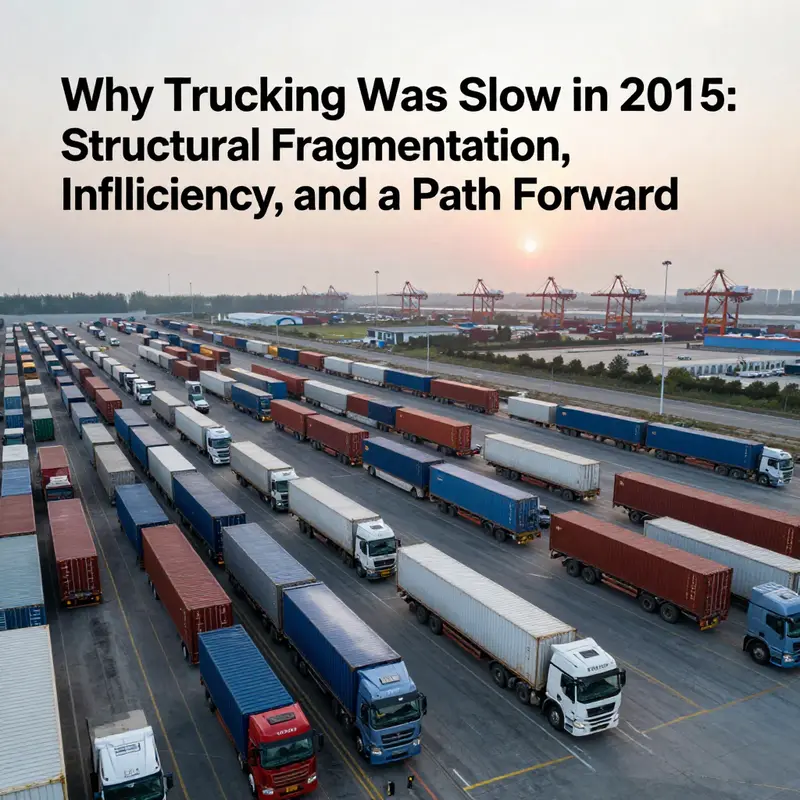
China’s trucking sector confronted a rare convergence of structural weaknesses and macro headwinds in 2015, slowing freight activity despite road transport’s central role in supply chains. The market endured overcapacity: an estimated 7.5 million small trucking outfits created a fragmented, intensely competitive environment where prices collapsed and profitability eroded. A striking 39% empty-run rate meant nearly two out of every five trucks moved without cargo, inflating unit costs and stressing cash flow. Demand for bulk commodities cooled as the economy slowed, dampening freight volumes and creating a tighter operating environment for shippers and carriers alike. Logistics inefficiency compounded the issue, with logistics costs reaching roughly 16% of GDP—a reflection of outdated processes, limited information sharing, and poor coordination among shippers, carriers, and receivers. Taken together, these forces did not merely soften growth; they exposed long-standing market fragilities. The chapters that follow translate these macro dynamics into concrete implications for Logistics & Freight Companies, Construction & Engineering Firms, Fleet Management Companies, and Food & Beverage Distributors, and outline actionable remedies across capacity alignment, efficiency, demand planning, manufacturing impact, and network modernization.
Slow Roads, Fragmented Ranks: How Overcapacity and Disarray Shaped China’s Trucking in 2015
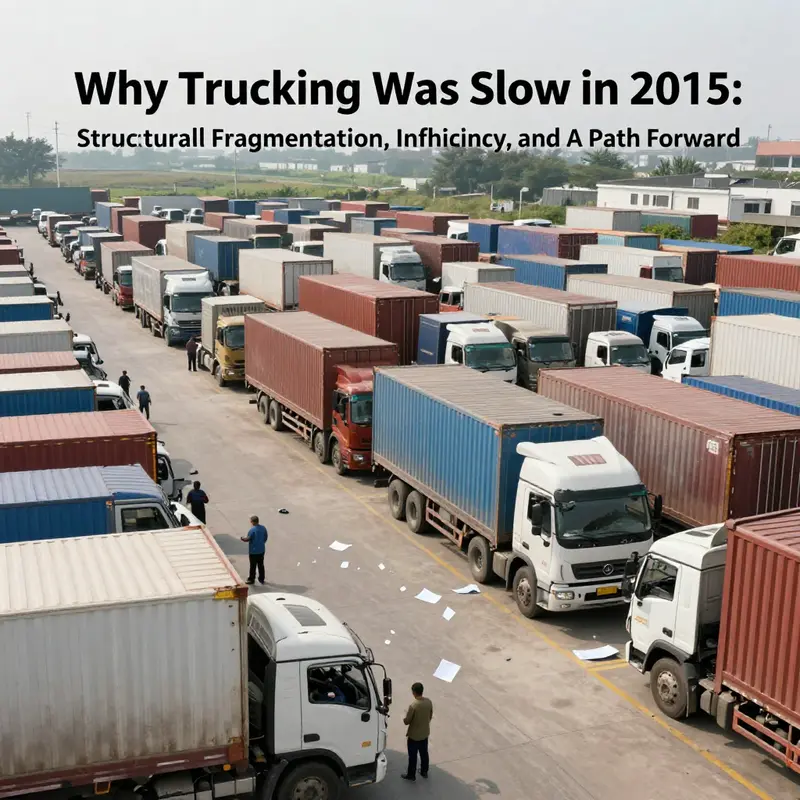
When the year 2015 arrived, the trucking landscape in China did not simply show a momentary lull. It presented a stubborn, systemic stagnation born from a paradox: more trucks than there were real freight opportunities, and a market structure that kept those trucks competing against one another rather than against the road’s inefficiencies. A slowing macroeconomy, a pullback in traditional bulk freight, and an industry still mastered by a myriad of small operators all converged to press down on profitability. The result was a downward spiral in utilization, pricing pressure that eroded margins, and a perception that the road to steady growth had suddenly grown steeper and more uncertain. In hindsight, the slowdown was less a single year’s misfortune than a symptom of deeper fault lines that had been quietly widening across the logistics chain.
Overcapacity was the most visible and stubborn fault line. The fleet had expanded well beyond the level that the economy could reliably absorb. In the years leading up to 2015, China’s road transport sector increasingly resembled a sprawling ecosystem of small, independent operators. The knowledge base emphasizes that a large share of capacity rested in the hands of individual drivers rather than integrated fleets or consolidated carriers. In the period described, roughly nine out of ten trucking capacities were controlled by individual operators, a statistic that reveals a market dominated by loose affiliations and informal competition rather than by coordinated, strategic capacity management. The fragmentation did not merely complicate operations; it undermined pricing power and the ability to optimize load factors across the network. Large firms held only a sliver of market share—about 1.2%—a testament to how dispersed the industry remained. In practice, this fragmentation translated into a race for any available load, an environment where price cutting and rapid turnover often overshadowed efficiency and reliability.
The precondition for such fragmentation has long been a history of rapid fleet growth. By the 2010s, the country’s road freight capacity had expanded as policy and private capital pushed more trucks onto the road. The implication for 2015 was clear: supply repeatedly outran demand, especially as demand shifted away from traditional bulk commodities whose movement had underpinned much of trucking activity. The coal industry, a long-time anchor for capacity needs, began to show signs of contraction in 2015 as provinces announced reduced production. That created a hollowing effect: fewer tons to haul, but the same or an even larger pool of trucks eager for work. The broader picture of demand likewise softened. Industrial logistics volumes grew only modestly in 2015—around 6.1%—a retreat from the growth rates witnessed in prior years. And on the international side, global trade demand remained weak, dampening the need for cross-border container movement that could otherwise have absorbed excess capacity on the domestic network.
Within this environment, the everyday economics of trucking deteriorated. A telling symptom was the high rate of empty runs. Estimates placed the empty-run rate as high as 39%, meaning nearly two out of every five trucks traveled without cargo. Such inefficiency directly inflated the cost per ton-mile and magnified the impact of weak demand. In a sector that already contended with thin margins, every unused kilometer translated into lost revenue. The cost structure of logistics, in fact, was a major concern. Logistics costs at the time represented around 16% of GDP, a striking figure when compared with the roughly 10% level common in more developed economies. That gulf underscored not just a cyclical downturn but an entrenched inefficiency across the chain—from shippers to carriers to receivers. Old practices, limited information sharing, and a lack of integrated planning amplified the frictions that fragmentation had already created.
The demand-side weakness was reinforced by a pronounced fall in truck sales during the first half of 2015. The broader business climate lowered confidence across the manufacturing and heavy-duty sectors, as reflected in a 17.71% year-on-year decline in overall truck sales and an even sharper drop for heavy-duty trucks, exceeding 30%. This plunge did more than reduce new-capacity additions; it signaled a broader retrenchment in the sector’s expectations for near-term growth. When demand expectations contract, the incentive to consolidate or modernize diminishes, and the lure of cheaper, incidental capacity—often operated outside formal systems—becomes more attractive to shippers who face volatile prices and uncertain service quality.
In such a fragmented and overbuilt market, the pricing dynamic tends to follow a familiar pattern: competition becomes a form of undercutting that can quickly erode profitability for many players, even as a few larger or more efficient operators attempt to maintain service levels and reliability. The combination of oversupply and disorganization fostered a marketplace where trust was scarce and underutilization was common. The literature points to persistent issues of “chaos” within the sector—low industry concentration, little formal coordination, and episodes of cargo misrepresentation or fraud that further degraded the reputation of the industry and increased risk for all participants. This is not merely a historical footnote; it is a key driver behind the slow pace of growth, because the risk-adjusted returns on trucking in such an environment remain unattractive to capital looking for predictable, scalable opportunities.
Against this backdrop, the macroeconomic decline cannot be separated from the micro realities on the ground. The heavy weight of inefficiencies meant that even as demand for certain goods waned, the network of trucks and routes remained in place, churning fuel and labor with little corresponding throughput. The result was a stale equilibrium in which capacity and demand were misaligned, and the costs of carrying freight remained stubbornly high. The impact of such a misalignment reverberates beyond the balance sheets of individual operators. It affects the reliability of supply chains, the ability of manufacturers to meet production schedules, and the willingness of customers to rely on a road-based freight system as a core component of their logistics strategy. In 2015, this was less about a single policy shock and more about a confluence of structural issues that had built into the industry’s DNA over years of expansion without commensurate modernization.
From the perspective of a broader narrative on trucking, the 2015 slowdown foreshadowed the challenges and the reforms that would come later. It was a reminder that growth in this sector is not a one-way street of more trucks and more loads; it requires proportional improvements in efficiency, information flow, and market structure. In other words, the slowdown was as much a signal about the state of the logistics ecosystem as it was about freight volumes. The NDRC’s subsequent analyses underscored that the root causes lay in the combination of overcapacity, fragmentation, and the resulting high costs that reduced the sector’s competitiveness both domestically and in international markets. A future-oriented path would need to address capacity concentration, create stronger incentives for consolidation, and promote the modernization of fleet management, data sharing, and capacity planning.
For readers looking to connect these themes with practical lessons, the linkage to broader insights—such as cross-border efficiency, risk management, and the adoption of more integrated logistics practices—remains essential. A useful cross-reference is the article that examines how cross-border challenges and regulatory landscapes shape trucking operations, illustrating how fragmentation can be mitigated through better information flows and collaborative networks. You can explore these ideas further through the piece on navigating cross-border challenges, which offers perspectives relevant to reorganizing capacity and improving reliability in markets undergoing structural stress. Navigating cross-border challenges: insights from the TCA annual meeting.
As readers consider the road ahead, a broader context helps frame the 2015 slowdown not as an isolated crisis but as a catalyst for modernization. Consolidation, better fleet-management practices, and sharper alignment between capacity and demand began to emerge as plausible avenues for turning the tide. The 2015 experience underscored the importance of creating incentives for efficiency, reducing the physical and financial frictions inherent in a highly fragmented system, and leveraging information technology to connect shippers, carriers, and receivers in ways that previously felt out of reach. Although the industry faced a protracted period of adjustment, the lessons from 2015 persisted: when capacity grew too fast for real demand, and when fragmentation prevented coordinated responses, profitability suffered, and the system’s resilience declined. The road to recovery depended on the willingness to rethink the structure of the market, to encourage collaboration, and to invest in the modernization that could turn idle trucks into productive capacity and uncertainty into reliability.
External resource for broader context on logistics efficiency and performance: https://lpi.worldbank.org/
null
null
null
null
Decelerating Freight, Fabric of a Sluggish Economy: 2015 Trucking Slowdown and China’s Manufacturing Malaise
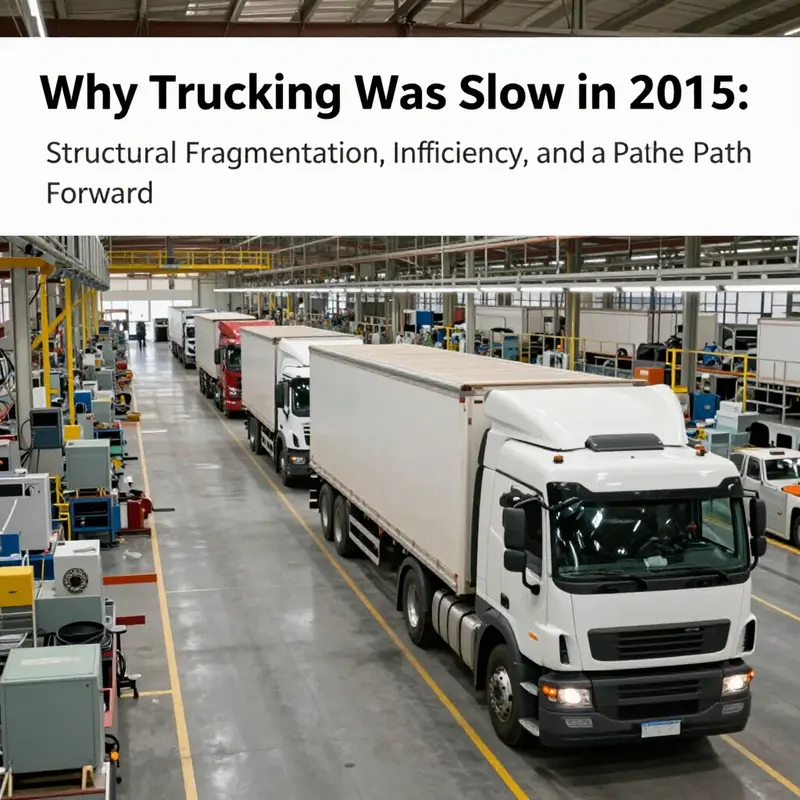
In 2015, the trucking ecosystem in China did not merely contract; it exposed fault lines in a broader industrial cadence that had begun to falter. Freight flows, once a steady river feeding factories and construction sites, ebbed as demand for bulk commodities waned and the engines of production slowed. The macro picture of an economy easing from a hot growth phase toward a more measured tempo translated into fewer orders for the raw materials that sustain heavy transport. Coal and iron ore markets, long the lifeblood of large haul logistics, contracted as appetite for inputs cooled. This reduced appetite did not stop at rails or ports; it reverberated through trucking lanes, where the volume of goods moved shrank in tandem with output. The freight market became starved of activity, and the sector found itself at the center of a systemic slowdown rather than a short term blip. The narrative of 2015 is a story of a logistics system trying to adapt to a softer industrial heartbeat, where the pace of manufacturing determined the rhythm of the roads.\n\nAmid this macro pullback, the industry structure amplified the pain. The landscape was described as small, scattered, chaotic, and poor. More than seven million trucking outfits were dispersed across the countryside, many with a handful of vehicles and minimal economies of scale. With so many operators competing for freight, pricing power evaporated and margins compressed. Fragmentation did not simply dampen profits; it stoked a race to the bottom where capability did not translate into stability, and the lack of scale meant many firms could neither weather nor pivot through the storm. Efficiency and reliability were luxuries; the emphasis was on survival, repurposing, and improvisation, often at the cost of service quality. The fragmentation also posed a governance challenge for the backlog of information that logistics networks rely upon: shippers, carriers, and receivers faced misaligned incentives, delayed data sharing, and opaque pricing signals, all of which elevated the risk of empty miles and wasted capacity.\n\nThe magnitude of inefficiency became stark when looking at trucks’ utilization. The empty run rate hovered around 39 percent, a statistic that reflected not just idle equipment but highlighted a structural cost embedded in the business model. When nearly two out of every five trucks move without cargo, the cost per ton mile climbs, eroding profitability. The industry thus found itself balancing the need to cut costs with the pressure to maintain service coverage, a precarious act in a soft macro environment. For fleets with capital tied up in trucks and financing, the economics of underutilized capacity became a central driver of caution in hiring and purchasing cycles.\n\nThe financial tremor extended into manufacturing orders. The first half of 2015 saw a pronounced drop in demand for heavy trucks, with sales declining by more than thirty percent in some segments. This created a feedback loop: weak sales discouraged investment in new production, which reduced the availability of compliant models, parts, and service channels for dealers and operators. The position of manufacturers, dealers, and fleet owners was less about seasonality and more about revisiting fundamentals such as capital allocation and product mix in a market where scale advantages were no longer a given. The downturn reinforced a broader pattern: when the macro environment is soft and the fleet is oversupplied, the cost of maintaining a large, modern fleet rises, making new orders a harder sell.\n\nLogistics costs themselves were a stark reminder of inefficiency. With logistics costs around 16 percent of GDP, well above the roughly 10 percent benchmark in many developed economies, the structural inefficiencies reflected a missing alignment of processes across the ecosystem. Outdated practices, limited integration, and data gaps contributed to higher waste and delayed shipments. In 2015, the push to squeeze more value from the same routes ran into the reality that digital coordination was not yet widely adopted. The result was higher waste, delayed shipments, and a slower return on investment for modernization efforts facing regulatory and macro headwinds.\n\nTwo regulatory inflection points in 2015 further disciplined the pace of the market. The National IV emission standards created a shock through production and sales channels. Dealers and buyers faced understocking or delays as they adapted to the new standards, and a backlog of vehicles emerged as customers hesitated while dealers pre-registered volumes. The effect was a peak in hesitation and a dip in heavy-truck sales, while residual values and fleet renewal timing shifted, requiring capital to be allocated toward compliant technologies. The market also grappled with misalignment between supply readiness and demand timing, delaying fleet replenishment and intensifying cycles of underutilization. Within this environment, discussions among fleet operators and dealers centered on what to buy, when to implement upgrades, and how to maintain compliance.\n\nA simultaneous recalibration reshaped demand mix. As freight volumes contracted, demand for specialized self unloading trucks fell sharply, with declines around the mid-fifties in some segments. By contrast, highway oriented vehicles for long haul logistics continued to fare relatively better and by the third quarter accounted for nearly 70 percent of the total medium to heavy truck market. This shift signaled a pivot toward more efficient, networked transport solutions that supported urban and regional distribution, while the overall market contracted. It also implied manufacturers and dealers would recalibrate portfolios, prioritizing reliability, fuel efficiency, and post sales support in a landscape where asset uptime mattered more than ever.\n\nTaken together, macro headwinds, regulatory disruption, capacity oversupply, and evolving market structure produced a multi year pull on the trucking sector. The 2015 slowdown was not a short cycle but a diagnostic reading of a manufacturing system recalibrating under pressure, learning to align capacity with demand in a world where both are shaped by regulation, efficiency imperatives, and global trade dynamics. For manufacturers, dealers, and fleet operators, 2015 prompted a rethink of balance sheets and a push toward modernization and smarter data, routing, and coordination across the logistics chain. The broader manufacturing implications were clear: when freight channels tighten, the entire production ecosystem feels the tremor. The 2015 trucking slowdown thus served as a turning point rather than a one year blip, highlighting how regulatory and efficiency dynamics reframe capital allocation and fleet strategy in a changing economy.\n\nFor readers seeking deeper regulatory and investment implications from this period, the discussion on emission standards and fleet procurement offers more detail. The broader context of logistics costs in a changing economy is explored in analyses that situate China’s 2015 slowdown within global trade patterns and policy responses.
Slow Wheels, Heavy Costs: How Fragmentation, Empty Miles, and a 16% GDP Logistics Burden Shaped China’s 2015 Trucking Slump
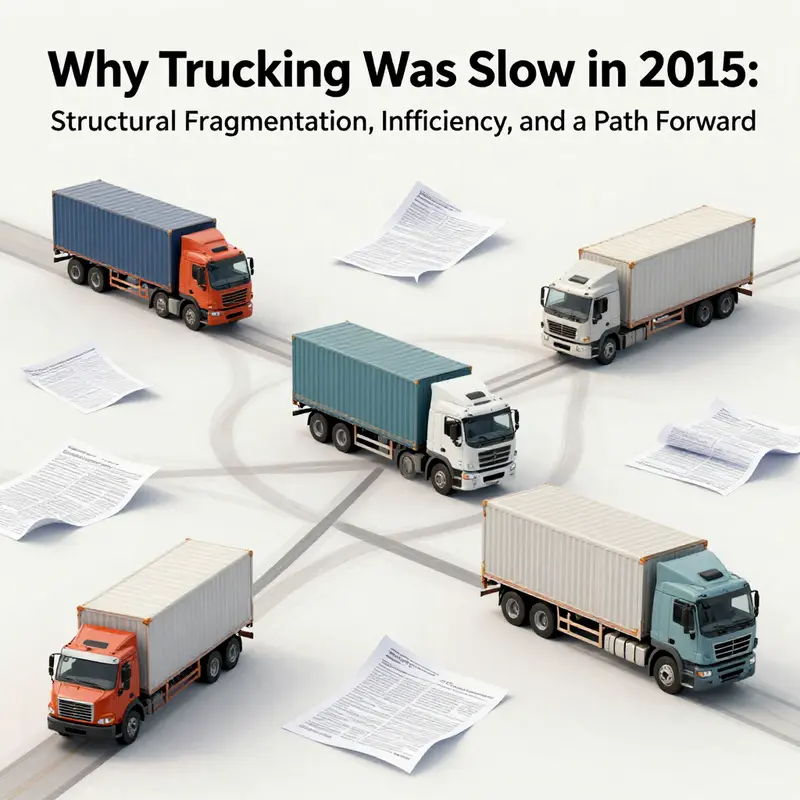
In 2015, the trucking sector did not slump because demand vanished overnight. It slowed because the system itself was structurally limping. The convergence of a weakening macro economy, a market saturated with small operators, and a logistics ecosystem still shackled by fragmentation created a perfect storm. The data from that year tell a story of inefficiency writ large: a logistics cost that hovered around 16% of GDP, a freight market starved for growth, and a fleet that often moved with too little cargo to justify the expense. The slowdown then was less a single flashpoint and more a symptom of long-standing frictions in how goods moved from point A to point B and how the people, machines, and information needed to keep that movement efficient actually worked—or, more often, failed to work together.
The backbone of the problem lay in network fragmentation. Across the country, there were somewhere near 7.5 million small trucking companies, most operating with only a handful of vehicles. This many micro-operators created a market that was, in practice, little more than a dense swarm of competing trucks, each trying to win a small slice of a limited pie. The result was a race to the bottom on price, where profits could erode simply because a truck could be said to be moving cargo for a marginally better rate than a neighbor’s. The description from observers of the era—small, scattered, chaotic, and poor in execution—captured a fundamental misalignment: when dozens of thousands of small players compete in an uncoordinated market, capacity becomes unpredictable, and pricing becomes a blunt instrument rather than a lever for efficiency.
Even as demand for bulk commodities like coal and iron ore softened with China’s slowing economy, the broader freight market felt the ripple effect. Freight volumes fell not only for the end products themselves but also across the chain: lower raw-material volumes meant less intermediate demand for trucking services, which fed back into a cycle of cautious hiring, deferred investments, and delayed fleet renewal. It wasn’t simply a matter of fewer trucks needed; it was that the ecosystem around those trucks—shipper networks, dispatch systems, load boards, and tracking capabilities—had not yet matured enough to stretch the remaining demand further or to extract more value from it.
One stark indicator of the inefficiency lay in utilization: the empty-run rate. Estimates placed the empty miles at about 39%, meaning nearly two out of every five trucks were traveling without freight. In a business where fuel, driver wages, maintenance, insurance, and debt service were already clamping margins, such idle capacity amplified costs per ton-mile. The economic logic of trucking—heavy vehicle, high fixed costs, and the need for steady throughput—clashed with a reality in which capacity was frequently chasing the next load rather than moving in an integrated, optimized pattern. When empty miles race ahead of actual demand, the arithmetic of profitability tilts toward loss rather than leverage.
These structural weaknesses fed into a second, equally persistent trend: the demand-side confidence for investment in equipment. The first half of 2015 saw truck sales drop sharply, with total sales down by 17.71% year-on-year, and heavy-duty trucks faring even worse with declines surpassing 30%. The signal from manufacturers and suppliers was clear: business forecasts were unraveling, and fleet owners were restraining capital expenditures. A market already crowded with small operators faced a double burden—lower volumes and thinner margins that made new-capital investments seem riskier and less attractive. The result was a slower renewal cycle, older fleets, and a higher likelihood that aging assets would further impair efficiency and reliability in service delivery.
Against this backdrop, logistics efficiency—already a complicated equation—stood in the way of a more robust recovery. Logistics costs as a share of GDP were significantly higher in many economies, running around 16% in the relevant analyses, compared with roughly 10% in many developed nations. Several intertwined causes emerged: fragmented networks that prevented seamless handoffs; a lack of real-time data integration across shippers, carriers, and receivers; and routing inefficiencies rooted in outdated practices and rudimentary information flow. When a system fails to align incentives across participants, even a moderate uptick in demand is quickly absorbed by frictions that cap throughput and raise the cost of moving goods.
To understand the deeper structural challenge, it is useful to consider the pre-pandemic lens applied by contemporary efficiency research. An empirical study on cross-border logistics efficiency, using Data Envelopment Analysis (DEA), found that systems were generally deemed “strongly efficient” by DEA standards before the disruption of the pandemic. Yet even within that broad assessment, serious flaws persisted. The analysis suggested that, despite an overall veneer of efficiency, fragmentation and suboptimal routing eroded true performance. In other words, the surface-level indicators could mask a stubborn core inefficiency: a network in which many moving parts did not coordinate in real time, where information gaps hindered responsiveness, and where the absence of integrated systems limited scalable growth for trucking firms.
The 2015 experience therefore cannot be excused as a mere business cycle blip. It reflected a set of conditions that constrained the entire industry’s capacity to scale, modernize, and become more productive. When the macro environment slowed and demand for traditional freight weakened, the industry’s structural weaknesses—fragmentation, underutilized capacity, and a lack of integrated information systems—transformed a cyclical slowdown into a longer, more painful adjustment. The consequences were not simply lower profits for truckers; they were higher costs of moving goods across the economy, which in turn dampened competitiveness and dampened downstream investment by logistics buyers who faced higher, less predictable freight expenses.
Against this slow-moving backdrop, attention began to turn toward the human and organizational dimensions that might unlock efficiency. The gap between potential improvements and actual performance was not solely a matter of fleets and routes; it was also about human capital, literacy in data-driven operations, and the willingness to adopt more integrated practices. The idea that investing in people could yield tangible improvements became a recurring refrain in industry dialogue, as reflected in discussions about new approaches to fleet management and workforce development. For readers seeking a practical angle on this pivot, the conversation around investing in people as a cornerstone of fleet transformation offers a bridge from the constraints of 2015 to a more productive future. Investing in People: A New Path for Trucking Fleets offers a lens into how firms could begin translating workforce development into measurable gains in reliability, safety, and efficiency.
The broader implication of the 2015 slowdown is that productivity in trucking cannot be restored solely through short-term demand stimulus or occasional efficiency gimmicks. It requires a systemic upgrade: better data sharing, smarter routing, more integrated logistics networks, and a culture that sees people as the core asset in moving goods. This means, in practice, technologies and practices that enable real-time visibility, better load matching, and more reliable dispatching. It means standardizing processes across a market of thousands of small operators so that a shipment can move seamlessly from shipper to carrier to receiver, without the delays and friction that currently drag down performance. It means rethinking capital cycles so that modern equipment and digital systems are accessible to fleets of all sizes, not just the largest players. And it means acknowledging that the cost of logistics, at 16% of GDP, is not merely a macroeconomic footnote; it is a barrier to competitiveness that demands strategic action.
As researchers and policymakers reflected on 2015, the lesson was clear: without meaningful consolidation of standards, better data integration, and a human-centered approach to fleet performance, the trucking sector would continue to bear a disproportionate share of logistics costs and would struggle to translate demand into durable profitability. The year served as a stark reminder that the old ways of moving goods—reliant on individual initiative, fragmented networks, and limited information exchange—could not sustain growth in a rapidly evolving economy. The road ahead required deliberate, coordinated changes that could bend the cost curve, reduce empty miles, and turn the notorious fragmentation into a source of resilience rather than a chronic vulnerability.
For readers seeking a broader context on how cross-border and regional logistics efficiency shapes economic outcomes, researchers point to external analyses that illuminate the mechanics of efficiency and price alongside policy and market structure. See the external study for a comparative lens on how efficiency translates into economic impact: Empirical Study on Cross-border Logistics Efficiency in Europe and America.
Final thoughts
The Year 2015 revealed that China’s trucking slowdown was not a transient dip but a mirror of deeper structural issues: overcapacity and fragmentation that depressed utilization, a high empty-mile rate that inflated unit costs, weakening demand from macro conditions, and pervasive logistics inefficiency that elevated the cost of delivering goods. For Logistics & Freight Companies, Construction & Engineering Firms, Fleet Management Operators, and Food & Beverage Distributors, the path forward lies in concerted capacity rationalization, data-driven load optimization, and targeted modernization of networks and information flows. Strategies include consolidating smaller fleets into more efficient, capable platforms; investing in route planning and telematics to reduce empty miles; aligning procurement with demand signals; and pursuing digital integration across end-to-end logistics processes. By addressing each layer—capacity, utilization, demand, manufacturing impact, and network efficiency—organizations can transition from a precarious 2015 to a disciplined, resilient operating model rooted in efficiency and collaboration.