
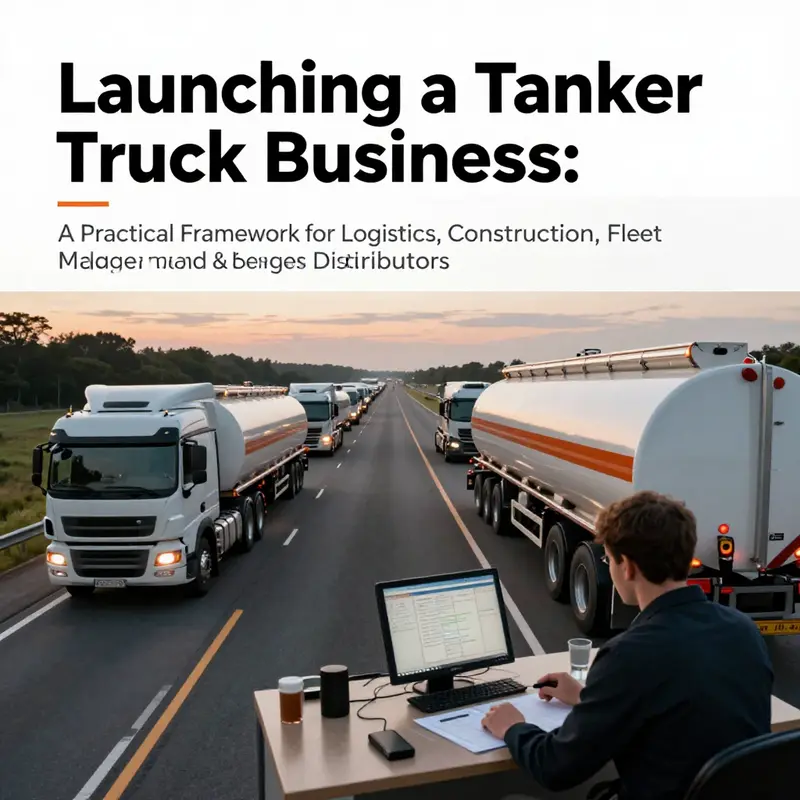
Launching a tanker truck business presents a strategic opportunity for logistics providers, construction firms, and distributors that depend on reliable liquid transport. The sector combines high regulatory requirements with demanding safety standards, but with disciplined market research, rigorous compliance, and disciplined operations, a new entrant can secure steady workloads and predictable revenue. This guide aligns three essential pillars with the needs of target customers: Logistics & Freight Companies seeking dependable bulk movement; Construction & Engineering Firms requiring hazardous and non-hazardous liquids for sites; Fleet Management Groups aiming to optimize asset utilization and service levels; and Food & Beverage Distributors needing sanitary, traceable transport. The three chapters that follow build a practical path from market segmentation and vehicle selection, through licensing and permits, to safety, technology, and growth strategies. Chapter 1 identifies market niches, routes, and equipment profiles that match client expectations. Chapter 2 codifies the regulatory framework, licensing, and insurance constructs that reduce risk and ensure continuity. Chapter 3 integrates safety culture, telematics, maintenance discipline, and scalable operations to support long-term expansion. Together, these sections provide a cohesive blueprint to turn a capital investment into a reliable, compliant, and profitable tanker trucking operation.
From Market Signals to the Right Rig: A cohesive path to niche, clients, and appropriate tanker equipment
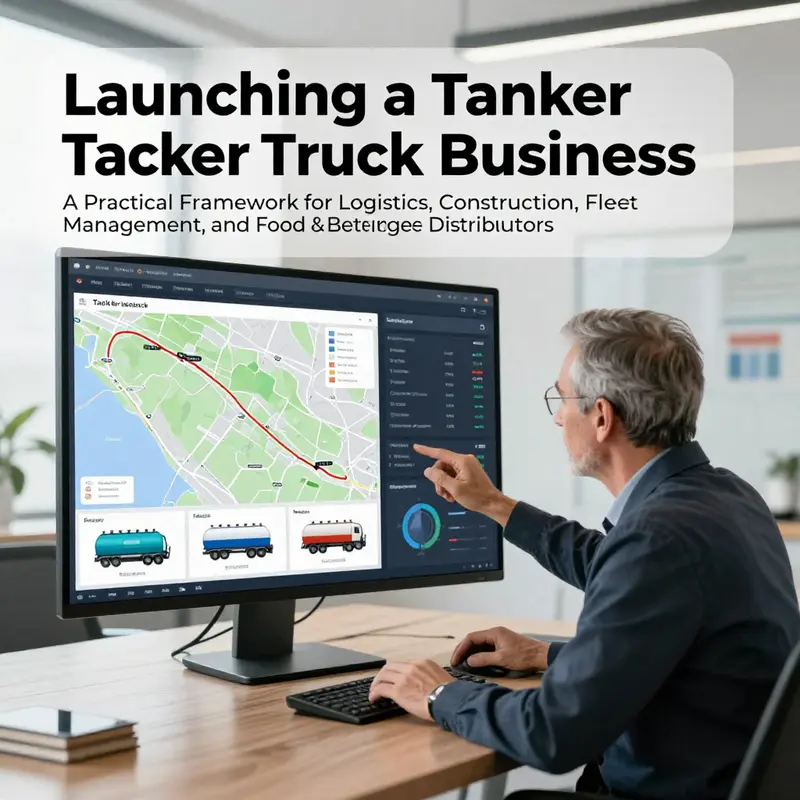
Launching a tanker truck business requires market intelligence, disciplined targeting, and a vehicle strategy aligned with real demand. The journey begins with market signals: where liquids move, which industries are active, and how regional infrastructure affects growth. The aim is to find durable demand and a service that others do not easily replicate. This is not only about choosing a cargo; it is about identifying a niche that fits your strengths, capital, and regulatory reality, then turning that niche into a dependable, compliant operation on the road. The early decisions ripple through every step, from tank choice to pricing and the standards you set for fleet and people.
Market research in this space hinges on understanding liquid streams and the regulations and logistics that govern each. Fuel distribution, chemical transport, and food grade liquids each have different service appetites, risks, and reliability needs. In regions with strong industrial clusters or agricultural output, demand patterns emerge that hinge on service continuity rather than price alone. Fuel customers value punctuality, regulatory compliance, and resilience to refinery outages. Chemical haulers seek robust containment, corrosion resistance, and safety records. Food grade transport adds sanitation and traceability requirements. Translate these sector cues into concrete service propositions: bulk fuel delivery with quality guarantees; chemical hauling with strict containment; or food grade transport with validated sanitation.
A practical way to map market activity is to overlay regional momentum with liquid categories. Use public reports on industrial activity, energy development, and agricultural output to spot geographies with higher tanker demand. Public data from agencies helps identify clusters where manufacturers need reliable outbound shipments or large farms require regular dairy or edible oil deliveries. The goal is to forecast your capacity to serve them consistently and safely, hour after hour.
Within this landscape you will often find a few natural niches with clearer profitability. A biodiesel pickup, a specialty chemical haul, or a regional food grade network can be more scalable and defensible than chasing broad demand. The value of a niche is threefold: it narrows the regulatory and safety requirements you must master; it sharpens marketing and business development by enabling clear value statements; and it guides fleet strategy by aligning tank materials and dimensions with cargo needs.
This clarity feeds directly into vehicle selection. Your fleet should reflect the cargo and routes you will serve. The choice between a simple nonhazardous system and a more complex regulated operation is strategic and financial. A straight fuel tanker must meet labeling and fire safety prerequisites and may require grounding equipment. If you plan to carry chemicals, stainless steel or compatible linings help resist corrosion and prevent cross contamination. For food grade liquids, choose materials approved for contact with consumables and implement sanitation protocols that support traceability. The operating environment also matters: remote or harsh terrain may favor rugged units, while high mileage highway routes favor fuel efficiency and uptime. The right balance of capacity and efficiency depends on cargo profile and geography.
Vehicle selection is an ongoing process that blends capital, maintenance expectations, and risk tolerance. Consider payload capacity and fuel efficiency as twin goals. Larger payload boosts revenue per trip but can raise maintenance costs. Telematics, GPS tracking, and data analytics provide the visibility customers demand and support compliant operations. When you pair a niche service with a well matched vehicle, you create a flywheel: better service drives repeat business and justifies smarter capital investments.
Sourcing is critical as well. Work with reputable suppliers for equipment and ensure trucks meet endurance and support needs. If cross border operations are on the horizon, build a fleet plan that adapts to differing regulatory demands. A modular or custom tanker can adjust to different cargos without sacrificing safety or efficiency. Rely on industry networks and experienced fleet managers to translate specifications into real world performance and to balance upfront cost, reliability, maintenance, and future flexibility.
The regulatory dimension cannot be overstated. Core licenses and permits—CDLs with HazMat and Tanker endorsements, FMCSA registration, DOT compliance, HazMat permits—shape hiring, safety training, and day to day operations. Insurance coverage is a practical barrier to entry and risk management: you need liability, cargo, and physical damage protection and strong safety practices to secure favorable terms. Your operating procedures should be documented and auditable, with driver training, pre trip inspections, maintenance logs, and incident reporting systems designed to deliver real value: less downtime, fewer penalties, and higher trust with customers.
With market signals and a clear niche aligned, build a simple, credible service proposition focused on reliability and safety, then on efficiency and price. Treat customers as partners who rely on you to safeguard products and deliver on time. Outline a lean go to market plan, a scalable fleet strategy, and a disciplined financial model that can withstand market cycles and regulatory shifts. Start with a focused pilot region or cargo and scale from there with measured expansion.
As you chart this path, align market demand, regulatory requirements, and vehicle capabilities. If data points to a region with strong agriculture, consider a food grade or biodiesel niche and a modular tanker that can adapt to different cargos. If data highlights clusters with limited transport options, a chemical niche may be the better bet, provided you can assemble the necessary containment, safety training, and insurance. The more precise your demand forecast, the more precise your fleet and operating plan can be, and the more confident you will be in early decisions that set the foundation for growth.
Ultimately, starting a tanker truck business is about disciplined execution. Listen to the market, talk to shippers, visit depots, and review regional indicators. Translate that listening into a concrete service offering supported by a well matched vehicle strategy, a solid safety program, and robust operating discipline. If you can lock in a reliable customer base, a fleet aligned to cargo, and a safety program that earns trust, you can weather market fluctuations and regulatory shifts with steadiness. The industry is growing, and growth is earned through market insight, niche focus, disciplined fleet selection, and a relentless commitment to safety and reliability. By starting with market signals, narrowing to a niche, and aligning fleet and processes to that focus, you set a course for a tanker business that can thrive now and into the future.
For readers considering cross border operations or longer term strategic questions, consider broader industry dynamics that influence decisions across borders. See resources on cross border trucking for context on regulatory environments and trade flows that shape opportunity and risk across regions. External references can be found at regulatory agencies and safety administrations that provide ongoing guidance for commercial motor vehicle operations.
null
null
Raising the Bar: A Purposeful Path to Safety, Technology, and Growth in a Tanker Truck Startup
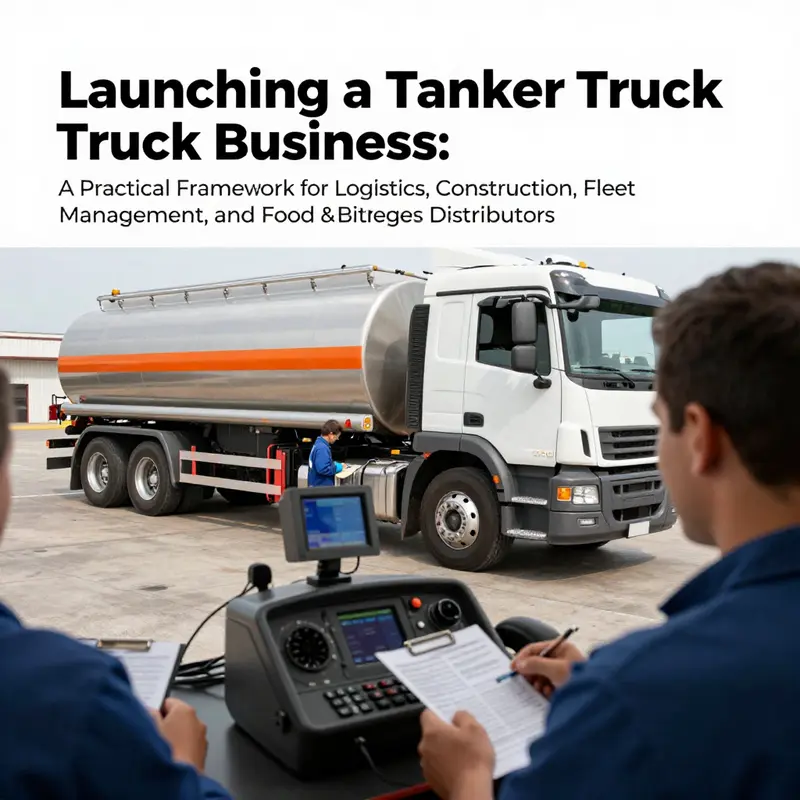
Launching a tanker truck business is not merely buying a truck and chasing crackling demand. It is a disciplined journey that blends safety discipline, technological leverage, and operational rigor into a sustainable growth engine. The tanker segment sits at the crossroads of essential supply chains and high-risk transport. Its success rests on three intertwined pillars: a culture and system of safety that earns the trust of customers and insurers; a technology-enabled operating model that converts planned routes into predictable, cost-efficient deliveries; and a growth strategy that scales capability without diluting reliability. When these elements align, a new entrant can compete not just on price, but on consistency, accountability, and the ability to handle complex loads in demanding conditions.
Safety is the foundation that underwrites every contract and every mile. In practice, it means building processes that extend well beyond compliance checklists and into daily habits. This starts with people. Driver training must be more than a one-off certification; it should be a recurrent, hands-on discipline that covers hazardous materials handling, pressure monitoring, spill response, and emergency procedures. Industry data suggests that compliant operations produce accident rates dramatically lower than the sector average, a metric that matters to shippers who depend on predictable service and to insurance carriers who price risk. For a startup, establishing a safety-first culture early reduces long-run costs and strengthens market credibility. The practical payoff is measurable: fewer incidents, steadier delivery schedules, and lower premium exposure over time. In tandem, vehicle compliance cannot be treated as a once-a-year inspection. Tankers must carry the right safety systems, such as grounding for fuel loads and robust leak detection capabilities. Regular inspections by certified bodies should be scheduled and logged with a cadence that anticipates wear and aging rather than reacting to failures. When a fleet operates with this cadence, the risk profile shifts in a way that makes it easier to win contracts with refineries, distribution hubs, and municipalities.
A crucial objective is to align licensing, permits, and certification with the realities of daily operation. In many regions the core requirements include a commercial driver’s license with the appropriate endorsements, registration with the national safety authority, and hazmat clearance for dangerous goods, if applicable. Layered atop these are environmental permits, facility approvals, and insurance tailored to liquid transportation. The cost of compliance is real, but the payoff is equally tangible: contracts with major buyers that insist on verifiable regulatory posture and incident-free performance. From the outset, a startup should treat regulatory compliance as an ongoing governance practice rather than a quarterly audit. The Road Transport Operating Permit and Hazardous Goods Transport Qualification, for example, are more than paperwork. They signal operational maturity and open doors to favored suppliers and large fleets that demand reliability in their supply chains. A proactive approach to permits also reduces the friction of renewal timelines and helps prevent costly operational standstills.
Technology acts as the force multiplier that turns safety and compliance into durable efficiency. The modern tanker operation relies on a suite of digital tools that deliver real-time visibility, better utilization, and tighter control over risks. At the core is smart fleet management: GPS tracking and telematics allow you to monitor location, speed, braking, and idle time across the entire fleet. The benefits extend beyond routing. Real-time data supports dynamic planning, enabling supervisors to reallocate capacity when a shipment slips or a client accelerates a delivery. In combination with geofencing and driver behavior analytics, this technology reduces fuel waste and wear on equipment, while improving on-time performance. In practical terms, many operators see fuel consumption drop by eight to twelve percent through optimized routing and reduced idle periods. The same data foundations underpin predictive maintenance. Onboard diagnostics enable preventive work before a breakdown, extending engine life and reducing unscheduled downtime. A disciplined maintenance log ensures that every part with a wear profile is tracked, and replacements occur on a schedule that minimizes risk to the cargo and to the crew.
Documentation and compliance have a digital dimension as well. Cloud-based permit management, driver certifications, and delivery records create an auditable trail that speeds onboarding, strengthens safety nets, and simplifies inspections. For a new entrant, the ability to demonstrate a transparent, trackable compliance history can be a decisive differentiator when courting large clients or negotiating rate structures. The right digital stack also supports data-driven decisions about routes, loads, and customer mix. Analytics can reveal patterns in demand across shifts and seasons, guiding investment in equipment types, maintenance windows, and staffing. Along with this, modern tanker operations benefit from automation in loading and unloading procedures, as well as standardized safety checks, so human errors are minimized even in high-pressure environments. All of these capabilities, when integrated, yield a safer operation that consistently meets or exceeds service levels while keeping operating costs in line.
Operational efficiency and profitability hinge on a disciplined daily rhythm. Beginning with market positioning, a tanker startup can gain traction by focusing on short-haul, high-demand lanes that align with the initial fleet capability. For example, a mid-sized 40-cubic-meter tank may comfortably perform two to three trips per day in a busy regional corridor, delivering cargo such as cement, food-grade liquids, or fuel blends. The revenue logic in this scenario can be compelling: if a single trip yields between eight hundred and twelve hundred dollars, multiple daily trips translate into meaningful monthly totals per vehicle, even before scale effects. More importantly, this approach keeps fuel and maintenance costs in a manageable range and allows room for the deployment of telematics and route optimization tools. When a startup combines this operational rhythm with a transparent pricing model and reliable service level commitments, it creates a steady cash flow that eases the path to profitability.
Fuel costs typically represent a substantial portion of operating expenses, often in the range of a third of the total. Smart routing and traffic-aware navigation help reduce unnecessary mileage and congestion exposure. In practice, even modest improvements in route accuracy can yield meaningful savings over a month, increasing the net margin per load. The emphasis on efficiencies should extend to asset utilization. Idle assets, if managed poorly, become sunk costs. A savvy operator explores flexible strategies such as leasing or short-term partnerships to balance capacity with demand, especially in peak construction or industrial seasons. This approach prevents the fleet from becoming an anchor during downturns while still preserving the ability to scale when market conditions improve.
A crucial lever for profitability lies in customer relationship management. Tanker operators work with a diverse set of clients, including refineries, distributors, industrial plants, and municipal facilities. Within this ecosystem, core customers—those delivering substantial monthly volumes—tend to contribute the lion’s share of revenue. A practical aim is to identify and cultivate clients who transport hundreds of tons monthly; these relationships deserve dedicated service levels, predictable pricing, and reliability that justifies long-term contracts. In this context, the value of a strong CRM cannot be overstated. It serves not only as a revenue stabilizer but also a platform for expanding services beyond pure transport. For instance, adding loading or unloading support, or offering bonded storage options, can raise the average revenue per client while deepening the customer’s dependence on your capabilities. In the broader scheme, a thoughtful growth plan recognizes when to deepen a relationship with a few key players versus when to pursue broader market exposure.
Growth in the tanker space often takes the form of both expansion and diversification. A prudent path is to layer value-added services onto core hauling capabilities. Storage, loading assistance, and bundled transport-and-storage packages can lift average customer value by a meaningful margin. Branding—consistent curbside appearance, an identifiable fleet, and a credible online presence—helps establish trust in a crowded market and supports premium pricing. Market expansion, while essential, should be pursued with an eye toward sustaining certification across new cargo classes such as food-grade liquids or chemicals. This approach opens access to higher-margin markets and longer-term contracts. For a new entrant, growth often benefits from partnerships or franchise-like arrangements that bring brand recognition, standardized training, and guaranteed supply chains. Industry data from larger networks indicate that partners with established branding and training programs exhibit higher first-year survival rates than independent operators, a reminder that growth should be anchored in systemic reliability rather than rapid scale alone.
All of these threads—safety, technology, operations, and growth—must be stitched into a coherent plan that holds through the inevitable market fluctuations. The best practitioners view this not as a fixed plan but as a living system that adapts to cargo mix, regulatory changes, and client needs. The business is strongest when it operates with a clear risk-adjusted model: the safer and more compliant the operation, the more efficiently it can deploy its assets, and the more capacity it can devote to revenue-generating activities. A practical way to manage this is to treat compliance and safety as ongoing governance, and to treat technology as an operating workflow. This makes it possible to translate regulatory requirements into concrete, repeatable routines that drive reliability and reduce waste. If a founder can achieve alignment among culture, process, and technology, the company gains not merely a competitive edge, but a durable competitive moat that helps weather regulatory shifts and shifts in demand.
In sum, starting a tanker truck business that endures requires a deliberate blend of safety discipline, technology-enabled control, and strategic growth that respects the cargo and the crew. It is a craft of balancing risk and reward—of turning stringent safety standards into dependable service, and of using data-driven logistics to convert a fleet into a living system that grows with the market. The chapters that follow will build on this foundation by detailing how to structure the business, procure and equip vehicles responsibly without overreaching capital, and shape market entry that aligns with the realities described here. Along the way, the practical checks—training hours, licensing pipelines, insurance design, and fleet optimization—will remain the compass that guides decisions and keeps the enterprise resilient. As you consider the path ahead, reflect on the human dimension of trucking: the drivers who carry critical loads, the technicians who keep the wheels turning, and the customers who rely on timely, safe deliveries. Investing in people yields returns that no single piece of equipment can deliver alone. For a deeper perspective on building teams and capabilities in trucking fleets, explore the discussion around investing in people as a strategic asset: Investing in people: a new path for trucking fleets.
For those seeking external regulatory context and formal guidelines, reference authoritative resources such as the National Public Service Platform. These guidelines provide comprehensive detail on transport safety norms, licensing prerequisites, and inspection regimes that shape every practical decision in tanker operations. Relevant guidelines can be consulted here: https://www.gov.cn/zhengce/.
Final thoughts
A successful tanker truck venture rests on three integrated pillars. First, precise market research and niche selection ensure demand aligns with the chosen vehicle types and service scope, particularly when serving Logistics & Freight Companies, Construction & Engineering firms, Fleet Management, and Food & Beverage Distributors. Second, robust licensing, permits, and regulatory compliance create a foundation of reliability and risk mitigation, enabling long-term customer trust and insurer confidence. Third, a disciplined focus on safety, technology, and operations converts regulatory readiness into competitive advantage: telematics-driven routing, proactive maintenance, driver training, and scalable processes that support growth into new geographies and service lines. By following these stages in sequence and maintaining a strong emphasis on client needs, a tanker truck business can achieve sustained profitability and resilience against market fluctuations.