
Singapore’s vibrant urban environment and dense commercial activity create compelling opportunities for food trucks. For logistics, freight, construction, fleet management, and food and beverage distributors, a mobile culinary operation can complement core services—enhancing brand reach, diversifying revenue streams, and supporting on-site teams. Yet the path to a compliant, scalable food truck hinges on disciplined planning: securing the right licenses, choosing a structure that aligns with risk and growth, designing a truck that meets health and safety standards, and selecting approved operating locations that fit a corporate logistics calendar. This guide distills regulatory requirements and practical considerations into a four-chapter framework designed for organizations that manage fleets, operators, or multiple sites across Singapore. Each chapter builds on the previous one, tying regulatory adherence to operational efficiency, cost control, and brand consistency. By following these steps, logistics and construction firms, fleet managers, and F&B distributors can launch a food truck program that integrates with existing workforce and site operations while delivering a reliable, compliant customer experience.
Licenses as Launchpads: Navigating Singapore’s Permits to Start a Food Truck
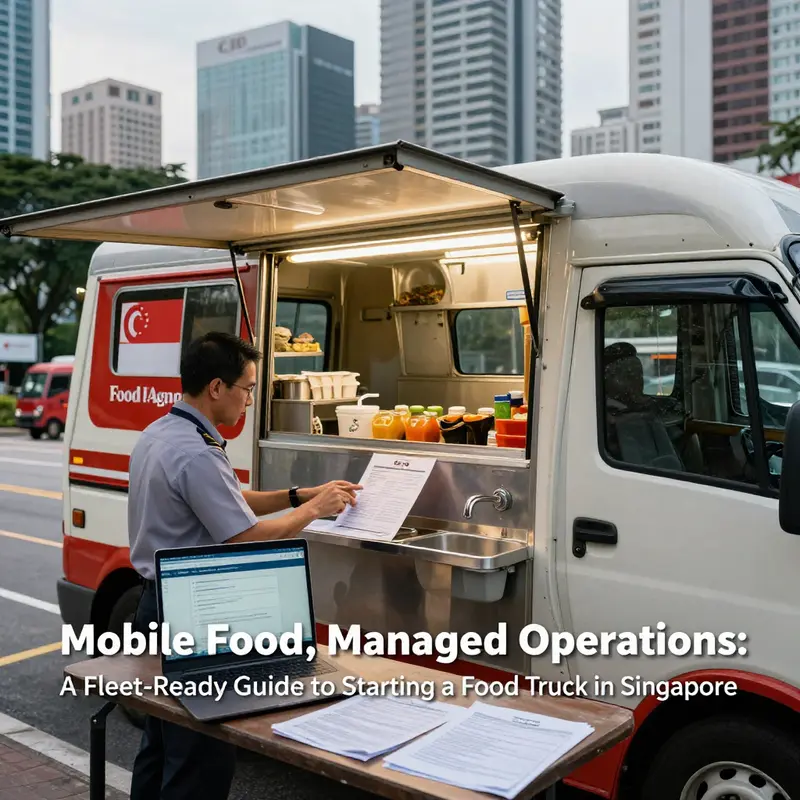
Launching a food truck in Singapore is as much a regulatory journey as a culinary one. The dream of rolling up to a morning crowd or a late-evening festival with a sizzling lunch or vibrant supper can be quickened by a solid plan, but the plan must begin with the gatekeepers who safeguard public health, traffic order, and fair competition. In practical terms, the path to a legally operating mobile kitchen runs through licenses and permits that come from two core agencies—the Singapore Food Agency (SFA) and the National Environment Agency (NEA)—plus ancillary registrations that keep your business clean, compliant, and resilient. The overarching framework sits under the Environmental Public Health Act, a law designed to ensure that food sold directly to consumers is prepared under hygienic conditions, handled properly, and transported in ways that do not compromise safety. Understanding how these pieces fit together is not merely a compliance exercise; it is the foundation of your brand’s credibility and your capacity to scale over time. When you begin to map your route, you are not chasing a checklist so much as shaping a system that will support every customer you serve, every location you visit, and every traffic lane you navigate with your mobile kitchen.
At the heart of the journey are two agencies that rarely operate in isolation. The SFA handles the food itself—its safety standards, ingredient compliance, and the processes that ensure anything you serve is prepared with consistently safe practices. The NEA, by contrast, governs the spaces where you operate, the hygiene and safety norms for mobile vendors, and the permissions required to set up in public or semi-public venues. This division of labor matters because it clarifies where your attention should focus first. If you intend to sell directly to consumers, the central move is to obtain a Food Shop Licence from the SFA to demonstrate that your mobile kitchen meets the hygiene and operational requirements that Singaporeans expect from any place handling food. This license is more than a credential; it is a pledge that your equipment, your workflows, and your staff exhibit traceable sanitation standards and reliable food handling practices. The application is completed through the SFA’s online portal, and the process includes submitting details about your truck’s design, its food handling plan, and the controls you will deploy to prevent contamination, cross-contact, and unsafe temperature abuses.
Yet a Food Shop Licence does not automatically authorize you to operate anywhere and anytime. In fact, much of the day-to-day reality of running a food truck in Singapore involves negotiating where you can park, how long you can stay, and what kind of operations you may embark upon in public spaces. This is where the MFV Permit—sometimes referred to as the mobile hawker permit—enters the picture. The MFV is issued by the NEA and covers the use of designated public areas for mobile vendors, including popular precincts like parks, markets, and event spaces. The distinction between a standard food shop licence and an MFV permit is important: the former confirms your kitchen’s safety and culinary compliance, while the latter confirms that you are allowed to operate in specific locations under the authority of local rules. If your business model includes bouncing between different positions—say, a weekend market, a park on weekdays, and a festival on a holiday—your plan must map the MFV requirements for each location and the timing for approvals. The process typically requires vehicle design plans, a clear statement of menu items, and an articulation of how you will maintain hygienic operations in a mobile setting. In practice, many operators begin with a fixed location arrangement that allows for a stable MFV footprint while gradually expanding to additional sites as they prove their reliability and compliance.
Beyond licensing and location permissions, Singapore’s regulatory framework invites you to think about the corporate form you will adopt. The choice between a sole proprietorship, a partnership, or a private limited company has practical consequences for liability, taxation, and reporting burdens. A private limited company offers the strongest liability protection and often aligns with growth strategies—especially if you plan to scale from a single truck to a small fleet or to bring in investors. A sole proprietorship can be simpler to start, but it places all personal liability on you and can complicate financing or expansion later. Whatever structure you choose, you will need to register with the Accounting and Corporate Regulatory Authority (ACRA). This registration is not a mere formality; it signals to lenders, landlords, suppliers, and potential partners that you intend to operate with a recognized legal entity. The decision touches on how you manage risk, how you allocate profits, and how you handle compliance across multiple vehicles and menus. In short, the corporate choice should align with your long-term plan as much as with your current appetite for administrative work.
With licensing and business structure aligned, the next practical chapter concerns the truck itself. A food truck in Singapore is a moving kitchen, and as such, it must be designed and equipped to meet health and safety standards that are strict in their expectations and comprehensive in their scope. The vehicle must be properly licensed and roadworthy, and it must house cooking facilities that can withstand daily use in Singapore’s climate. Essential elements include refrigeration capable of maintaining safe temperatures for perishable ingredients, adequate cooking equipment matched to your menu, efficient waste disposal solutions, and reliable handwashing amenities. Fire safety provisions are not optional; they are part of the essential risk controls that inspectors evaluate during checks. The design should also consider practical realities: a layout that minimizes cross-contamination, a workflow that reduces time out of the cold chain, and a footprint that feels approachable to customers while leaving space for staff to operate safely and comfortably. Branding is not an afterthought here. Your truck’s exterior—its colors, its signage, and the way you present your menu—forms a critical part of customer perception. A cohesive design signals professionalism and can help justify your location choices to officials who assess your readiness for a given site. The balance between aesthetics and functionality matters because your equipment and layout will influence how easily you pass inspections, how quickly you can clean up after service, and how reliably you can sustain a high standard on busy days.
The regulatory path also runs through the clarity of the locations you plan to serve. NEA’s designated areas define where a mobile vendor can set up and how long you can stay. These zones are curated to minimize traffic disruption and to ensure a fair distribution of mobile food options across neighborhoods and events. The practical challenge is to align your business model with these zones: does your concept thrive in parks with seasonal footfall, or do you prefer the energy of malls and shopping centers, where prior approvals can open doors to high foot traffic? Each site comes with its own set of requirements, including possibly temporary occupancy licenses or time-limited permissions for specific events. Understanding the landscape and cultivating good relationships with community centers or event organizers can help smooth the way through approvals, especially for locations that see high demand or that require special arrangements such as waste management, power supply, or water access.
A crucial, ongoing thread in this narrative is health and safety compliance. Every food handler on your truck should undergo recognized food safety training. The SFA’s foundational courses, such as Safe Food Handling, establish the baseline knowledge your team must carry, including proper temperature control, personal hygiene, and cleaning protocols. Inspections by the SFA do occur regularly, and they can be unannounced, which means you must maintain clean practices and rigorous record-keeping as part of your daily routine. Recordkeeping spans many areas: supplier traceability, ingredient provenance, temperature logs for cold storage, and a documented cleaning schedule. The aim is not merely to pass a one-time inspection but to embed a culture of safety that traverses every shift, every menu change, and every new supplier. This disciplined approach to hygiene not only reduces risk but also strengthens your brand’s trust with customers who may be testing a new concept for the first time.
Marketing a food truck in this regulatory environment demands a clear, authentic voice about what you offer and how you offer it. In Singapore, success increasingly hinges on how well you leverage digital touchpoints to tell your story. A strong online presence helps you communicate your hours, location changes, and menu updates to your following, while your on-site service should reinforce the same narrative through consistent quality, quick service, and a memorable guest experience. While this is a modern reality, the core remains the same as it has always been: people crave good food served with reliability. Your menu design should reflect not only what you cook best but also what you can sustain under the operational constraints of a mobile kitchen. Simplicity can be a virtue here; a focused core menu often translates into a faster service cycle, tighter inventory management, and fewer variables that might threaten safety or consistency. As you grow, you may experiment with rotating items that align with seasonal ingredients or local taste preferences, but any expansion should be mapped to your compliance framework so that new dishes do not outpace your control measures.
A robust launch plan also calls for a prudent understanding of the licensing cadence. Licenses and permits are not one-off hurdles; they require ongoing management. Food Shop Licences and MFV permits must be renewed, and each renewal is an opportunity to review your operations against evolving standards and local guidelines. This ongoing discipline is less about bureaucratic fatigue and more about keeping your operation resilient against the inevitable changes that come with growth—whether that means shifting your menu in response to supplier performance, relocating for seasonal demand, or integrating a second vehicle with a parallel licensing footprint. The practical skill here is to build systems that track expiration dates, schedule renewal activities well in advance, and preserve the documentation inspectors rely upon to verify you remain in good standing. You will also want to stay attuned to any policy updates from SFA or NEA, because amendments to hygiene standards, permitted locations, or permit conditions can alter how you plan for a new check, how you charter your route through a festival, or how you collaborate with host venues.
In the end, starting a food truck in Singapore is about transforming a culinary concept into a regulated, trusted, and scalable service. The licenses and permits are not obstacles to creativity; they are the scaffolding that helps your business grow with confidence. As you prepare to apply, a practical mindset helps: gather the right design schematics for your truck, prepare a clear food safety plan, outline the locations where you intend to operate, decide on a business structure that aligns with your risk tolerance and growth ambitions, and assemble your team around a simple, repeatable service model. With these elements in place, you can move from a heartful concept to a legally compliant, reliable mobile kitchen capable of serving a steady stream of customers who know that what they get is safe, clean, and delicious. The licensing journey is thus not a hurdle to overcome but a framework that empowers you to deliver great food on wheels with integrity and consistency. It is the quiet backbone of a business that hopes to become a beloved part of Singapore’s vibrant street-food ecosystem, where every plate tells a story of careful preparation, careful partnership with regulators, and careful attention to the experiences of the people who choose you for lunch, dinner, or a celebratory bite at an event. For anyone who wants to move from concept to curbside, the message is clear: respect the rules, prepare meticulously, and allow your passion for food to flourish within a system designed to keep everyone safe and satisfied. This is how a food truck can become a lasting, legitimate, and beloved part of Singapore’s bustling food scene.
For authoritative guidance and the latest requirements, consult official sources as you plan your journey. The Singapore Food Agency’s Food Shop Licence outlines the essential steps to certify your mobile kitchen, while the National Environment Agency’s mobile hawker resources detail the permitting process for operating in designated public spaces. As the regulatory landscape evolves, your readiness to adapt—without compromising safety or service quality—will determine how effectively you convert your vision into a thriving, compliant business on the streets of Singapore.
External resource: For official licensing guidelines and current requirements, see the NEA’s Mobile Hawkers page at https://www.nea.gov.sg/our-services/food-safety-and-hygiene/mobile-hawkers
Building the Framework on Wheels: Choosing the Right Business Structure for a Singapore Food Truck
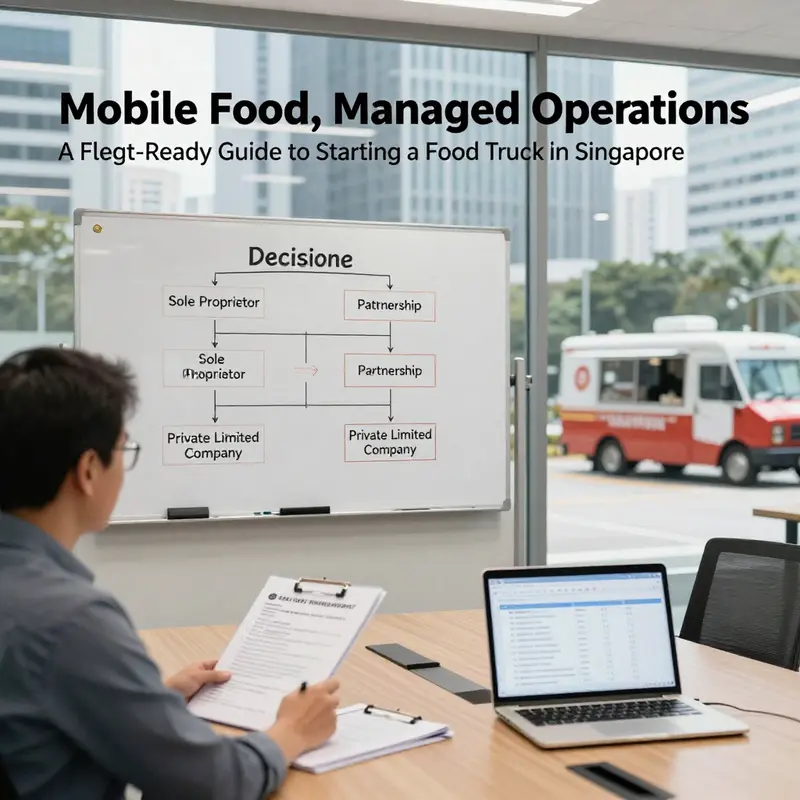
When you picture a food truck cruising through Singapore’s vibrant streets, you’re imagining a moving business with a precise structure. The skeleton of that dream is your business form. It determines liability, taxation, risk, and growth. In Singapore, regulatory clarity and a supportive startup ecosystem make choosing a structure a strategic decision, not a box-ticking exercise. The right form can unlock partnerships, capital, and scalable operations, while a misaligned choice can slow or constrain your ambitions. For mobile food ventures, three pathways commonly surface: private limited company, sole proprietorship, and limited partnership. Each has different implications for liability, governance, fundraising, and regulatory compliance with agencies such as SFA and NEA. As you map your options, imagine your truck not just as a kitchen on wheels but as a legal entity that will carry your brand, your recipes, and your future. First, the Private Limited Company (Pte Ltd) is often the most robust structure for growth. It creates a separate legal entity, offering limited liability to shareholders and a framework for formal governance, financing, and multi-unit expansion. You’ll typically appoint directors, a corporate secretary, and maintain statutory records; you’ll also need to comply with annual filings via ACRA. A Pte Ltd is advantageous if you expect to raise capital, bring on partners, or operate several fleets. However, it also brings higher administrative costs and regulatory expectations. In Singapore there is a resident director requirement: at least one director must ordinarily reside in Singapore. This helps anchor governance and accountability to local expertise. Sole proprietorships offer simplicity and speed. They suit first-time operators testing a concept or running a single truck with lean overhead. The upside is minimal setup and straightforward taxes; the downside is unlimited personal liability and limited capacity to attract formal investment or scale. If your plan is to validate a concept with low friction and you are comfortable bearing personal risk for early growth, a sole proprietorship can be a pragmatic proving ground. As you scale and consider multiple trucks or bringing partners in, you will likely outgrow this structure and look toward incorporation or a more formal governance framework. Limited partnerships are less common for mobile food businesses. An LP requires at least two partners: a general partner who bears unlimited liability and one or more limited partners who contribute capital but do not manage the business. LPs do not create a separate legal personality in the same way a company does, which can complicate branding, asset protection, and lending relationships. Unless there is a clear strategic or tax-driven reason to pursue a partnership approach, LPs tend to be less attractive for most operators who want a straightforward growth path. Across these options, the choice hinges on risk tolerance, growth ambition, and access to capital. If you expect to run multiple trucks, a central kitchen, or partner with investors, a Private Limited Company is often the best foundation. If your initial plan prioritizes speed and low overhead, with an eye toward incorporation later, a Sole Proprietorship can work as a stepping stone. If there is a compelling strategic reason to structure as a partnership, consult a professional to evaluate governance, liability, and tax implications. No matter which structure you choose, the regulatory reality is that licensing and compliance do not magically align with form alone. The Food Shop Licence, MFV permits, and related requirements hinge on clear accountability, documented food safety practices, and robust record-keeping. When you couple a well-chosen structure with disciplined governance, safety, and operational controls, you position your business to meet inspections, access favorable terms with suppliers, and pursue scalable growth. Frame your decision around a few practical questions: Do you anticipate bringing in partners or investors in the near term? Will you need to scale beyond a single truck? Are you prepared to invest in governance and reporting that supports long-term resilience? Answering these questions honestly will guide you toward a structure that fits your growth plan. To operationalize your choice, map your five-year horizon to the structure that best supports it. If you foresee two or more trucks or a central kitchen, start with a Private Limited Company and plan for governance that scales. If the aim is to validate a concept quickly and then formalize later, begin with a Sole Proprietorship and reserve the option to convert. If you want a formal investment-friendly framework with a clear separation between management and ownership, a Limited Partnership could be considered, but only after careful professional advice. Ultimately, the right structure is a strategic lever, not a constraint. It should align liability protection, capital strategy, regulatory compliance, and long-term resilience with Singapore’s dynamic food scene. Use it to clarify roles, set up governance, and streamline compliance, so you can focus on the food, the service, and the customer experience. For readers seeking broader context, you can explore regulatory discussions related to mobile operations and scalability, and combine this with a practical Singapore-focused business-startup overview to anchor your plan.
Rolling to Compliance: Designing, Equipping, and Securing Your Singapore Food Truck
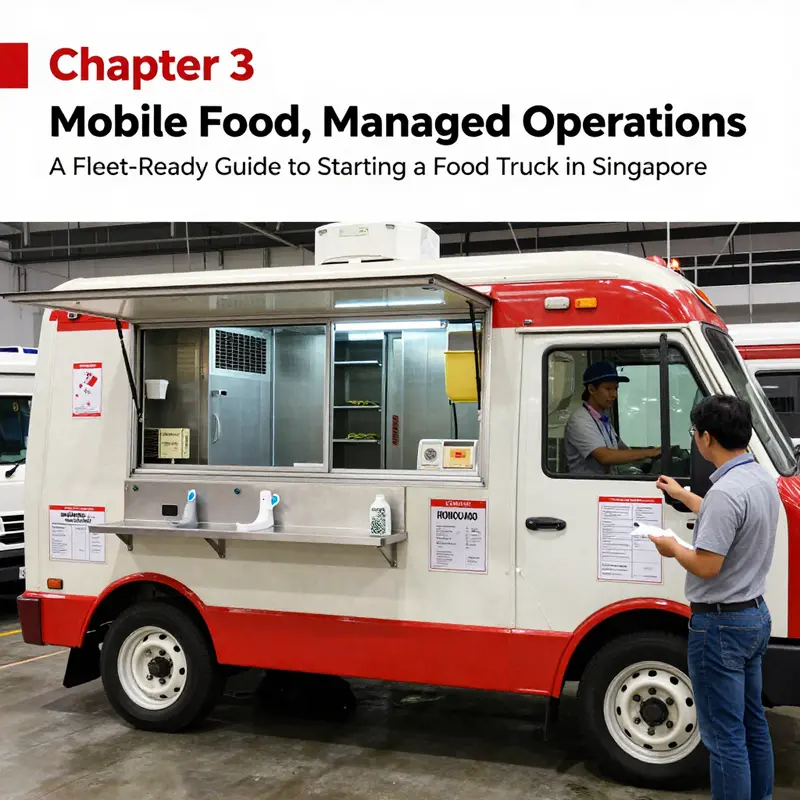
In Singapore, a food truck is more than a mobile kitchen; it is a carefully engineered space that must meet the same standards as a brick‑and‑mortar operation, while adapting to the realities of street service. The design choices you make at the planning table ripple through every stage of your venture—from branding and customer perception to safety, cleanliness, and the all‑important licenses that keep you legally on the road. When you approach design with regulatory alignment in mind, you create a compact theater of service that feels seamless to customers and solid to regulators. This chapter threads together the aesthetics of concept and the pragmatics of compliance, showing how to shape a truck that not only delivers great food but also endures inspections, audits, and scrutiny from multiple agencies without friction. It is a narrative of integration: how your menus, your vehicle, your kitchen, and your daily practices harmonize to form a compliant, compelling business on wheels.
Begin with the concept and branding, because they determine much of the truck’s physical and operational layout. A clear concept frames the menu, the target audience, and the customer experience. It also informs the exterior and interior design decisions. In Singapore, the appearance of a food truck matters as much as the food itself. Your branding must be visually appealing, legible from a distance, and compliant with street‑level visibility requirements. Think about how lighting, signage, and color palette contribute to brand recognition without compromising safety. The vehicle’s exterior should invite customers while respecting safety rules for commercial vehicles. Signage must be clear, legible, and positioned so it does not obscure vital equipment, fire safety devices, or windows used for observation by inspectors.
A crucial bridge between concept and execution is regulatory alignment. From the earliest sketches, you should coordinate with the authorities that govern vehicle classification, registration, and the regulatory appearance of a mobile food establishment. In practice this means understanding how your truck will be classified by road and vehicle authorities and what design features are permissible within those classifications. Visibility requirements, lighting, and exterior modifications have to be evaluated for roadworthiness. A well‑designed truck respects these boundaries, reducing the likelihood of delays during licensing or after the truck is on the road. This is not simply about aesthetics; it is about building a foundation that supports smooth approvals and ongoing compliance.
Turning to the heart of the mobile business—the kitchen. A food truck must be a compact but fully functional kitchen designed to withstand the rigors of daily operation. Kitchen design should prioritize a logical workflow: ingredients stored near prep areas, cooking zones adjacent to ventilation, and waste streams isolated from clean zones to prevent contamination. Commercial‑grade appliances are non‑negotiable in a mobile setting. Grills, fryers, refrigeration units, sinks, prep counters, and storage must be integrated with sufficient clearances for cleaning, maintenance, and safe operation. Ventilation is not a luxury but a safety imperative. Adequate exhaust, dampers, and fire suppression systems reduce the risk of grease fires and ensure comfortable working conditions for staff, especially in hot climates or when operating in enclosed spaces. Any gas or electrical installations should be performed by qualified professionals, with systems installed and certified to regulatory standards. The Singapore Civil Defence Force (SCDF) guidelines provide the framework for safe gas and electrical work in mobile kitchens, and complying with these guidelines is essential to avoid fire hazards and future unplanned downtime.
Waste management sits alongside the cooking line as a core hygiene discipline. A well‑designed truck includes grease traps, appropriate waste storage, and a plan for disposal that aligns with environmental health expectations. The layout should ensure cleaning supplies and waste containers are segregated from food contact surfaces, with a defined cleaning schedule that prevents cross‑contamination and ensures traceability. Regular maintenance logs for equipment, as well as waste disposal records, contribute to a credible compliance posture. In this sense, the truck becomes a living system where hygiene practices are built into the daily routine rather than treated as a separate burden.
Health and safety compliance threads through every practice, from ingredient sourcing to person‑in‑charge training. Food handlers require appropriate training and credentials, typically culminating in a valid Food Handler’s Certificate. The broader food safety framework emphasizes temperature control, cross‑contamination prevention, and sanitary handling of all ingredients. Regular inspections by the food safety authority are common, and preparedness is a continuous discipline. Establishing standard operating procedures for receiving deliveries, storage, thawing, cooking, and hot and cold holding helps ensure that food safety is not an afterthought but a core operating principle.
Licensing and permits are the formal gatekeepers that validate your ability to operate legally. In Singapore, you generally begin with the Temporary Food Establishment (TFE) license for temporary or mobile operations. Depending on how and where you operate, you may also need an MFV permit from the National Environment Agency (NEA) for specific public spaces, or a TOL for fixed locations. The business entity itself—whether a sole proprietorship, partnership, or company—will require registration with ACRA. This stage is not merely paperwork; it clarifies liability, taxation, and reporting interfaces for ongoing compliance. Each step has its own timelines and documentary requirements, so mapping the sequence early helps prevent last‑minute bottlenecks. As you pursue licenses, you should also anticipate inspections. The SFA may review your Food Shop Licence as a hygiene‑and‑safety benchmark, while the NEA and SCDF may scrutinize waste management plans and fire safety arrangements, respectively. A proactive approach—collecting certificates, calibrations, and maintenance logs—reduces friction and speeds through the process.
Operational resilience rests on a disciplined approach to compliance. A practical mindset is to treat compliance as a living calendar rather than a one‑time event. Create a monthly rhythm of checks: renewals, equipment servicing, staff certifications, and updated food safety training. The penalties for non‑compliance can be severe, ranging from fines to suspension of operations or even closure. The risk is not only regulatory but also reputational; a mobile kitchen that repeatedly fails to meet hygiene expectations damages customer trust and vendor relationships, and can limit future location approvals. Documentation is the backbone of accountability. Maintain readily accessible records of licenses, inspections, sourcing and supplier qualifications, temperature logs, cleaning schedules, and staff training certificates. When regulators request information, you should be able to present a clear trail showing that safety, hygiene, and environmental standards are being upheld every day.
The practical arc of turning a concept into a compliant, running truck begins well before the first wheel turns. Start with the branding and layout and carry that thread through the kitchen design, equipment procurement, and staff training. The design should reflect your concept while leaving room for regulatory adjustments as you scale. Buy equipment that can handle the demands of a busy service window and be prepared to upgrade ventilation, gas lines, electrical connections, and fire suppression as necessary. Build a waste management framework into your operations from day one, with explicit responsibilities assigned to team members and a transparent disposal chain. Practice food safety in every step of your process, from supplier selection to the final plate. And finally, align your licensing plan with a realistic timetable, recognizing that approvals often hinge on the quality and consistency of your compliance record. If you approach licensing with a problem‑solving mindset rather than a hurdle, you will move from concept to street service with fewer delays and more confidence.
To anchor these ideas in the daily reality of launching a Singapore food truck, imagine a typical week when you are preparing to go live. You begin with the branding mockups and a layout that matches your kitchen flow. You bring in commercial equipment with professional installation, ensuring gas, electrical, and ventilation lines are certified and tested. You design a waste stream that minimizes odor and housekeeping demands, and you train staff on hygienic handling and temperature control. You assemble the required documentation—certifications, maintenance logs, supplier attestations—and file the TFE application while preparing supplementary permits if your operating plan requires them. You schedule a pre‑opening inspection with the relevant authorities and use the interim period to refine SOPs and calibrate cooking times to local preferences and climate. When the truck finally hits the street, the first week becomes a live trial of your systems:Are you maintaining temperatures across shifts? Are your cleaning routines robust enough to prevent cross‑contamination? Are your staff following procedures consistently? By answering these questions day by day, you convert a regulatory checklist into a dependable operational rhythm that supports a growing brand.
Every design choice should be judged against the twin pillars of customer experience and regulatory feasibility. A well‑designed truck that feels inviting but is also easy to inspect is more likely to earn location approvals and to win repeat customers. The goal is not merely to pass inspections but to create a consistent, high‑quality service that conforms to hygiene, safety, and environmental guidelines without imposing unnecessary burdens on your team. The regulatory landscape can seem daunting, but when you weave compliance into the fabric of your design—through layout, equipment, training, and recordkeeping—you create a vehicle that is as reliable as it is appealing. In a competitive market, reliability and safety are differentiators as powerful as the flavor of your dishes.
The path to launching a Singapore food truck is a journey from concept to kitchen to compliance. It is a journey that rewards meticulous planning and disciplined execution. As you navigate the approvals, you are building not just a vehicle but a credible enterprise that regulators can trust, customers will remember, and partners will want to support. With every design decision, you define a brand that promises consistency, safety, and delight—values that travel as surely as the wheels beneath your truck. And as you operate, you will find that the same habits that keep you compliant also keep you efficient, profitable, and ready to scale. The regulations exist not to stifle creativity but to ensure the highest standards of food safety and public health in a mobile, dynamic environment. Your task is to honor that mandate with thoughtful design, careful installation, and rigorous discipline in daily practice.
For readers seeking official guidance on the licensing framework and to confirm current requirements, consult the Singapore Food Agency’s Food Shop Licence guidelines, which detail the hygiene and safety standards for mobile food operations. The broader ecosystem—vehicle registration, fire safety, and environmental hygiene—unfolds through the relevant agencies, each with its own processes and timelines. While the specifics may shift with updates, the core principles remain stable: a well‑designed truck that integrates safety, sanitation, and customer experience is the start of a sustainable, compliant food‑on‑wheels business in Singapore. As you progress, keep the line of communication open with the authorities, document every step, and treat compliance as an ongoing practice rather than a one‑time milestone. That approach will extend the life of your concept, protect your investment, and help you deliver consistently excellent food in a mobile setting.
External resource: For official licensing guidelines and up‑to‑date requirements, see the Singapore Food Agency’s Food Shop Licence page, which provides detailed application steps, forms, and regulatory expectations. https://www.sfa.gov.sg/food-businesses/food-shop-licence
On the Road in Singapore: Securing Spots, Upholding Standards, and Winning Fans for Your Food Truck
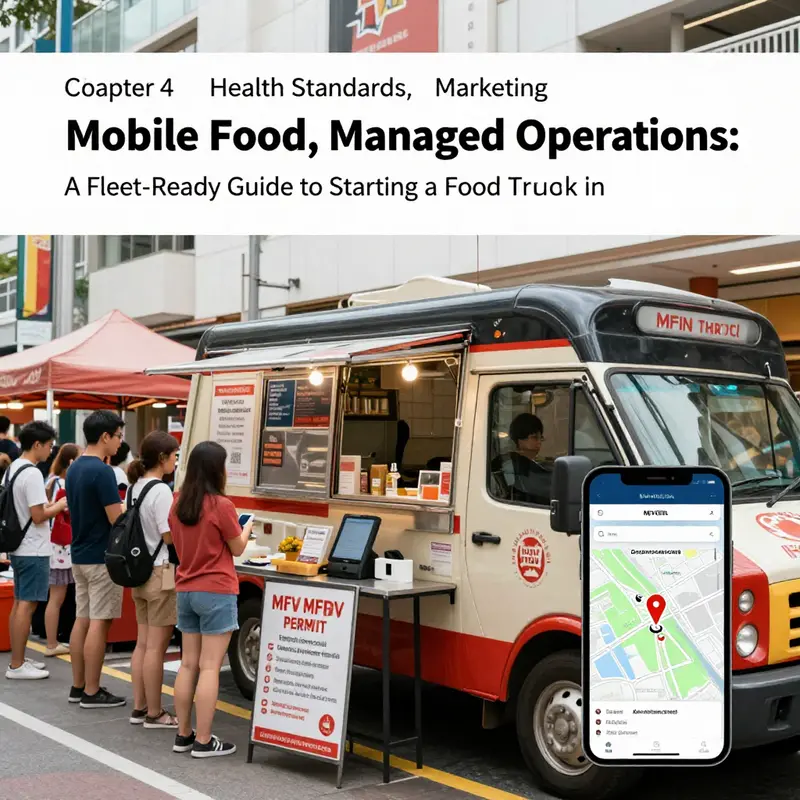
The journey to launch a food truck in Singapore begins long before a single plate hits a hungry table. It starts with a tough-eyed assessment of rules, a clear plan for where you will serve, and a marketing spark that turns curious passersby into returning customers. In this chapter, we move through three threads that shape every successful mobile eatery in Singapore: choosing locations with an eye on costs and crowd flow, maintaining health and safety standards without slowing creativity, and building a brand and a following that makes your truck a familiar, trusted fixture in the city’s bustling dining scene. The road you choose will be constrained by regulations, yet within those constraints lies room for discovery, experimentation, and steady growth. Your ability to navigate permits, design a compliant yet effective kitchen on wheels, and connect with customers will determine not just survival but the speed of your progress toward sustainable profitability.
Any aspiring operator should begin with the fundamental licenses that allow you to sell food directly to consumers. In Singapore, the Singapore Food Agency (SFA) is the cornerstone agency for hygiene and safety, and a Food Shop Licence through the SFA is the central requirement for any mobile vendor that serves food or beverages to the public. This licence acts as a baseline assurance that your truck, its kitchen, and your staff meet rigorous hygiene standards and operate within the law. The application is typically submitted through the SFA’s online portal, and the process is designed to ensure you have thought through critical controls—equipment adequacy, washing facilities, temperature management, and clean sourcing practices. In practical terms, the licence anchors your ability to exist in the street-food ecosystem, but it is not the only permit you may need. Depending on how and where you operate, additional permissions may be required: an MFV permit from the National Environment Agency (NEA) if you intend to operate in public spaces such as parks or markets; a Temporary Occupation Licence (TOL) if you are anchored at a specific site for a period; and a business licence from the Accounting and Corporate Regulatory Authority (ACRA) if you are structuring your venture as a company. These layers create a mosaic of compliance, yet they are navigable with a disciplined approach to planning, budgeting, and process design.
Beyond licensing, the decision about how to structure your business shapes risk, taxes, and day-to-day administration. You might begin as a sole proprietor or decide to form a partnership or private limited company. Each path carries different implications for liability and reporting. A private limited company, while more complex to set up, offers the shield of limited liability and is often more scalable as you add partners, expand locations, or bring in investors. If your aim is a single, highly themed vehicle that grows into a multi-truck operation, the private company route becomes increasingly attractive. Yet the tradeoffs—cost, compliance burden, and governance requirements—must be weighed against your growth strategy. A preliminary business plan that maps out your menu strategy, target locations, projected permits, and a financing plan helps you decide the most suitable structure and keeps you aligned as your venture matures.
As your concept takes shape, the vehicle itself becomes a central character in your story. The design of your food truck is not merely about aesthetics; it is about safety, efficiency, and customer experience. Singapore’s health and safety standards require that your mobile kitchen be equipped with proper cooking facilities, refrigeration, waste disposal systems, and handwashing stations. The vehicle must be roadworthy and licensed for operation, with a layout that supports safe food preparation and movement of staff during service. The branding should be integrated into the design to attract the eyes of pedestrians and to communicate your culinary story in seconds. Effective branding on a truck comes from a strong color palette, legible menus, and a layout that guides the eye from the menu to the pickup counter. It is also wise to design the interior for service flow: an efficient order-taking zone, separate handwashing and utensil areas, and a clear separation between raw and cooked foods to minimize cross-contamination. Every decision—gas lines, electrical supply, water storage, and waste management—must be documented and maintained. In practice, this means investing in high-quality insulated storage units, reliable refrigeration, and a handwashing station that meets public health expectations. If you invest here, you will see dividends in the form of fewer service disruptions, longer equipment life, and higher customer trust.
Locating the ideal servicing grounds is as crucial as the menu itself. In Singapore, the National Environment Agency (NEA) manages designated spaces for mobile vendors, and these spaces are the heartbeat of street-side entrepreneurship. Popular venues include public parks, malls and shopping centers with prior approvals, as well as events and festivals that draw crowds looking for something new. The reality, however, is more complex than simply choosing a place with high footfall. Permit fees can be substantial, and competition for prime spots is intense. Early preparation and flexibility are your best allies. Begin by identifying a few preferred zones—perhaps a park known for weekend gatherings, or a business district corridor where lunch traffic is predictable—then map the application steps for each site. Some sites require you to go through the NEA for an MFV permit, others may require coordination with town councils or property managers for mall or venue access. The process is iterative: scout the site, understand the permit landscape, time your visits for peak footfall, and adjust your schedules to align with event calendars and public-generated demand. In many cases, you will need to juggle multiple sites, each with its own cadence, which makes a well-structured calendar essential. It is wise to consider off-peak hours or less crowded zones as pilots to test demand and refine your operations without bearing the full weight of high-cost locations. The goal is to balance proximity to your target customers with sustainable operating costs, a balance that distinguishes a short-lived pop-up from a durable neighborhood staple.
The health and safety framework in Singapore is not a checklist to complete once; it is an ongoing discipline. The bedrock is a clean, well-run kitchen where every handler understands food safety principles. All food handlers should ideally have completed recognised training in food safety, and many operators pursue a credential such as the SFA’s Safe Food Handling course. Training is more than a box to tick; it is a foundation for trust with customers who want assurance that their meals are prepared with clean hands, clean equipment, and safe temperatures from kitchen to table. Regular inspections by SFA—often focusing on temperature control, cross-contamination controls, and the integrity of the supply chain—are part of the reality of operating in Singapore. A robust system for recording food sourcing, supplier certificates, batch numbers, and temperature logs not only keeps you compliant but also creates a traceable story of quality customers can rely on. You should also design your operations with easy-to-audit hygiene in mind: color-coded utensils and surfaces, clearly labeled storage zones, routine sanitisation schedules, and a documented cleaning routine that staff can follow even on the most hectic service days.
In the marketing realm, the first principle is clarity. A strong brand identity helps you stand out in a crowded market, where the city’s palate is as diverse as its skyline. Your truck’s name, its logo, and its menu should tell a story that resonates with a defined audience. Once branding is clear, leverage digital channels to share your story. Social media platforms become your storefront, your event calendar, and your real-time locator. Accountable, timely posts about where you will be serving, what you’ll be offering on a given day, and any special menu items can turn casual observers into regulars. The best campaigns blend mouthwatering visuals, behind-the-scenes glimpses of the cooking process, and authentic narratives about the people behind the business. You can further strengthen your reach by aligning with local events, festivals, and corporate catering opportunities that expand your exposure beyond daily foot traffic. A sound approach to payments is essential in Singapore’s increasingly cashless landscape. Offering digital payment options—whether mobile wallets, tap-to-pay cards, or QR-based payments—smooths the customer experience and reduces queue times, which in turn can increase the number of customers served during peak hours.
The day-to-day operation of a mobile kitchen in Singapore hinges on a well-coordinated supply chain and a disciplined operating rhythm. One practical discipline is to build a supplier network that provides consistent quality and reliable delivery windows. Fresh produce, proteins, and dry goods must be stored in ways that preserve safety and quality. This means investing in reliable cold-chain equipment, secure dry storage, and a waste management plan that complies with local environmental guidelines. You’ll also want to establish standard operating procedures for every task: receiving deliveries, checking temperatures, stock rotation, and end-of-day shutdown. Documentation, while sometimes viewed as bureaucratic, becomes a practical ally: it helps you forecast demand, manage inventory, and prepare for inspections without last-minute scrambles. The best operators bake in redundancies—backup suppliers, spare parts for essential equipment, and contingency plans for weather or crowd dynamics. In Singapore, where climate can be hot and humid, the reliability of your cooling systems and water supply is particularly critical. The simplest way to keep this steady is to design your workflow so that critical tasks are visible, repeatable, and easy to audit by a supervisor or a new staff member.
The emotional centerpiece of a successful food truck is the customer experience. A well-executed operation invites people to linger, which is unusual for a busy city street. It starts with the line of people greeted by a friendly team that knows the menu and can answer questions with confidence. A clearly presented menu reduces decision time and speeds service, while signage that communicates ingredients and potential allergens strengthens trust. The physical layout should invite movement rather than create bottlenecks. A welcoming pickup window, with a visible display of the food on the grill or in bowls, helps eager customers place their orders quickly and feel confident about the portions and quality. The menu itself becomes a narrative—one that tells guests who you are, what you believe in, and why your food is worth their time. The experience does not end at the last bite; it extends into follow-up engagement. Collecting feedback—whether through QR codes, brief surveys, or casual conversations—gives you real-time insight into what resonates and what to adjust next. Such feedback is the engine behind menu evolution, pricing adjustments, and service improvements that keep customers coming back.
Budgets and timeframes are never merely numbers on a sheet; they are the rhythm of your business. Permits and licenses carry costs that must be forecast in your initial budget and revised as you scale. The ongoing costs of maintaining a compliant operation—regular equipment servicing, health and safety training renewals, and licence renewals—should be aligned with projected sales and seasonal demand. When you design your financial plan, factor in the upfront investment in a robust kitchen setup, branding, a launch marketing push, and a provisional reserve to cover months of uncertain cash flow. The Singaporean market rewards planners who manage costs without sacrificing quality, who implement systems that scale with growth, and who commit to consistency of product and service. A chain of small wins—clean equipment, on-time deliveries, clear menus, happy customers who leave positive reviews—builds a momentum that can carry you through slower seasons or a crowded festival calendar.
The regulatory environment in Singapore is dynamic, with policy adjustments and new guidelines occasionally changing the operating landscape. To stay ahead, you should adopt a posture of continual compliance rather than periodic check-ins. Make it routine to review licensing requirements, permit renewals, and site approvals, and to stay connected with the agencies that authorize your operations. This proactive stance reduces the risk of sudden disruptions and keeps your attention on delivering a consistent guest experience. Your planning should always have a follow-up calendar: renewal dates, inspection windows, and major events you want to participate in. The best operators treat compliance not as a barrier but as a framework that protects customers and lends credibility to the brand. Integrating compliance with your marketing and operations creates a resilient business model that can weather regulatory changes and market shifts alike.
For operators who wish to explore deeper, practical guidance and official guidelines, the Singapore Food Agency’s licensing framework provides a solid foundation to build your strategy on. The official Food Shop Licence page outlines the steps, requirements, and documentation needed to secure the heart of your venture: the ability to feed Singaporeans and visitors with confidence and care. As you plan your path, keep in view the sequence that ensures you can legally operate from day one while you refine your concept, strengthen your brand, and grow a loyal following. In a city renowned for rapid pace and big ideas, the food truck format can thrive precisely because it blends mobility with intimate, curated experiences. It offers a platform to experiment with flavours, service models, and partnerships that large fixed-location venues often cannot easily accommodate. The magic happens when you combine a well-designed kitchen and a legitimate permit with a compelling brand story and an empathetic approach to customers. When these elements align, your Singaporean road tour becomes more than a business plan; it becomes a daily invitation for people to discover and celebrate food on the move.
As you prepare for launch, remember that the path is not a single destination but a continuous journey. Location planning, health and safety commitments, and strategic marketing are not discrete tasks; they are interwoven threads that, when managed thoughtfully, create a durable, adaptable venture. The next chapters will expand on turning this foundation into a scalable operation, including practical tools for menu design, vendor relationships, and technology-enabled guest engagement. If you are curious about the official licensing process and want to ensure that every step you take is aligned with Singapore’s standards, the official Food Shop Licence page remains the most authoritative reference. For ongoing guidance on official requirements and updates from the Singapore Food Agency, you can consult the licensing portal directly. For the latest guidelines, see the Singapore Food Agency’s Food Shop Licence page: https://www.sfa.gov.sg/food-businesses/food-shop-licence
Final thoughts
Launching a food truck in Singapore through a logistics- and fleet-oriented lens yields a structured pathway to compliance, efficiency, and growth. By first securing the necessary licenses, then selecting an appropriate business structure, followed by meticulous design and equipment of the truck, and finally aligning with approved operating locations and strategic marketing, organizations can minimize risk while maximizing utilization of their fleets and sites. This approach ensures that a food truck becomes a dependable extension of existing logistics or site networks—capable of delivering consistent quality, timely service, and measurable returns. As the regulatory landscape evolves, maintaining a proactive compliance posture and integrating with your core operations will be central to sustained success.