

Trucking operations sit at the intersection of complex regulatory frameworks, operational discipline, and strategic growth. For Logistics & Freight Companies, Construction & Engineering Firms, Fleet Management Companies, and Food & Beverage Distributors alike, the path from business idea to compliant, licensed, and operating trucking business is paved with red tape, mandatory licenses, safety standards, and tax considerations. A reliable business setup firm acts as a navigational partner, translating regulatory requirements into a practical launch plan and an efficient ongoing compliance program. The right partner does more than file forms; they bring industry-specific insight, end-to-end service capability, transparent pricing, a solid reputation, and local know-how that aligns with where you intend to operate. This guide presents a structured approach to evaluate and select a firm that can support your trucking venture from company formation through to Road Transport Operator’s License (RTOL) compliance and beyond. Each chapter distills a critical criterion, tying back to a cohesive strategy for your sector—whether you move goods for major logistics networks, support construction and engineering supply chains, manage fleets across diverse geographies, or distribute perishable products requiring stringent safety and licensing standards. By focusing on industry-specific expertise, comprehensive service offerings, pricing transparency, and local regulatory navigation, you can reduce risk, accelerate time-to-license, and free your leadership team to concentrate on growth, service quality, and customer satisfaction. The discussion below translates these criteria into practical evaluation steps, helping you identify a partner who understands the unique regulatory and operational realities of your industry and your jurisdiction. The four chapters that follow build a holistic picture: first, the depth of regulatory knowledge and sector experience; second, the breadth of services from formation to licensing and tax strategy; third, the clarity of pricing and risk management; and fourth, the firm’s local presence, reputation, and ability to navigate municipal and state requirements. The aim is clear—select a trusted adviser who can convert regulatory complexity into a smooth, efficient, and scalable trucking operation.
Choosing a Trucking Industry-Specific Business Setup Firm: Key Criteria for Startups
Starting a trucking business requires more than a company name. It demands a setup partner who understands freight regulations, licensing, and the pace of a carrier operation. The right firm translates complex federal, state, and local requirements into a practical game plan that fits your launch timeline. The single most important criterion is industry-specific expertise: a partner who speaks FMCSA, USDOT, MC numbers, hours-of-service, ELD mandates, insurance thresholds, and state permit processes. With this knowledge, they can help you select the right entity type, file the necessary registrations, and assemble a compliant pre-launch package that scales with growth.
Beyond formation, look for a comprehensive service approach: licensing and permits, tax registration and advisory, and cash-flow aware accounting guidance tailored to trucking. The firm should provide clear pricing, milestones, and a transparent timeline so you can predict when each license will arrive and when you can start operations. Ask for references or case studies from other trucking startups to gauge responsiveness, reliability, and the ability to handle urgent changes.
Local expertise matters as much as national know-how. Verification of regional permits, road-use taxes, and weight restrictions can save weeks of delay. Ensure the firm has a track record with clients in your target region and can discuss how they navigate local registrations and inspections. Finally, assess ongoing support: how they monitor regulatory changes, update documents, and prepare you for audits as you grow from a single vehicle to a small fleet.
Choosing the Right Partner: End-to-End Service as the Lever for Trucking Entrepreneurial Success
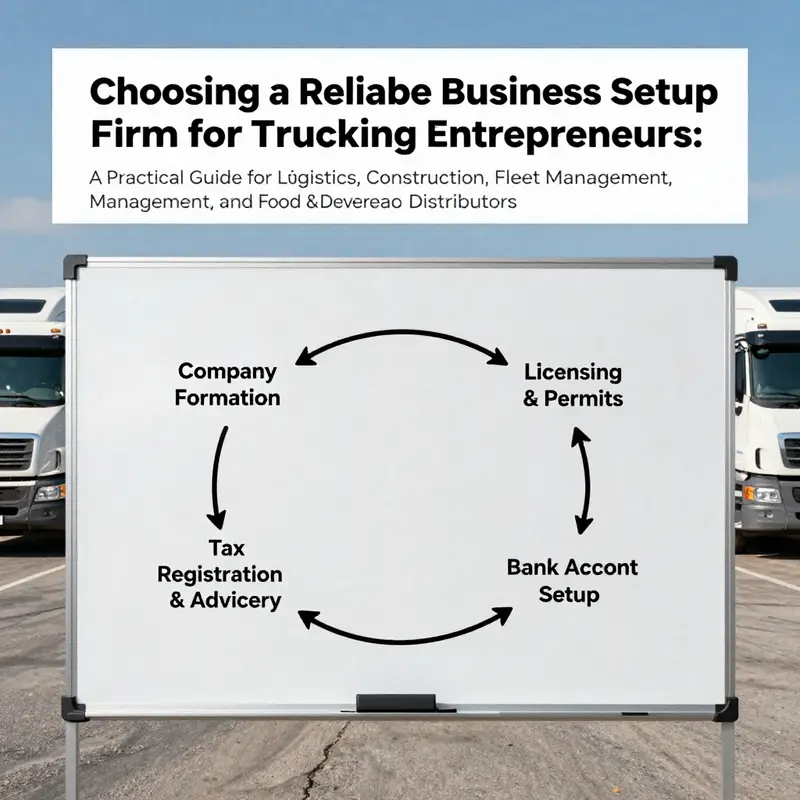
Choosing a business setup firm for a trucking venture is more than a filing choice; it is a strategic decision that can determine how smoothly a startup moves from a dusty spreadsheet to a fully licensed, compliant fleet on the road. The right partner does more than submit documents; they become a continuous enabler of compliance, efficiency, and growth. For a trucking entrepreneur, the aim is not to acquire a one-off service but to secure end-to-end support that covers the lifecycle of the business—from pre-launch planning through post-launch scaling. In practice, this means seeking a firm that translates regulatory complexity into a clear, actionable roadmap and then sticks with you as the road roughens, lanes narrow, or opportunities widen. A thoughtful selection process recognizes that the value of a firm lies not only in what they can file today but in how they partner with you to adapt tomorrow.
When evaluating potential firms, industry-specific expertise is the compass. A capable provider should bring a track record of working with transportation and logistics entities, understanding the unique compliance hurdles that trucking faces. This includes familiarity with Road Transport Licenses or their regional equivalents, knowledge of vehicle specifications, driver qualification standards, and the safety management frameworks that underpin lawful operation. It is about fluency in the paperwork that protects your operation and the practical know-how that prevents delays. A partner that speaks the language of RTOLs, operating authorities, and insurance certificates reduces guesswork and helps you sidestep costly missteps that can stall a budding fleet.
A credible firm must offer comprehensive service offerings that extend well beyond a single registration phase. The most valuable relationships are those that can guide you through company formation with the right entity type, assist in securing operating permits, and map out a licensing path that aligns with your fleet’s profile—whether you intend dry van, temperature-controlled transport, or specialized freight. They should help assemble the documentation that regulators require: vehicle technical records, driver qualification certificates, and a robust safety management system. This end-to-end perspective is essential because the process is not static; as you scale, your licensing and regulatory obligations will evolve, and your partner should evolve with you.
A key element of end-to-end support is transparent, upfront pricing. Your chosen firm should provide a clear quote that covers every stage of the journey—from initial name approval and entity formation to obtaining the final licenses and registrations. Hidden costs are the enemy of predictable budgeting, especially for a trucking startup where cash flow is often a critical constraint. The right firm will also help you weigh tax registration and advisory options, such as choosing the most practical tax framework for your situation, which can improve cash flow in the early stages. They should be able to walk you through the decision points that affect your bottom line, such as whether to pursue a simplified VAT regime or other regime choices that fit a lean startup model.
Equally important is the firm’s reputation and track record. In the logistics world, word travels quickly, and verified feedback from other transportation entrepreneurs provides a practical barometer for reliability, responsiveness, and outcomes. Look for a portfolio that demonstrates timely licensing, smooth onboarding of new entities, and a history of helping clients navigate regulatory inspections and audits with minimal disruption. A firm’s ability to deliver consistently—across documentation accuracy, speed, and post-licensing support—often signals a durable partnership rather than a one-off transaction. The presence of testimonials from peers in the trucking or logistics space can be a strong proxy for the level of service you should expect.
Local knowledge remains a decisive factor. Trucking operations are tethered to the regulatory atmosphere of the places where you plan to operate. Regions differ in municipal and state-level requirements, licensing nuances, and local compliance expectations. A firm with a robust local footprint or deep regional understanding can anticipate bureaucratic hurdles before they appear, helping you avoid last-minute stopgaps that stall operations. This local insight streamlines the path to the Road Transport License or equivalent, supports the alignment of fleet specifications with regional standards, and reduces the blind spots that can occur when guidance comes from distant or generalized advisors. The right partner treats local context not as an afterthought but as a defining feature of the service you receive.
Beyond compliance, the most forward-thinking firms position themselves as lifecycle partners. They do not simply shepherd you through the initial registration; they remain engaged as you scale. The end-to-end approach includes ongoing compliance management, regulatory filings, and strategic guidance as your operations expand. Pre-launch planning should translate into practical market positioning: route planning exercises, market analysis for viable lanes, and an honest assessment of demand and competition. The business model must be tuned to your strengths—whether you lean into standard freight, temperature-sensitive goods, or specialized freight capabilities. The goal is to establish baseline processes and performance targets that you can measure and improve upon once the wheels start turning.
As the operation moves from pre-launch to post-launch, technology and integration become the backbone of efficiency. A capable partner will integrate with fleet and dispatch systems, helping you adopt a basic yet scalable technology stack that aligns with your trajectory. Proficiency in fleet management software and dispatch workflows is not about flashy features; it is about eliminating administrative drag so drivers can focus on delivering loads safely and on time. A mature provider can outline an implementation pathway that includes driver onboarding templates, compliance monitoring dashboards, and reporting mechanisms that satisfy regulators as well as lenders and insurers. The long-term value is in continuous improvement: you grow, and your technology stack grows with you, without the need for disruptive vendor shifts.
Financing and capital considerations are another pillar of a solid end-to-end partner. A thoughtful firm recognizes that equipment financing or leasing often forms the backbone of a scalable fleet. Rather than pushing a one-size-fits-all financial package, the partner helps you compare options that fit your cash-flow profile and growth plan. They translate the capital requirements of a larger, more capable fleet into a staged path that matches your revenue trajectory. This might include guidance on securing lines of credit, evaluating lease-to-own arrangements for essential trucks and trailers, and aligning these decisions with forecasted utilization and maintenance costs. In short, the right partner makes capital planning a tactical exercise rather than a gamble, helping you avoid overextension while still pursuing aggressive growth.
The practical takeaway for trucking entrepreneurs is straightforward: seek end-to-end support that covers the entire lifecycle of your business. The value proposition rests on reducing complexity, mitigating risk, and enabling faster, more compliant, and more efficient operations. A capable firm is not merely a hired administrator; it is a strategic ally who translates regulatory fog into a clear action plan, who maintains the bridge between policy and practice, and who remains in your corner as the fleet grows. To maximize this partnership, you should look for three non-negotiables in your evaluation. First, demonstrate a proven industry-specific track record with a clear focus on transportation and logistics compliance, including licensing and safety program requirements. Second, offer a transparent, itemized pricing structure that leaves little room for surprise charges. Third, provide ongoing, scalable support that extends from pre-launch market positioning through post-launch growth enablement.
A partner who also emphasizes people-centered approaches can be especially powerful. Trucking growth is as much about people as it is about paperwork. A firm that prioritizes driver onboarding, training, and retention aligns with long-standing best practices in building resilient operations. This focus on people resonates with the broader industry shift toward sustainable workforce development and operational reliability. For instance, consider firms that promote leadership in human capital—investing in training, safety culture, and clear career pathways for drivers and support staff. These elements, while not always glamorous, create a durable foundation for compliance and performance on the road. To connect a practical example to this perspective, you can explore resources that discuss people-first strategies in trucking, which echo many of these same principles in a real-world context. people-first strategies in trucking.
In your final decision, place weight on the quality of the pre-launch planning and how the firm translates that planning into a tangible post-launch execution framework. Ask for a sample roadmap that shows the sequence of milestones from entity formation and licensing to safety program implementation and fleet readiness. Request a demonstration of how they monitor regulatory changes in your operating region and how they alert you to upcoming compliance requirements. A credible partner will provide not only a plan but a governance approach: who handles what, how progress is tracked, and how you can verify that each milestone has been achieved before moving to the next phase. This governance mindset matters because trucking operations live and breathe in cycles—renewals, inspections, insurance renewals, maintenance windows, and regulatory updates all demand timely, coordinated action. When a firm can demonstrate this disciplined approach, it signals a sustainable, scalable partnership rather than a transactional engagement.
Finally, as you compare proposals, keep your focus on clarity and alignment rather than price alone. A low quote that omits critical steps or hides costs can create more risk than it saves. Conversely, a higher but transparent, well-structured proposal that maps to your growth plan can be worth the investment. The right firm will welcome questions and provide direct, understandable answers that help you see how each service category supports your end goals. They will also facilitate connections to broader industry resources—networks, advisory communities, and educational materials—that extend beyond paperwork and into practical growth strategies. The aim is not merely to secure a license; it is to lay the groundwork for a compliant, efficient, and scalable trucking business that can weather regulatory changes and market shifts with confidence.
For those seeking a reference point on how to approach launching and scaling a trucking operation, consider consulting authoritative guidance on trucking-company formation and growth. External resources provide broader context and standard practices that can complement the tailored guidance from your chosen firm. External resource: https://www.trucking.com/starting-a-trucking-company
Clear Credentials, Clear Path: Selecting a Trucking Startup Setup Partner with Transparency, Price Clarity, and Risk Management
Choosing a business setup partner is more than selecting a vendor. For trucking entrepreneurs, the right firm acts as a regulatory navigator, a financial architect, and a steady risk partner. The decision shapes everything from the pace of your launch to the moment you first meet roadside compliance. A firm that demonstrates transparency, pricing clarity, and proactive risk management helps you turn a potentially overwhelming process into a structured, predictable journey. When you couple industry-specific know-how with clear communication about every step, you gain more than a smooth registration; you gain a dependable ally who keeps you aligned with changing rules and market realities. This mindset—transparent processes, unambiguous costs, and forward-looking safeguards—undergirds sustainable growth in a sector where penalties, delays, and missteps can ripple into cash-flow problems. As you evaluate candidates for this pivotal role, let transparency be your baseline, let pricing be your gauge of fairness, and let risk management be your assurance that growth won’t outpace compliance.
Transparency sits at the core of trust. In practice, it means demand for visible, verifiable credentials and a clearly documented workflow. A capable firm can provide proof of essential licenses and registrations that authorize trucking operations in your jurisdiction. In the United States, this includes, at minimum, regulatory authorities that govern interstate transportation, such as valid operating authority, USDOT registration, and any state or federal licenses appropriate to your model of operation. Across other markets, equivalent licensing regimes apply. The crucial part is not the acronym but the auditable trail. Ask for copies of licenses, certificates, and the exact scope of what the firm can and will handle on your behalf. Then, verify those numbers through the regulator’s official portals. In the U.S., the SAFER system and the USDOT Unified Registration System provide reliable cross-checks for a carrier’s authority and registration status. A firm that cannot or will not provide these verifications should raise a red flag. In your dialogue, frame transparency as a testable standard: can the firm supply current, verifiable licenses, and a documented process map that you can inspect before you commit contractually?
A robust service agreement is your roadmap. Rather than accepting a generic brochure, insist on a detailed contract that specifies exactly what will be done, who does it, and when it happens. A well-structured agreement lays out every service stage—from name approval and entity formation to the filing of regulatory applications and post-setup support. It should define milestones, deliverables, and what constitutes completion. Importantly, it must spell out responsibilities for you and for the firm. Will you provide documents, or will the firm file on your behalf? Are there dependencies on third-party providers, such as insurers or bonding agents, and who coordinates those relationships? A transparent contract reduces friction and sets expectations upfront, so there are fewer disputes later on. Industry research consistently shows that when a setup partner presents a clear service breakdown, startups experience fewer compliance delays in their first year. The lesson here is practical: you should be able to map your progress from day one to license issuance and know precisely where you stand at each checkpoint.
Pricing clarity follows transparency. Ambiguity in fees is a frequent source of stress for new trucking ventures. A trustworthy firm offers a comprehensive, itemized quote with no hidden add-ons. Look for fixed-fee packages that cover the core bundle—such as MC number or operating authority applications, USDOT registration, basic insurance placement, and any essential bonding support—plus a reasonable period of ongoing compliance alerts after setup. A concrete example might be a fixed-fee package around the low thousands, inclusive of multiple filings and a limited window of post-setup guidance. The important point is not the price alone but the predictability of the cost. Watch for phrases like “starting at” or vague caveats that a fee may apply for “state variations” or “document reviews.” Real-world industry observations in 2026 point to a troubling pattern: a significant share of startups faced budget overruns when engaging low-cost providers whose licenses or qualifications were not properly licensed themselves. Your goal is to shield your cash flow by insisting on a quote that leaves little room for surprise, and by securing a written statement that outlines every conceivable added cost before any work begins.
Beyond the numbers, risk management is the practical backbone of a firm’s value. The best setup firms do more than file paperwork; they function as proactive risk managers who help you build a resilient operating posture. Start by confirming the firm’s approach to insurance and bonding. Trucking fleets typically require a minimum level of liability and cargo coverage to operate legally and to meet customer expectations. The firm should guide you toward reliable insurance channels and help you secure quotes that meet regulatory and contractual requirements, including the possibility of a surety bond if your operating model calls for it. Then assess the firm’s ongoing compliance tools. Do they offer a monthly or quarterly compliance checklist? Do they provide readiness assessments for electronic logging devices (ELD) and other regulatory technologies? Will they alert you to renewals for USDOT numbers, MC numbers, and insurance well before deadlines? A thoughtful firm treats renewals not as administrative chores but as strategic triggers that help you plan cash flow and maintenance cycles, avoiding lapses that could halt operations.
A practical approach to risk also means acknowledging regional realities. Local knowledge matters because regulations at the municipal or state level can shape your licensing and operating requirements in ways that differ from national standards. A firm with a strong local footprint or deep regional experience can translate high-level compliance concepts into concrete steps tailored to your area. They understand which permits are essential, which inspections are routine, and how local agencies tend to interpret safety and driver qualifications. This specificity reduces friction and accelerates your path to a compliant fleet on the road. It also makes ongoing support more valuable, because the partner can anticipate regulatory shifts that impact your operation and prepare you in advance rather than reacting after a violation occurs.
The decision-making process should also account for the broader ecosystem of trusted partners. A firm that can connect you with vetted service providers—whether for insurance, bonding, or regulatory consulting—adds a layer of reliability that goes beyond a single transaction. This ecosystem approach is particularly important for trucking startups that intend to scale quickly and diversify their service offerings. In practice, such firms coordinate a network of professionals who understand trucking trust, the language of risk, and the cadence of regulatory changes. They don’t just stamp approvals; they help you build a governance structure that makes growth sustainable.
What does a truly reliable firm look like in action? It begins with a specialization in trucking and freight logistics startups. It is evidenced by client testimonials or case studies that show successful MC number acquisitions, timely license issuances, and demonstrated adherence to post-setup compliance. It includes clear, ongoing support that lasts beyond the initial registration. The more you see evidence of a partner’s continued engagement after setup—regular updates, compliance reminders, and access to expert advice—the more confident you can feel about your long-term trajectory. When you align with such a partner, you acquire more than a service; you gain a boundary-spanning ally who helps you navigate premium customer expectations, fluctuating regulatory landscapes, and the daily realities of operating a trucking business.
To ground your search in practical reality, consider industry-wide resources that validate and curate reputable providers. Real-time validation of business setup partners is available through established industry directories that maintain vetted listings and performance indicators. This kind of resource helps you compare candidates on the basis of measurable outcomes rather than marketing claims. For a broader industry perspective on regulatory and operational realities that shape how setup firms can support you, you can explore discussions on cross-border challenges and regulatory insights from trusted industry forums and associations.
As you evaluate potential partners, bring these questions to the table in a structured dialogue. Is there a transparent, documented process for every filing, with clear ownership of each step? Does the firm offer a fixed-fee package with no hidden charges, or will you face unexpected costs during later stages? Do they provide ongoing risk-management tools and proactive regulatory monitoring, not just one-time filings? And how intensely do they tailor their guidance to the specific regulatory environment you will operate in? The most successful trucking startups treat this choice not as a one-off decision but as a strategic relationship that aligns with long-term planning, debt management, and growth milestones.
For readers seeking a broader industry lens beyond the specifics of your agreement, a good starting point is a practical, up-to-date resource that highlights real-world considerations for trucking startups facing cross-border and interstate challenges. This resource synthesizes insights from regulators, industry practitioners, and fleet managers to illuminate best practices in regulatory alignment and partner selection. If you want to read further, you can explore the topic here: Navigating cross-border challenges—key insights from the TCA annual meeting. Navigating cross-border challenges—key insights from the TCA annual meeting.
In sum, choosing a trucking-focused setup partner with transparency, pricing clarity, and robust risk management isn’t about finding the cheapest service. It’s about securing a dependable, informed collaborator who can translate complex regulatory requirements into a clean, actionable plan and keep you out of trouble as your operations grow. Transparency gives you trust; pricing clarity protects your budget; risk management safeguards your license to operate. Together, these pillars help you launch—and then scale—a trucking business that delivers on promises to customers, employees, and regulators alike. For trucking entrepreneurs who want to minimize roadblocks and maximize uptime, this approach offers a clear, practical blueprint for a smooth start and a resilient future.
External resource: https://www.safersystems.org/
Local Knowledge, Reputation, and Regulatory Navigation Reimagined: A Practical Guide for Trucking Entrepreneurs Choosing a Setup Firm
Choosing a business setup firm is not about securing a quick license; it is about building a trusted partnership that can weather the regulatory maze that trucking entrepreneurs face from day one. In any jurisdiction with a robust road freight sector, the path to legal operation begins with entity formation, proceeds to licensing, and then hinges on compliance infrastructure that must adapt as the business scales. A firm that specializes in transportation and logistics offers more than a filing checklist. It translates policy nuance into practical steps, turning daunting rules into a workable roadmap. For trucking ventures, this matters twice: first, for obtaining essential licenses such as the Road Transport License, and second, for instituting governance mechanisms that keep the fleet compliant while the enterprise grows. When you’re selecting a partner, you’re choosing how smoothly you’ll move from registration to revenue. The right firm does not merely file papers; it helps shape the operational backbone—vehicle records, driver qualification standards, safety programs, and tax structures—so you can focus on moving cargo rather than wrestling with forms.
The heart of this decision lies in a blend of local intelligence and professional credibility. A firm with industry-specific expertise can interpret how regulations are implemented on the ground, how inspections are conducted, and how licensing timeliness can swing on a single staffer’s capacity. This is particularly true for trucking because the regulatory ecosystem is not static. Rules evolve with safety data, environmental concerns, and shifts in labor policy. A partner who stays ahead of these changes, who can anticipate delays or upgrades in the licensing process, becomes not just a service provider but a guardrail for market entry.
Beyond competence, the right firm demonstrates a clear, transparent approach to pricing and scope. It should offer end-to-end support—from choosing the most suitable legal structure to filing name approvals, from securing the RTOL to setting up a compliant tax posture and a dedicated business banking arrangement. In practice, this reduces the risk of misclassifications, missed document requirements, or cash flow headaches caused by overlapping fees. When the price is explicit and the service stages are mapped, the entrepreneur gains confidence to invest in operations rather than chasing bureaucratic surprises.
Yet numbers and process maps tell only part of the story. The most critical factor is how well a firm understands the local ecosystem where you intend to operate. This goes beyond generic regulatory knowledge. It encompasses culture, relationships, and the informal channels that often decide how quickly things move. In trucking, where time is literally money, knowing the right person to call for a permit amendment or for guidance on a municipal requirement can shave days or weeks from a project timeline. The best firms maintain a living network of relationships with regulators, insurers, and senior officers within transport ministries or equivalent agencies. They are not just back-office processors; they are navigators who translate policy into executable steps and who can explain, in plain language, why a particular document is needed and how to prepare it correctly the first time.
A chapter of this guide previously explored the practical steps involved in registering a trucking company. Yet without a partner that can translate complexity into executable action, those steps remain theoretical. Local knowledge becomes a form of capital—one that is grown through relationships, trust, and repeated interactions. This is where the research on knowledge governance becomes highly relevant. In the context of establishing a business in the UAE, for example, successful trucking ventures often rely on a hybrid form of knowledge governance. They combine coordinated transactions, constructed professional interactions, and quasi-hierarchies that enable them to integrate external insights with internal capabilities. In simple terms, a startup can access tacit knowledge—such as which permits are processed quickly, or which government officials are more receptive to certain types of applications—through networks. This tacit layer—soft information embedded in human relationships—often explains why two firms following identical regulatory checklists end up with very different timelines.
That insight is not just academically interesting; it translates into practical due diligence questions. When evaluating a firm, you should ask for examples of how they have helped other trucking operators move through the licensing maze within your target region. Ask about their most frequent choke points and how they mitigated them. Look for references from other transport and logistics business owners who can speak to the firm’s responsiveness, professionalism, and success rate. A credible firm will gladly share client stories that demonstrate their capacity to maneuver around bureaucratic bottlenecks and to tailor solutions to a company’s specific operational model.
In evaluating local knowledge, it is also reasonable to inquire about the governance mechanisms the firm employs to absorb external information and repackage it for clients. Does the firm cultivate coordinated processes across its team—where one expert handles entity formation, another governs licensing, and a third oversees tax strategy—while maintaining a single point of contact for the client? Or does it rely on a more fluid, consultative approach with frequent cross-functional collaboration? The answer will reveal how well the firm can scale with a growing trucking operation. In the end, the question is not only about who can file the forms but who can foresee changes in the regulatory climate and adjust the plan with you, not merely for you.
The value of a locally embedded partner becomes even more evident when you consider the social dynamics that influence business decisions. In many markets, personal ties and face-to-face conversations form the backbone of trust. This is where the concept of wasta—regionally understood as networking and influence—plays a subtle but real role. A firm that understands how trust is built, how decision-making hierarchies function, and how to present information to senior officials in a manner that respects local etiquette can accelerate approvals and reduce friction. The willingness to engage in in-person meetings, to listen before prescribing a solution, and to show patience with the cadence of local offices adds layers of reliability that virtual-only interactions cannot match.
The integrated picture that emerges from these observations is clear. When you choose a setup firm for a trucking business, you are selecting a partner who will be your bridge between policy intent and day-to-day operations. The most effective partners combine sector-specific expertise with a robust local footprint, and they govern knowledge through structured processes that retain flexibility. They understand that the licensing journey is not a one-time event but a continuing relationship that supports compliance, safety, and growth. They know that each permit, each driver qualification certificate, each safety management metric, is a building block for your trucking enterprise. And they are prepared to co-create with you a governance model that can adapt as you expand—from a single truck to a scalable fleet—and as regulations evolve in response to new safety, environmental, or labor considerations.
In this context, the practical question is how to validate a firm’s capability in a way that aligns with your strategic goals. Begin with a clear ask: what is the firm’s process for securing RTOL and what are the typical timelines given your region of operation? Request a detailed, line-item quote that covers every service stage—from the earliest stage of company name approval to the moment you receive your final licenses. A reputable firm will present a transparent fee structure and will not rely on hidden charges or vague milestones. Ask for a client list or case studies that reflect work with transport and logistics operators similar in size and scope to your plan. The right evidence is not only about numbers; it is about outcomes: faster licensing cycles, fewer rejections, smoother audits, and a demonstrated understanding of the local regulatory environment.
To complement this emphasis on local presence and reputation, consider how the firm plans to support your ongoing compliance needs. A full-service partner should offer, beyond formation and licensing, guidance on tax registration and advisory services. They should discuss the best tax posture for your scenario, including whether simpler VAT arrangements are appropriate for a small-scale operation, and how to structure your bank accounts to support clean financial separation between personal and business activities. And because cash flow matters in trucking startups, the right partner will also outline how to set up banking arrangements that facilitate efficient payment streams from customers and timely settlements with suppliers and service providers.
An essential element of the decision is the perceived integrity and responsiveness of the firm. Reputation is not a single attribute but a composite of timeliness, accuracy, and the ability to manage expectations under pressure. In a sector where delays can cascade into missed freight windows, a setup partner that communicates candidly about risks and has a plan to respond promptly when issues arise earns trust that formal qualifications alone cannot guarantee. You should expect a clear point of contact who will keep you apprised of progress, flag potential snags before they become roadblocks, and propose practical workarounds that align with your operating tempo. When your business depends on the timely movement of goods, trust in the partner’s reliability becomes a competitive advantage in its own right.
This chapter has emphasized the profound impact of localized knowledge and reputable execution on the journey from company formation to legally operating a trucking business. Yet the practical reality remains: you will not succeed by using a setup firm as a substitute for your own diligence. You will succeed by integrating their guidance into a disciplined, iterative process that builds your internal capability. Start with a precise map of required documents and approvals, but also reserve time for relationship-building activities with regulators and inspectors—where feasible and appropriate. Schedule a first round of meetings that includes a compliance officer, an operations lead, and, if possible, a local consultant who understands the informal networks that truly accelerate progress. This strategy will yield not only faster approvals but also a deeper, tacit understanding of how your regulatory environment behaves in practice, which is the intangible asset that underpins long-term success.
For trucking entrepreneurs who recognize that people and relationships are as critical as paperwork, the choice of a setup firm becomes a strategic decision about how you will grow. The firm you select should help you see around corners, anticipate administrative needs, and navigate the subtle dynamics of local governance with confidence. It should be a partner who helps you translate regulatory intent into safe, compliant, and scalable operations. And it should be a collaborator who isn’t afraid to challenge you when a path looks overly cautious or ambiguously compliant, while still remaining aligned with your business goals. In short, the right local partner can transform a potentially overwhelming process into a smooth and efficient launch, enabling you to devote your energy to building your fleet, expanding your routes, and delivering value to customers from day one.
As you map the path forward, remember that knowledge—both formal and tacit—carries into every decision you make. The governance of that knowledge, how you manage it with your partner, and how you apply it within your own organization, will determine not only how quickly you gain regulatory clearance but how resilient your business becomes in the face of change. To keep this chapter grounded, you may consult broader scholarship on localized knowledge governance and how firms integrate external insights with internal capabilities. For a broader theoretical perspective on localized knowledge governance, see this scholarly article on governance of knowledge.
Finally, as a practical tip, consider the value of proven leadership and human capital within your setup partner. In trucking, investing in people—drivers, compliance specialists, and operations coordinators—often yields the highest returns. You can explore related thinking in published discussions about people-first strategies in trucking, which highlight how talent and culture amplify operational reliability and regulatory agility. For a concrete example of that perspective, see Investing in people key to trucking’s success. These ideas align with the core message of this chapter: the choice of a setup firm is not merely about documents; it is about securing a durable channel to know-how, trust, and local effectiveness that will carry your trucking venture from startup to steady operation.
Final thoughts
Selecting a business setup partner for trucking ventures is a strategic decision that shapes regulatory trajectory, speed to license, and long-term operating efficiency. By anchoring the choice in four core criteria—industry-specific expertise and regulatory knowledge, comprehensive end-to-end service offerings, transparent pricing and risk management, and robust local knowledge and reputation—your organization can reduce missteps and accelerate time-to-operating status. A partner with deep understanding of RTOL requirements, vehicle and driver standards, and safety management systems will translate complex regulations into actionable tasks, making the formation and licensing journey predictable and workable. The emphasis on end-to-end support ensures that formation, licensing, tax planning, and banking needs are coordinated rather than treated as isolated steps, thereby minimizing delays and compliance gaps. Transparent pricing protects your organization from hidden costs and ensures you can forecast cash flow and return on investment with confidence. Finally, local knowledge and a strong reputation facilitate smoother negotiations at municipal or state levels and enable quicker responses to evolving regulatory landscapes. In an industry where margins depend on uptime and reliability, a carefully chosen setup partner becomes a strategic asset—one that enables you to launch with confidence, stay compliant, and scale responsibly across logistics networks, construction and engineering supply chains, fleet operations, and temperature-controlled distribution channels.