
Understanding the licensing requirements for truck drivers is crucial for logistics, construction, fleet management, and distribution firms. While truck drivers in the U.S. do not need a personal business license, obtaining a Commercial Driver’s License (CDL) is essential for operating commercial vehicles legally. This article dives into the distinctions between CDL and business licenses, the regulatory frameworks governing these requirements, and the effects on independent drivers and owner-operators. Each chapter will clarify these nuances to assist companies in aligning their operations with legal standards and best practices.
Why Truck Drivers Need a CDL, Not a Business License: Safety, Law, and Practical Realities
The requirement for a Commercial Driver’s License (CDL) rather than a general business license reflects a clear policy choice: regulators want to ensure who sits behind the wheel is trained and fit to operate large, heavy, or hazardous vehicles. A CDL is a skills-and-safety credential. A business license is a registration to conduct commercial activity. They serve different purposes, and that distinction shapes the obligations for individual drivers and for the companies that hire them.
A CDL proves a driver can safely control a commercial motor vehicle. It is tailored to vehicle size, weight, and cargo risks. Federal standards, administered through state motor vehicle agencies, require written exams, on-road skills tests, and medical certification. Endorsements add further scrutiny for specialized work. Examples include endorsements for tankers, passenger transport, and hazardous materials. Each endorsement means additional testing, rules, and in some cases background checks. This layered approach reduces risk by matching driver capability to vehicle and cargo complexity.
Business licenses, by contrast, are issued by cities, counties, or states to authorize commerce. They verify that an activity is permitted locally and that taxes or fees are paid. A business license does not evaluate driving ability or safety knowledge. It does not require a skills test or a medical exam. That is why licensing for drivers focuses on the CDL system rather than on general business credentials.
The federal regulatory framework makes the distinction explicit. The Federal Motor Carrier Safety Administration (FMCSA) sets minimum standards for commercial driver licensing. States issue CDLs that meet those standards. The FMCSA also regulates carriers: businesses that operate commercial motor vehicles on public roads. Carriers must register with federal and state agencies, obtain operating authority, and maintain specified insurance levels. So, while drivers do not need a personal business license to drive, the company that employs them or contracts with them must meet a host of licensing and registration requirements.
This arrangement creates a dual compliance model. The driver must meet individual qualifications. The company must meet business-level obligations. For an employee driver, the employer handles carrier registration, insurance, and most permits. For an owner-operator, both sides matter. An owner-operator typically must hold a CDL to drive legally. If they operate as an independent business, they may also need to register a business entity, obtain local business licenses, get a motor carrier number, and meet tax and insurance requirements. Operating as a business introduces responsibilities beyond the CDL. Those responsibilities include payroll classification decisions, tax filings, and regulatory filings that vary by state and by the nature of the work.
Safety is the central reason CDLs exist. A CDL program demands a medical exam, often called a DOT physical. The exam screens for conditions that could impair driving, such as uncontrolled hypertension, seizures, or severe sleep apnea. A driver’s vision and hearing must meet minimum thresholds. The medical certificate is part of the licensing package. States maintain records of medical certification status as they issue and renew CDLs. This medical oversight reduces the chance of incapacitation on the road, which is critical given the mass and momentum of commercial vehicles.
Beyond health, CDLs cover knowledge and skill. Written tests assess understanding of safety regulations, vehicle systems, and cargo handling. Skills tests verify control of the vehicle in maneuvers such as coupling and uncoupling trailers, backing, and performing safe road tests. Endorsements require additional training and testing. Hazardous materials endorsements, for instance, include a federal background check that screens for security risks. This ensures that certain cargoes do not end up under the control of individuals who pose a threat to public safety.
Another practical reason a CDL is required instead of a business license is enforceability. Traffic enforcement officers, commercial vehicle inspectors, and company safety managers can look at a driver’s license and quickly determine qualifications and restrictions. A CDL carries coded information about vehicle class and endorsements. That data makes roadside enforcement straightforward. A business license would not provide this operational detail. It would say little about a driver’s ability to steer a loaded tractor-trailer safely.
Insurance and liability are shaped by this separation too. Insurers underwrite based on driver qualification and carrier practices. A valid CDL reduces an insurer’s perceived risk. Conversely, carriers must show they manage safety systems, maintain vehicles, and employ qualified drivers. When an incident occurs, investigators examine both driver qualifications and the carrier’s compliance. The CDL becomes a key element of that investigation.
For drivers contemplating owner-operator status or independent contracting, the distinction between a CDL and a business license matters in daily operations. A CDL keeps you legal on the road. A business registration makes you legal as an entity that earns income. If you bill shippers or brokers directly, you may need a business structure and local permits. You will likely need to obtain operating authority or lease authority, show proof of insurance, and comply with tax obligations. These business-level steps are separate from the licensing requirements that let you drive.
Some specific permits illustrate how responsibilities split. The Interstate Commerce operating authority, commonly known as an MC number, recognizes a business as a regulated motor carrier. It is not a substitute for a CDL. The International Registration Plan (IRP) and International Fuel Tax Agreement (IFTA) address multi-jurisdictional registration and fuel tax reporting for vehicles that operate across state lines. States issue business licenses and tax registrations. Each of these requirements targets the business operation, not the driving skill.
Regulatory enforcement treats drivers and carriers differently. A driver can be placed out-of-service or have their CDL suspended for certain violations. Carriers can be fined, have their operating authority revoked, or face civil penalties for systemic safety failures. Both sets of penalties aim to improve safety, but they operate through different mechanisms: one targets the fitness of the driver, the other targets the fitness of the business to operate a fleet.
There are important nuances for drivers to understand. First, some localities may require business permits for certain activities, such as taxicab or passenger shuttle operations. If a driver is providing those services as a business, local licensing rules can apply. Second, commercial vehicle drivers may need special endorsements tied to work type. A driver hauling passengers needs a passenger endorsement. A driver carrying chemicals needs a hazardous materials endorsement and a separate security threat assessment. These are not business licenses, but they add obligations similar to those businesses face when transporting regulated goods.
Third, being an owner-operator can bridge the two worlds. When a driver forms a corporation or LLC, the business entity carries legal and tax responsibilities. That entity may need local business licenses, employer registrations, and federal tax IDs. The driver retains the need for a CDL, while the business picks up carrier and administrative duties. In the event of an incident, both the individual driver and the business entity can be scrutinized.
For employers, the separation of driver and business obligations helps structure compliance programs. Companies build driver qualification files that document CDL status, medical certificates, driving records, and training. At the same time, they maintain policies, vehicle maintenance records, insurance certificates, and filings that demonstrate the business’s fitness. This division clarifies who must do what and where accountability lies.
Understanding the distinction also matters for career planning. For someone entering trucking, the immediate hurdle is the CDL: training, testing, and meeting medical standards. After that, a driver can work for a carrier that handles business compliance. If the driver seeks greater autonomy or potential income upside, then learning about carrier registration, taxation, and business licensing becomes necessary. Each path carries different administrative burdens and different risk profiles.
The policy design behind separate driver and business licensing balances specialization with enforceability. Skill and health are centralized in the CDL system. Corporate responsibility, insurance, and tax matters are managed through business registration and carrier regulation. Together, they create a system that focuses on safety while allowing clear lines of regulatory control.
If you want to explore how companies support driver qualifications and invest in their workforce, see this resource on workforce development in the industry: investing in people key to trucking’s success.
For the official federal guidance on commercial driver licensing and carrier responsibilities, consult the Federal Motor Carrier Safety Administration: https://www.fmcsa.dot.gov
Licensing the Road: Distinguishing Driver Credentials from Fleet Licenses in the Trucking World
On the road, licensing questions often focus on the vehicle and the operator, but the reality is more nuanced. The answer to whether truck drivers need a personal business license is straightforward in the United States: no. The driver’s license, known as a CDL, is a credential that authorizes operation of large vehicles after passing tests and meeting medical requirements. A separate business license lives at the level of the company, not the individual. The driver may operate under the authority of a company that possesses its own licensing and operating certificates, and in some cases, a sole proprietor who dispatches freight under their own name may face business licensing requirements, but even then the licensing landscape looks very different from a simple driver’s license.
To understand why, you need to map two regulatory trees: the driver credentialing path and the fleet or carrier licensing path. The CDL sits under the federal safety framework administered by the Federal Motor Carrier Safety Administration (FMCSA), but the tests and issuance happen through the states. The CDL is structured to assure that the person behind the wheel has demonstrated the competence to manage a vehicle that can weigh many tons and require extended stopping distances, wide turning radii, and careful lane control. In practice, this means a driver must pass a series of written exams covering traffic laws and safety regulations, the specific vehicle configuration, and a knowledge of how to operate the vehicle safely in everyday traffic. The road skills test, conducted in a controlled environment, validates the driver’s ability to perform essential maneuvers—backing, coupling and uncoupling, air brakes operations, and proper inspection routines. The medical qualification that accompanies the CDL cannot be overlooked; many states require a current medical certificate that confirms the driver meets vision, hearing, and general health standards necessary for the demands of heavy-vehicle operation. The CDL designation also translates into class designations, with Class A generally covering tractor-trailers, Class B covering heavy straight trucks, and Class C addressing certain smaller vehicles with hazardous materials or passenger implications. The result is a credential that signals the driver’s fitness to operate a vehicle with significant size and power, and it sits squarely within the professional standards for the occupation.
The other side of the equation concerns the business or carrier license that keeps the trucks moving on public roads. In the United States, this is not a license that rests on the driver’s shoulders alone. A trucking company—whether a traditional corporate entity, a limited liability company, or a sole proprietorship operating under a business name—must be properly registered and authorized to engage in freight transport. The most visible part of this authorization is the operating authority the carrier must possess to move goods commercially. The matrix of requirements includes proof of insurance adequate to the operation of heavy vehicles, compliance with safety programs and record-keeping, and the ability to demonstrate ongoing adherence to federal safety rules. The entity will typically receive a designated identifier, such as a Motor Carrier (MC) number and, in many cases, a USDOT number that tracks safety records, inspections, and compliance over time. The existence of these identifiers is not the same as a driver’s personal license; they belong to the business entity that controls and operates the fleet. The practical effect is that a driver can work for a licensed carrier without personally holding a business license, but they cannot legally operate a trucking company’s vehicles in a manner that constitutes a separate business without the appropriate corporate licensing and compliance infrastructure.
This distinction between driver credentials and company credentials becomes even more nuanced when one compares systems across jurisdictions. The included research materials reveal a contrasting scenario from another major market, where licensing is organized through a Road Transport Operating License. In that framework, a trucking company must obtain a Road Transport Operating License from the local transportation authority before any commercial vehicle can be used for freight. The company must meet criteria around vehicle safety and equipment, driver qualifications, and an overarching safety management system. The license is valid for a fixed term, often four years, and renewal is tied to ongoing compliance. Larger, heavier vehicles require additional safeguards, including dynamic monitoring systems that relay real-time data to approved platforms to help regulators verify compliance. In this model, individual drivers may be exempt from a formal business license if they operate only small, non-specialized freight vehicles up to 4,500 kilograms, provided they hold valid driver’s licenses and the necessary operating qualification certificates. Yet even in that simplified scenario, the vehicle itself must possess a Road Transport Certificate, which is issued after obtaining the appropriate business authorization or exemption. The contrast is not about which side is more burdensome, but about the structural separation of personal credentials from corporate permissions. It underscores that licensing systems are carriers of policy that reflect local governance, insurance markets, and enforcement capacity.
The distinction can be stated succinctly: drivers must demonstrate competence and fitness to operate a vehicle, while companies must demonstrate they have the organizational capacity, financial backing, safety culture, and regulatory compliance to manage a fleet. The licensing framework thus operates on two tracks that intersect every time a truck leaves the yard: the driver’s license that legitimizes the act of driving itself, and the company’s licensing and operating authority that legitimizes the business of moving freight. For the driver, the certification is personal and portable across workplaces; for the company, the credentials belong to the legal entity and the operations infrastructure that supports the fleet. In practice, this means workers who realize their own business ambitions by offering freight services as independent contractors or sole proprietors still navigate a licensing landscape that may require a separate business license, tax registrations, and specific transport permits beyond the CDL guidelines. These requirements are highly jurisdictional and are shaped by local, state, and national policies, which is why the answer can vary from jurisdiction to jurisdiction.
There is a broader implication for safety and risk management that rides on the licensing structure. When a company relies on a large fleet, it is typically compelled to adopt a robust safety management system, with documented procedures for vehicle inspections, maintenance scheduling, driver training, incident reporting, and corrective action. The company must maintain appropriate insurance coverage that reflects the risk profile of its operations. It must also ensure that every driver employed by the carrier holds a valid CDL and meets the company’s own standards for safety, hours-of-service compliance, and medical fitness. This creates a chain of accountability where the driver’s skill and the company’s governance work in tandem to reduce the probability of accidents, cargo losses, or regulatory violations. If a driver leaves a job and continues to operate under their own legal entity, the company’s insurance and permits may no longer cover that vehicle, and the operator risks penalties for noncompliance. Conversely, a driver who runs a small, sole-proprietor operation may discover that even if they hold a CDL, the business license and operating permits they need to lawfully move freight for others must be obtained through the appropriate local or state processes. The practical effect is that the line between being a driver and being a business owner who employs drivers can blur if the operator fails to attend to the business licensing requirements that exist beyond the CDL guidelines.
Within the broader licensing landscape, a central thread is the role of safety, insurance, and fleet governance. The driver’s primary obligation is to demonstrate the skill to operate the vehicle safely. The company’s obligation is to demonstrate that it can manage risk, including safety oversight, regulatory compliance, and financial responsibility. From a risk-management perspective, the separation of these roles creates a built-in check against overextension. A driver who lacks a thorough understanding of the governing safety rules can be prevented from operating through the CDL framework, while a company that cannot meet insurance and safety requirements can be barred from securing operating authority or may face heavier oversight and penalties. When read together, the licensing framework emerges not as a barrier to employment for drivers, but as a structure that enables safer, more predictable, and more accountable freight movement. The driver’s license is the passport to the road, but the business license is the passport to operate a business on the road.
The narrative above may seem almost philosophical, but it bears direct consequences for day-to-day decisions in the trucking industry. For someone considering a career path that combines driving with entrepreneurship—perhaps launching a small, independent freight operation—the distinction matters from day one. Do you register as a business, and if so, what kind of business entity? Do you secure the necessary operating authority for a fleet and arrange appropriate insurance coverage? Or do you join an established carrier, letting that entity maintain the licensing and regulatory obligations while you focus on driving and safety? The answers depend heavily on where you operate, what you haul, and how your business plan is structured. In any scenario, the two-track licensing regime remains the clearest lens through which the regulatory landscape can be understood: drivers pursue credentials that validate their capability to drive heavy vehicles; companies pursue licenses that authorize and govern the movement of freight as a business activity.
For readers seeking to align their practices with regulatory expectations, the connection between policy design and practice is critical. The licensing system functions best when there is clarity about who is responsible for what. The driver must stay current on CDL requirements, medical certificates, and any endorsements tied to the cargo (hazardous materials, for example). The company must maintain a compliance program, ensure vehicles meet safety standards, and verify that all drivers in its fleet hold valid credentials. The alignment of these elements reduces the likelihood of violations and the penalties that follow, and it improves the predictability of operations for customers and regulators alike. When the overall system works as designed, a truck can move efficiently across state lines and, in some cases, across international borders, with the safety and governance mechanisms already in place to manage risk.
The question of licensing can also be revisited in light of practical examples and real-world pressures. In tight labor markets, carriers might use contractors or independent operators to augment their fleets. In such arrangements, the regulatory responsibility for licensing may shift in subtle ways—from the company’s obligation to obtain and maintain an operating authority to the operator’s obligation to ensure personal credentials and tax registrations are up to date. The effect is not merely bureaucratic; it affects the sustainability of fleets, the stability of employment, and the reliability of service for customers. It also underscores why drivers and fleet managers must be conversant with both the CDL standards and the business licensing landscape; a lapse on either front can complicate insurance coverage, compliance audits, and even the ability to secure freight contracts in competitive markets. In short, licensing is not simply a formality; it is a framework that supports safe, reliable, and regulated freight transport.
The chapter’s guiding reminder is simple: do not assume that the absence of a personal business license for a driver means a license-free life on the road. The driver’s credential is essential, the company’s licensing is essential, and the legal environment demands continuous attention to both. The driver’s CDL is the gateway to the road; the company’s operating authority is the gateway to operating at scale. Together, they form a framework that supports safe, reliable, and regulated freight transport. For readers who want to dive deeper into the specifics of these regulatory structures, a resource on the regulatory front – including the possibility of relief measures during extraordinary weather events – provides additional context. See the linked resource for a sense of how policy tools can adapt to changing conditions in trucking operations: regulatory relief for winter storms trucking. That kind of material helps illuminate the reality that licensing is not a static barrier but a dynamic system that responds to operational realities.
Finally, a careful note on jurisdictional variation and authoritative guidance. While the United States relies on CDL credentials for drivers and operating authorities for companies, other jurisdictions—such as the Chinese system described in the detailed materials—employ a Road Transport Operating License that governs company-level freight activity with a four-year renewal cycle and additional requirements for heavy vehicles. The driver’s personal license remains a central piece, but the business regulatory framework can impose broader obligations. For readers seeking a formal, up-to-date statement of the relevant rules, turn to the official sources cited in the materials, which summarize the governing principles in different jurisdictions. One authoritative resource from the Ministry of Transport outlines the Road Transport Management Regulations and related licensing structures, which helps illustrate how licensing arrangements can vary across borders and how the core logic—driver credentials versus company licensing—remains a consistent anchor across systems: Ministry of Transport – Road Transport Management Regulations.
As a final takeaway, the licensing question boils down to a practical rule of thumb: a driver in the United States does not need a personal business license to operate a commercial vehicle; a company, however, must secure the appropriate licensing to move freight legally and safely. For those who manage fleets or consider entrepreneurial routes in trucking, the licensing landscape will shape every step from formation and registration to compliance programs and risk management. The driver’s CDL is the gateway to the road; the company’s operating authority is the license to operate at scale. Together, they form a framework that supports safe, reliable, and regulated freight transport.
End of chapter.
[Note about citations: External resource listed above.]
Licenses, Authorities, and the Business of Driving: How Federal and State Rules Shape Truck Driver Licensing and Commercial Operations
Understanding trucking licensing starts with the CDL. The Commercial Driver’s License is issued by states under federal FMCSA rules, providing a baseline for licensing, medical fitness, hours of service, and safety requirements. Although the CDL is issued by state authorities, the federal framework ensures national safety and consistency. The medical card and the Medical Examiner’s Database (MED-X) help track fitness to drive. On the business side, the carrier or motor carrier must hold operating authority (the MC number) and maintain insurance to haul freight. A personal business license for the driver is not required to operate a CMV, but independent operators may need local business registrations. States administer written and skills tests and regulate intrastate operations, and they can add requirements reflecting local conditions. The result is a layered, dual-system: federal standards set the baseline, while states tailor rules to their own markets. Fleets manage compliance costs through training, audits, and tools like electronic logging devices (ELDs) and robust recordkeeping. For a deeper dive, see the FMCSA website for current rules, updates, and guidance.
When a Business License Isn’t Required: Practical Risks and Steps for Independent Truckers and Owner‑Operators
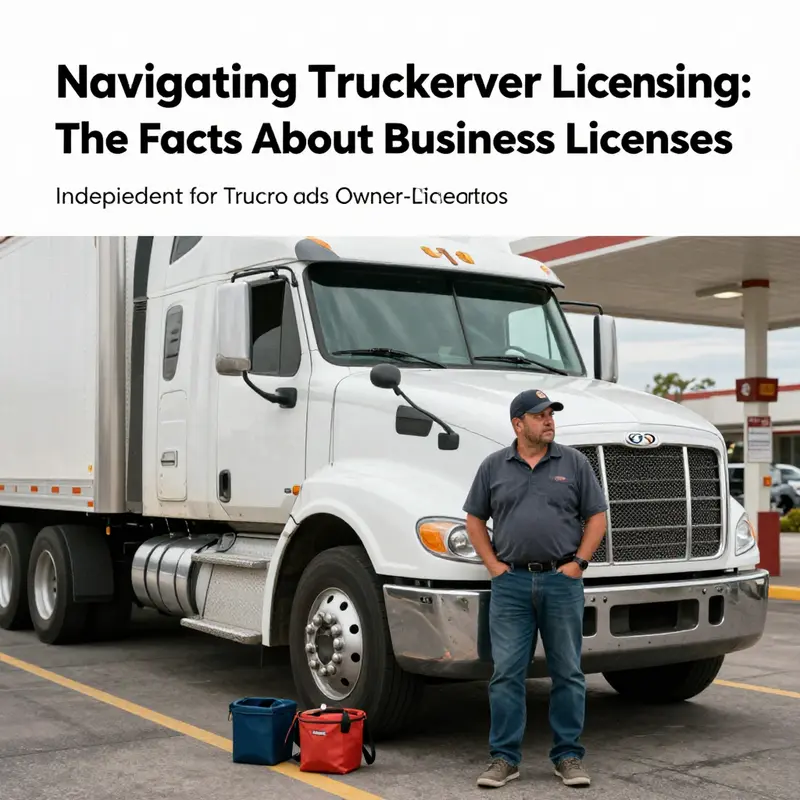
Operating without a personal business license may be lawful in many places, but it is not risk‑free. For an independent truck driver or an owner‑operator, the absence of a formal business license changes how regulators, customers, insurers, and courts see you. It alters your exposure to personal liability. It affects your access to contracts, financing, and insurance. It also shapes tax treatment and day‑to‑day financial management. This chapter walks through those consequences and translates them into clear, practical choices. It frames tradeoffs and outlines steps operators commonly take to protect earnings, reputations, and personal assets.
At the most basic level, a driver needs a Commercial Driver’s License (CDL) to hold the wheel of a commercial vehicle. That requirement is separate from business registration. The CDL lets you legally operate vehicles governed by federal and state safety rules. But beyond that, when you move from employee to independent operator, a new set of obligations and risks arrives. Many of these arise because the law and the market treat a named business differently than an individual. Contracts may demand proof of business registration. Insurers price coverage differently for named businesses. Courts treat litigation and debt collection differently when a business entity exists. Understanding those distinctions informs better decisions.
One immediate consequence of operating as a sole individual without formal registration is legal and regulatory gray area. Some municipalities or states require business licenses or permits for commercial activity. Even when a general business license is not mandatory, local zoning rules, weigh station requirements, and city contracting rules can impose registration or permit conditions. Missing a required permit can trigger fines. Worse, regulators may temporarily bar operations until requirements are met. These interruptions cost money and time. The safest approach is to confirm your specific county and state requirements, and to document that confirmation. If the business is crossing state lines, federal oversight becomes relevant, and that oversight often links to the company or motor carrier entity responsible for safety and compliance.
Perhaps the most consequential issue is liability and risk allocation. When a crash, cargo loss, or regulatory violation occurs, plaintiffs and regulators look for financially responsible parties. If you operate without a registered business, claimants can pursue the driver’s personal assets. Insurance covers many scenarios, but coverage limits and exclusions matter. Commercial policies frequently require the insured entity to be named on the policy and to hold specific operating authorities. If a policy was purchased in an individual name without proper disclosures, insurers could argue a breach of terms and refuse coverage. Creating a limited liability company or corporation does not make you immune to liability, but it can provide a meaningful separation between business obligations and personal assets. This separation is particularly important when lease agreements, equipment loans, or long‑term contracts are involved.
Another practical impact is on contracting opportunities. Shippers, brokers, and large logistics providers often require proof of business registration and commercial insurance before awarding contracts. They want to verify authority, insurance limits, and, sometimes, corporate creditworthiness. Without a business registration, you may fail vendor onboarding checks. That shrinks your pool of opportunities and can force reliance on spot freight or less favorable terms. If you plan to build recurring relationships or tendered lanes, investing in a business structure and the associated paperwork opens doors. It also allows clients to issue payments to a business name, simplifying accounts receivable and compliance.
Closely tied to contracting is insurance access and cost. Insurers evaluate risk partially by looking at the entity’s organization, claims history, and documented operations. A registered business with a clean safety record may secure broader coverage or better rates than a sole individual with equivalent risk. Some commercial policies require specific forms of business documentation for issuance. Cargo insurance, physical damage coverage, and trucking liability policies often include endorsements tied to motor carrier authority or business registration. Without the right credentials, you may be offered limited coverage or be deemed ineligible for some policies. Given the high costs of liability claims in trucking, proper coverage is essential.
Financial management and tax implications also follow from your business status. Banks and lenders generally require an employer identification number (EIN) and business registration to open a business account or to extend a loan. Mixing personal and business funds complicates bookkeeping and increases audit risk. It also obscures profitability, making it harder to price rates accurately, bid on contracts, and plan maintenance or equipment replacement. On the tax side, operating as a formal business—such as an LLC or S‑corp—can create opportunities for tax planning. Expenses commonly deductible for motor carriers include fuel, maintenance, depreciation, per diem, and certain owner compensation structures. Without proper business documentation, you may still claim some deductions, but errors in classification increase audit exposure. Clear books and a formal business identity streamline filing and support more consistent tax outcomes.
Beyond accounting and insurance, professional credibility matters. Shippers assess not just price, but reliability and compliance. A registered business with proper documentation sends a message of permanence and seriousness. That can affect negotiation power. It can also change how brokers and freight marketplaces rank carriers. For an owner‑operator building a brand or scaling a small fleet, that credibility speeds growth. Even a single‑truck operation benefits from presenting as a business when competing for dedicated lanes or long‑term contracts.
Given these implications, a practical approach balances risk, cost, and growth objectives. Not every owner‑operator needs immediate, complex corporate structures. For many, a small set of administrative steps yields most protections and keeps compliance manageable. First, obtain an EIN from the IRS. That is free and straightforward. Next, consider forming a simple limited liability company in your home state. The filing cost is modest in most states. An LLC provides a clear legal picture to insurers and clients. It also allows you to open a business bank account and separate finances. Pair the LLC with a business bank account and basic accounting software. Even minimal separation of funds simplifies tax reporting and strengthens your position in disputes.
If you plan to operate across state lines or to pursue contracts that require motor carrier status, learn about motor carrier operating authority. This includes registration with federal systems and often with state agencies for fuel taxes and vehicle registration programs. Authority requirements link to insurance minimums and to other filings such as process agent designations. A registered business can hold that authority and match the documentation expected by brokers and shippers. When contracting, insist that contracts name the proper business entity, and clarify insurance certificates and indemnity clauses. Ask clients for their standard requirements before bidding.
Insurance needs deserve special attention. Confirm with agents that policies name your business entity as insured. Understand endorsements and coverage triggers. Keep certificates of insurance current and deliver them to brokers and shippers promptly. Many disputes arise when coverage expirations coincide with incidents. Maintain records of maintenance and driver logs; these records can be critical in defending claims.
Tax strategy and recordkeeping matter for long‑term viability. Maintain accurate expense records, keep mileage logs, and track per diem claims if applicable. Use the business bank account for all revenue and expenses. When you hire help, treat payroll properly. Small details—like mixing personal and business expenses—can erode liability protection in court. In other words, when you choose a business structure, follow the formalities associated with it.
Finally, weigh the costs of formalization against the benefits. For some owner‑operators, a minimal LLC plus correct insurance and tax procedures will capture most advantages. For others pursuing large contracts or building a fleet, additional steps like corporate formalities, bonding, and expanded insurance are warranted. If you lease onto a carrier, review the lease carefully. Understand who maintains authority, who carries primary insurance, and how claims are handled. Many lease arrangements require specific business documentation from owner‑operators.
For operators who want examples of workforce investment and professionalization trends, consider exploring industry discussions on hiring, training, and people strategies. One useful perspective is available in the piece “investing in people: key to trucking’s success,” which examines how investment in human capital strengthens operations and reputation. That reference helps frame why clients prefer working with professionally organized carriers rather than individuals.
When operations cross the boundary between local and interstate work, federal standards apply. The Federal Motor Carrier Safety Administration outlines safety, licensing, and registration requirements for commercial motor vehicle operations. Familiarity with those federal standards reduces surprises and helps match your business choices to regulatory expectations. For more detailed guidance from the FMCSA, see the agency’s official site: https://www.fmcsa.dot.gov.
Deciding whether to operate without a business license is not just a legal question. It is a strategic one. The right choice depends on your appetite for risk, growth plans, and the markets you need to serve. Minimal steps—an EIN, an LLC, proper insurance, and clear bookkeeping—deliver disproportionate benefits. They reduce personal exposure, improve contract access, and make tax and insurance dealings simpler. For owner‑operators who aim to scale, or who move high‑value cargo, formal registration becomes essential. Approaching these choices deliberately gives independent truckers control over their exposure and opens options for steady growth and professional reputation.
Final thoughts
Recognizing the distinction between personal business licenses and commercial driver licensing is critical for those engaged in logistics, construction, fleet management, and distribution. While truck drivers need a CDL to operate legally, the absence of a personal business license simplifies operation for many. Transportation companies, however, must adhere to regulatory compliance and ensure their licenses are up-to-date. Understanding these licensing requirements not only aids in legal compliance but also supports effective operational management in the trucking industry.