
The demand for dependable box truck services continues to grow as e-commerce intensifies urban last-mile delivery, construction projects expand, and food and beverage distribution requires reliable, time-sensitive transport. For organizations in Logistics & Freight, Construction & Engineering, Fleet Management, and Food & Beverage Distribution, a well-planned box truck operation can deliver predictable revenue, greater control over service levels, and improved supply-chain resilience. This guide presents a disciplined, four-step framework designed to help you launch a box truck business that aligns with the needs of these sectors. Each step builds on the previous one, from market reconnaissance to vehicle selection and financing, to legal and regulatory readiness, and finally to customer acquisition and day-to-day operations. By combining market insight with disciplined cost management, strategic partnerships, and scalable processes, you can position your venture for steady cash flow and sustainable growth across multiple industry verticals.
Charting the Road: Market Research and Niche Identification for a Box Truck Startup
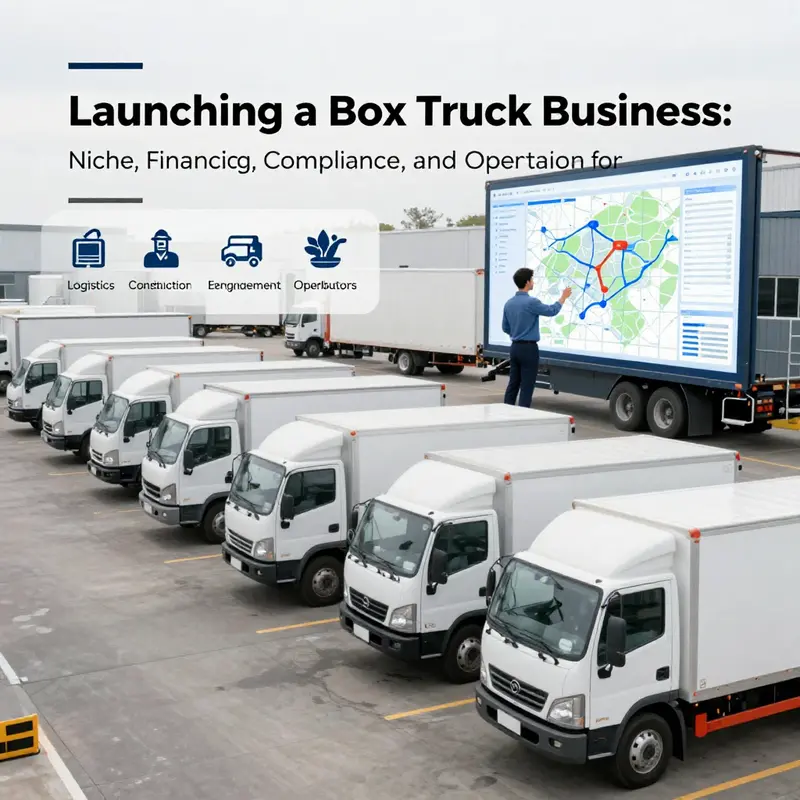
A box truck business begins not with a vehicle alone, but with a map. The road to profitability runs through careful market research and a clearly defined niche. In practice, this means stepping back before you step into the cab and asking sharper questions than, “What truck should I buy?” The market reality is sizable and evolving. The box truck market was valued at about $12.7 billion in 2024 and is projected to grow at a 4.6% compound annual growth rate. This expansion is driven by the surge in e-commerce and the demand for flexible, local delivery options beyond the major national carriers. For a new entrant, those numbers translate into opportunity, but only if you translate them into a strategy that fits your resources, geography, and risk tolerance. Market research, then, becomes your compass and your blueprint rolled into one.
The first discipline is to define the demand you intend to serve. In practical terms, you map out who needs box truck service in your area and why these needs are likely to recur. Local and regional demand often clusters around a few core categories: e-commerce and last-mile delivery for small to mid-sized retailers, furniture and appliance transports that require careful handling, and recurring industrial deliveries to warehouses, restaurants, or medical facilities. A growing niche within this mix is cold chain logistics, where refrigerated box trucks can command higher margins because the handling requirements and compliance costs are more stringent. But a niche is not merely about a fancy service label; it’s about a repeatable pattern of demand you can reliably accommodate with your assets and processes.
To identify a viable niche, the most essential step is to analyze the existing flow of deliveries in your target region. Which businesses deliver to customers directly or to other businesses, and how often? Look at retail centers, micro-fulfillment hubs, and local manufacturing. Consider whether you want to concentrate on a geographic niche—urban cores with dense delivery windows, suburban corridors with predictable routes, or rural areas with fewer but larger shipments. Each geography has its own rhythm, and your choice will shape vehicle selection, driving hours, fuel strategies, and even insurance costs. In addition to geography, you can think in terms of service type. Some operators specialize in last-mile residential deliveries, others in scheduled recurring routes for retailers, and still others in the more specialized, higher-margin work like moving furniture or handling fragile cargo. The key is to identify a service pattern that aligns with your equipment and your strengths, not the other way around.
With demand in view, turn to competitive landscape. A practical approach is to observe what other box truck operators are doing in your region. What kinds of customers do they serve? What pricing schemes and service levels do they advertise? How do they present themselves online, and what kind of reputation do they cultivate through references and reviews? A common gap often emerges: a lack of real-time visibility for customers, less flexible scheduling, or limited use of modern technology to streamline operations. Those gaps aren’t flaws; they’re openings. A new entrant can differentiate by offering reliable live-tracking, transparent pricing, and scheduled recurring deliveries that fit a business’s calendar. If most competitors operate with only basic communication and manual invoicing, then a higher level of transparency and digital integration can become a powerful selling point.
Sustainability is another trend worth factoring into your niche. Eco-conscious clients increasingly value fuel efficiency and lower emissions. If you can position yourself as a greener option—perhaps by optimizing routes to minimize idle time, using fuel-efficient vehicles, or exploring electric box trucks in the future—you can attract customers who want to reduce their own carbon footprint and may be willing to pay a premium for it. This isn’t just about being “green” for optics; it’s about cost-effective routing, maintenance planning, and a forward-looking fleet strategy that keeps you competitive as regulations evolve and technologies mature.
All of these considerations—demand, geography, service type, competition, technology, and sustainability—feed into a clear, action-oriented niche. The choice is not random; it should reflect your resources, your local ecosystem, and your capacity to deliver consistently. A well-defined niche does more than attract customers; it shapes every subsequent decision. It informs what size box truck you buy, how you staff and train drivers, what routes you pursue, how you price services, and how you market yourself. It creates a story for your business that clients can trust because it aligns with their everyday needs and constraints.
Historical examples underscore the logic. A real-world operator in a similar space began with two used 4.2-meter vans and targeted furniture delivery in a mid-sized city. By integrating with e-commerce platforms, they found a reliable loop of orders, optimized routes, and predictable revenue. This is not merely anecdotal; it demonstrates how a focused niche can accelerate cash flow and scale when paired with the right technology and partnerships. Even if your starting point is more modest, the principle remains intact: you win by clarity about who you serve, what you deliver, and how you will deliver it better than the competition.
Once you have a defined niche, you can begin translating that clarity into practical choices. Vehicle selection becomes a function of the service type and the expected route structure. A 4.2-meter cargo van might be ideal for tight city deliveries where parking and curbside access are challenging, while a 6.8-meter box truck could be better for longer routes or heavier loads. Financing options become a strategic lever—buy used to lower upfront costs, lease to test the market, or finance through traditional lenders with terms that fit your revenue ramp. The regulatory environment, training needs for drivers, and insurance considerations will also hinge on the niche you adopt. If you anticipate refrigeration or cold-chain work, you’ll need specialized equipment and coverage; if you focus on furniture moving or bulky goods, cargo handling, padding, and loading protocols take center stage.
A practical framework for approaching this stage is data-informed experimentation. Start with cautious capital expenditure: perhaps a used vehicle or a short-term lease to validate the market fit, rather than a full ownership commitment. Pair the asset with a lightweight tech stack—digital invoicing, simple route planning, and basic customer communication tools—to begin building a reputation for reliability. Use every job as a data point: who contracted you, what route you ran, what the margins are after fuel and maintenance, and what clients say about the experience. This empirical approach reduces risk and builds a compelling case for expanding once you hit profitable, repeatable demand.
The roadmap is not merely about the truck; it’s about the people and processes that sustain it. As you refine your niche, consider the role of partnerships and talent in making service levels consistent. A chapter later will delve into people and operations in greater depth, but the seed is already planted here. To keep you moving, think of your niche as a promise you make to customers: reliable timing, careful handling, transparent pricing, and a frictionless experience from first contact to final delivery. That promise becomes the backbone of your brand in the market and a magnet for repeat business.
For readers who want a deeper dive into the strategic rationale behind box-truck planning, one can explore the broader literature on planning and market positioning in the logistics space. A related line of thinking emphasizes how the landscape is shifting away from a one-size-fits-all approach toward flexible, niche-focused solutions that can adapt to the ebbs and flows of e-commerce, weather, and urban regulations. In practice, this means you can begin with a modest footprint today and meaningfully grow as demand confirms your niche’s viability. A logical next step is to test the market with limited exposure, capture learnings quickly, and prepare to scale in a targeted fashion rather than across a broad, unfocused service menu. This approach aligns with proven stories of small operators who built durable revenue streams by specializing and then gradually expanding into adjacent services as capacity, reputation, and cash flow allowed.
Internal links can play a supporting role here. For instance, those who want to explore how to connect with talent and build teams for trucking fleets can read about investing in people as a core strategy. Investing in people for trucking fleets offers a perspective on the human side of growth and the practices that enable consistent service quality as you scale. It’s not a detour; it’s a necessary complement to choosing a niche and securing your early contracts. The work of market identification and the discipline of niche-focused execution set the stage for a sustainable operation, one where people, processes, and vehicles work in concert rather than at cross purposes.
The approach outlined here does not demand perfection before you start. It demands clarity and discipline. You should know who your customers are, what problems you solve for them, and how you will measure success in the first six to twelve months. It’s about starting with a defensible position, validating it with real customers, and then building a repeatable model that grows with your capacity and your confidence. In the next chapter, you’ll translate this market clarity into a concrete business framework: licensing, insurance, and compliance, along with the practical steps to acquire your first asset, arrange financing, and set up a minimal but scalable operation. The theme of certainty—knowing your niche and the value you bring—will continue to drive every decision as you move from plan to execution.
External resource for deeper context on business planning in this space can deepen your understanding of the broader dynamics involved. For a comprehensive guide on building a box truck business plan, see external resource material at Shopify’s guide to box truck business planning. https://www.shopify.com/blog/box-truck-business-plan-guide
Foundations in Motion: Selecting the Ideal Box Truck and Smart Financing to Launch Your Delivery Venture
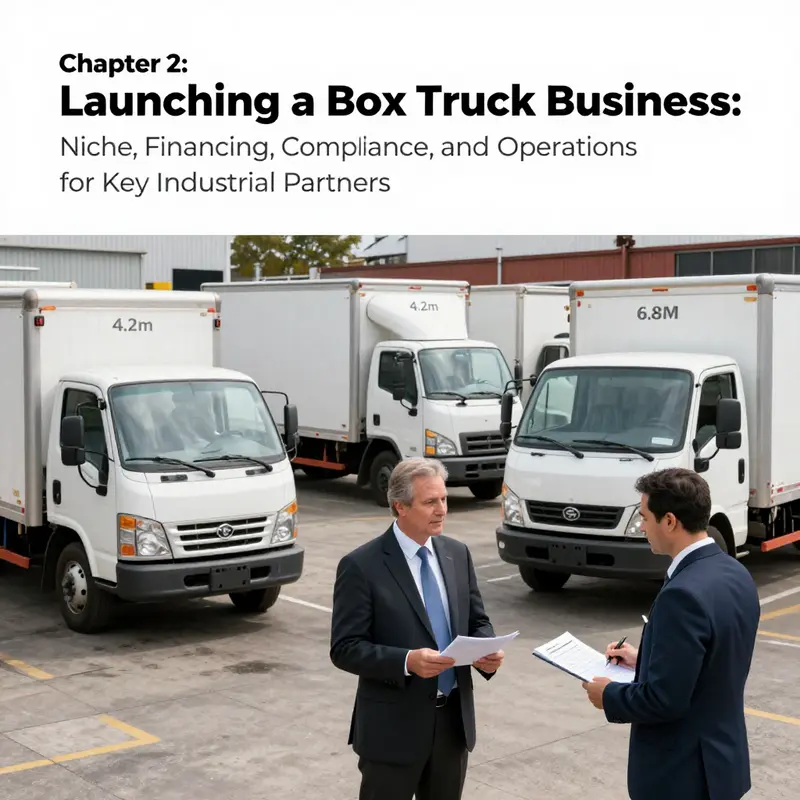
Launching a box truck business starts with a decision that may seem straightforward but anchors every later move: choose the right vehicle to fit your market and pair it with financing that preserves cash flow and growth potential. In this chapter, you’ll see how the vehicle size, fuel dynamics, and financing options align with your chosen niche, and how making deliberate trade-offs at the outset can reduce risk while keeping you agile as you test your model. The goal is to establish a sturdy foundation so your first truck is not a sunk cost but a versatile tool that earns steady revenue while you scale.
First, orient your choice around the needs of your target market. For urban, last‑mile or high‑volume parcel deliveries, a smaller box truck with a compact footprint and a payload of roughly 1.8 to 2.5 tons is often optimal. This size finds a balance between maneuverability in dense city streets and the capacity to move a meaningful number of shipments in a single trip. It is responsive to customers who expect quick turnaround times and predictable delivery windows. On the other hand, if your plan includes longer routes, bulkier shipments, or regular industrial or commercial deliveries, a larger box truck—one with higher payload capacity—may be necessary. The realities of route density, city congestion, and the types of goods you will routinely handle will push you toward one end of the spectrum or the other. Regardless of size, the core objective is to align the truck’s capacity with the typical load your customers will expect you to carry while maintaining cost efficiency for fuel, maintenance, and driver time.
Fuel efficiency becomes a central consideration as you assess reliability and operating costs. A diesel-powered box truck generally offers better fuel economy over multi-stop urban routes and longer legs, plus durability that suits high utilization. The practical takeaway is not to chase the latest technology for its own sake, but to prioritize engines and configurations with proven reliability and a documented maintenance history. When you are evaluating a used vehicle, careful due diligence on mileage and service records can yield a strong entry point with a shorter payback period. If you opt for a new vehicle, you gain warranty protection and modern safety features, but you must be prepared for a higher upfront cost. The decision often comes down to your capital availability and your risk tolerance: a fresh unit reduces immediate maintenance surprises but binds more capital; a well-maintained used unit frees cash for growth but requires a disciplined maintenance plan.
An important nuance in the financing conversation is the financial structure you choose to acquire that first truck. Traditional bank loans are familiar and can offer favorable interest rates, yet the approval process tends to be thorough and time-consuming. They also usually demand a meaningful down payment—commonly in the 20 to 30 percent range—before you take possession. This can be a hurdle for many first-time operators who need to maintain liquidity for insurance, maintenance reserves, and working capital for customers’ accounts receivable cycles. Specialized commercial vehicle lenders, by contrast, tailor their underwriting to the realities of trucking operations. They often provide faster approvals, more flexible documentation requirements, and terms that match typical cash flow patterns in a startup that relies on repeat contracts rather than a single, large upfront contract. If you are wary of locking in a long-term debt too early, lease‑to‑own programs present a prudent bridge. With lease-to-own, you step into a truck with lower upfront cash outlay and a structured path to ownership after a set period, typically three to five years. This path can be especially attractive if you want to test market fit, refine your workflow, and scale gradually without bearing the full burden of ownership from day one.
In adopting any financing plan, the core principles are simple: start small, preserve a cushion, and invest in capabilities that compound over time. The advice here mirrors a broader ethos of prudent growth. Begin with one truck and a clear service offering. Build a roster of reliable, repeat customers so you can forecast revenue and plan maintenance without abrupt cash gaps. A well-stocked contingency fund for unforeseen repairs is not a luxury; it’s a practical requirement for keeping promises to customers and protecting your reputation. As you chart this path, you’ll also want to embed technology into your operation to stave off inefficiencies. A combination of telematics, GPS tracking, and route optimization software can yield meaningful savings in fuel and time. The aim is not to chase every gadget but to deploy tools that deliver tangible returns—shorter routes, fewer idle minutes, and faster, more accurate invoicing and delivery confirmation.
Once you have a sense of whether you’re pursuing a smaller urban focus or a broader regional operation, you can map financing to your anticipated cash flow. A practical approach is to model three scenarios: one where you buy outright with a modest down payment; one where you lease with the option to buy; and one where you finance a used unit with a shorter loan term. Each path has implications for maintenance reserves, interest costs, and the ability to weather slow periods between contracts. You can build a buffer by maintaining a monthly reserve for fuel and maintenance that is proportionate to your fleet size. For a single truck, even modest variances in fuel prices or repair costs can swing margins, so plan for volatility.
To inform your decisions about ownership versus leasing, consider the long game. Ownership provides equity and the potential for depreciation benefits, but it also ties up capital and creates exposure to resale value and major repairs. Leasing preserves liquidity and offers predictable monthly costs, but long-run ownership options can become expensive if you miss out on favorable buyout terms or if market values rebound in unexpected ways. A hybrid approach—starting with a lease-to-own arrangement to test the market, then transitioning to ownership once you’ve proven the model—can be a practical compromise for first-time operators. This approach aligns with the overarching mindset of starting small, learning quickly, and expanding once you have consistent demand.
As you weigh vehicle size, fuel strategy, and financing, remember that your choice of truck is the nucleus around which your entire operation revolves. It shapes maintenance scheduling, insurance premiums, driver training, and even the way your dispatch system is configured. In the early stages, the goal is to minimize risk while maximizing reliability and service levels. A lean, well-documented maintenance regime not only reduces unexpected downtime but also strengthens your negotiating position with customers and lenders. When maintenance history is transparent and consistent, it becomes a reliable signal of your business’s competence and forward planning, which in turn lowers perceived risk for lenders and customers alike.
To deepen the conversation about how people and technology intersect to optimize a growing fleet, consider the broader perspective offered in Transforming Fleet Management: The Case for Investing in Human Capital. This resource underscores that people and processes, when aligned with the right tools, drive the efficiency that translates into dollars and sustainable growth. Transforming Fleet Management: The Case for Investing in Human Capital.
In evaluating the practical costs, you will inevitably confront the balance between purchase price, ongoing maintenance, and insurance. The cost picture for a single truck breaks down into recurring categories—fuel, maintenance, insurance, and depreciation—with notable variation by geography, driving patterns, and maintenance history. A rough planning heuristic often cited in the industry is to expect fuel costs to represent a significant portion of monthly expenses, with maintenance and insurance contributing stable, predictable slices. Depreciation, while non-cash, remains a meaningful accounting and financing consideration because it affects tax treatment and resale value projections. The key is to build a disciplined budgeting routine that tracks this blend and flags deltas early so you can adjust routing, fill gaps with repeat business, or renegotiate terms with suppliers. If you’re considering a fresh unit, remember that the published price range for a new 4.2-meter configuration could be lower than typical expectations due to regional pricing dynamics; however, the real constraint for many startups is the upfront capital rather than sticker price alone. For most entrants, a well-chosen used unit—carefully inspected and with verifiable service records—often yields the best balance of affordability and reliability, allowing you to allocate more resources to customer acquisition and cash-flow reserves rather than to debt service.
Once you have identified the vehicle class that best suits your market niche and a financing path that preserves liquidity, you can begin to sketch how you will roll this into a scalable operation. Start with a one-truck model, coupled with a few stable contracts or a monthly service arrangement that offers predictable revenue. Your focus should be on reliability, speed, and accuracy: a truck that arrives on time, with properly packaged goods, and with a clear, digital proof of delivery that your customers can trust. The more you can demonstrate consistency in service, the more you can justify additional capital for expansion when the time is right. And while you plan growth, keep in mind that the financing decision is, in essence, a living part of your business plan. As volumes grow, you’ll revisit the terms, the structure of your debt, and the balance between owned versus leased equipment. The cadence of review—quarterly or semi-annual—should be integrated into your operational discipline so the company can pivot quickly if demand shifts or if costs fluctuate.
Finally, a practical note on sourcing and due diligence during this phase. When you’re evaluating whether to buy used or new, create a simple checklist that covers: service history, mileage, accident records, and the condition of major components like the engine, transmission, brakes, and tires. Negotiate warranties or service packages if available, and verify the vehicle’s documentation and title status. The financing conversation benefits from a parallel checklist that includes down payment amount, interest rate, loan term, monthly payment, total cost of ownership, and any prepayment penalties. In both cases, getting third-party inspections or a trusted mechanic’s opinion can be a non-negotiable step. By combining cautious purchasing with disciplined financing, you set a pace that matches your early revenue patterns and builds confidence with future lenders as you consider expanding your fleet.
As you prepare to move from concept to operation, keep your narrative focused on how the vehicle and financing choices enable you to serve customers reliably while maintaining room to adapt. The right balance will depend on your local market, the competitive environment, and your appetite for risk. The guidance above provides a framework to approach the decision—one that honors the practical realities of delivering goods on time, protecting cargo, and keeping your financials in healthy order while you scale.
External resource for broader context on launching a box truck business: https://www.entrepreneur.com/article/397825
null
null
Chapter 4 — From First Call to Repeat Business: Building Your Box Truck Customer Base and Streamlined Operations
When you set out to build a box truck business, the most powerful moves happen where customers meet dependable service and where operations hum with precision. This chapter follows that instinct: you design a service that a specific audience actually needs, then you align every process—dispatch, routing, delivery, invoicing, and support—so that trust grows into repeat business. The goal is to turn once-off deliveries into predictable lanes, and predictable lanes into a scalable fleet. It’s a sequence of decisions that begins with a clear target market and ends with a operating rhythm that makes money while you sleep a little easier at night.
To begin, anchor your strategy in a defined market and a manageable service map. The most resilient box truck operators don’t chase every opportunity; they craft a value proposition around a few high-potential niches. Local retailers and e-commerce brands seeking reliable last-mile and scheduled deliveries form a natural starting point. Furniture stores and appliance installers demand careful handling, precise time windows, and professional hand-offs. Small manufacturers want regional distribution with predictable transit times. White-glove options—room-of-choice placement, setup, and removal of packaging—differentiate you in crowded markets and justify higher margins when customers value reliability more than price alone. A practical, repeatable mix is to offer last-mile and regional delivery with optional white-glove services and a predictable cadence of contracts.
Operationally, this means you map service lines to customer profiles. You design routes that maximize loading efficiency and minimize dwell time. You develop a simple pricing framework that captures base delivery cost, distance, time windows, and any accessorial tasks like stair carry, inside delivery, or assembly. The trick is to be transparent. When customers know exactly what they’re paying for, it reduces disputes and accelerates onboarding. This clarity feeds your credibility and encourages longer-term commitments. In practice, you’ll find that the most valuable customers value on-time performance, real-time tracking, and responsive support more than a low introductory price. If you want to see a pathway for strong customer relationships, look to the discipline of service delivery that underpins successful fleets. It’s not flashy; it’s reliable.
Your fleet choice should reflect this service map. Box trucks sized for city streets and tight loading zones are ideal for last-mile to regional lanes. Ownership considerations—buying, leasing, or sharing capacity—should align with the scale you expect in the first year. A key point is to not overextend upfront. Start with one or two solid vehicles, establish contracts with anchor customers, and prove the model before expanding. In the early phase, your operation should feel like a well-oiled dispatch desk: precise assignments, clear driver instructions, and a single point of contact for each client. The work is not glamorous, but it is relentlessly practical. You’ll be balancing capacity against demand, and your success hinges on how quickly you can move a load from pickup to delivery while keeping the customer informed every step of the way.
A core capability that binds your customer base to your operations is dispatch discipline. A simple, reliable system for job intake, load planning, and driver assignment reduces the chance of miscommunication and missed windows. Dispatch should know what loads exist, the routes they require, and the driver who can execute them with the fewest delays. Real-time GPS tracking and telematics allow you to refine routes and adapt to traffic or weather changes without startling customers with delayed ETAs. The most effective operators use route planning that groups deliveries along a single corridor whenever feasible, cutting idle time and fuel usage while preserving service levels. In some markets, even modest route optimization can yield double-digit efficiency gains over a month, translating directly into higher margins. The practical implication is straightforward: invest in a routing mindset that treats time as a primary unit of currency.
The backbone of customer-facing processes is a robust yet lean technology stack. Dispatch and routing software automate load assignments, sequence deliveries, and share ETAs with customers. A customer relationship management (CRM) system tracks prospects, quotes, and ongoing accounts, turning scattered conversations into a livable history you can audit and grow from. A driver app or tablet delivers digital manifests, captures proof of delivery, records photos, and secures signatures—all in one streamlined flow. Data becomes your currency: utilization, on-time performance, incident rates, and profitability by customer become the metrics you tune every week. With this setup, you convert a manual, error-prone operation into a reliable service that can scale without burning out your team.
People are the most important asset in this transition. You will see the strongest returns when you invest in your team as a core capability, not as a last-minute thought. Hiring the right drivers and dispatch staff, then providing ongoing safety training and clear performance expectations, creates a culture of accountability that customers notice. A well-structured onboarding playbook helps new clients feel confident from the first interaction to the first delivery. The same playbook guides your internal team to deliver consistently, which in turn builds trust with customers. This is where the link to human capital becomes central. Transforming fleet management through investing in human capital is not mere sentiment; it’s the mechanism by which you scale service quality and maintain high margins as you grow. For a deeper framework on this principle, you can explore the discussion around investing in people in the industry resource Transforming fleet management through investing in human capital.
From there, pricing discipline becomes a natural extension of trust. A transparent base rate plus distance and time components, with clear surcharges for stairs, inside delivery, or white-glove tasks, helps clients budget with confidence. A straightforward fuel surcharge mechanism keeps you resilient against volatile fuel markets. The art is to strike the balance between simplicity for customers and profitability for you. Your quotes should be easy to understand, with the terms and expected SLAs spelled out in plain language. When you couple this clarity with reliable performance, customers accept longer commitments and negotiate better terms in exchange for predictable service—precisely what you want for steady cash flow.
Onboarding and relationship management are the glue that holds multiple lanes together as you scale. An onboarding playbook sets expectations, communications preferences, and escalation paths. Clear SLAs and agreed-upon KPIs—such as on-time delivery, first-attempt delivery rate, and accurate POD—become the anchors of account reviews and renewal conversations. The aim is to move from one-off deliveries to a portfolio of accounts with recurring lanes. That transition is where recurring revenue becomes real and predictable, which gives you the leverage to invest in more capacity and better service.
As you build out this engine, you’ll also want to cultivate a network of partnerships that complements your direct sales. Direct outreach to local businesses, building relationships with property managers, moving companies, and retailers, and participating in local business associations can yield a steady stream of inbound inquiries. Marketing should be simple and locally focused: a professional website that communicates service lines, a clear value proposition, and testimonials; local search optimization so when a shop needs last-mile logistics, your name rises to the top; and a referral program that rewards current customers for introducing new accounts. Lead qualification is essential here. You want lanes with consistent hours, accessible loading points, and service requirements you can comfortably meet, not a cluster of sporadic, high-maintenance jobs that strain your dispatch capacity. The sales process should be straightforward: capture leads with clear source tagging, deliver quotes quickly, and onboard them with a minimal friction contract and a defined SLAs. You don’t need a large marketing budget to start; you need a reliable, repeatable process that turns interest into committed business.
Operationally, the 90-day rhythm matters. In days 1 through 30, you lay the foundation: define your target market and service lines, secure the required licensing and insurance, set up the core dispatch and CRM systems, recruit your initial driver(s) and an operations coordinator, and publish standard operating procedures for loading, unloading, and POD. In days 31 through 60, you acquire the vehicle(s) or confirm lease terms, complete initial maintenance setups, and launch a pilot with a small set of anchor accounts to stress-test your processes and pricing templates. Days 61 through 90 are about scale and optimization: expand live operations to additional lanes or customers, refine routing and load planning, establish a routine of customer reviews and feedback loops, and monitor KPIs so you can adjust pricing, staffing, or equipment as needed. This cadence is not a rigid timetable but a disciplined pattern that helps you grow without sacrificing service quality.
A concrete proof point helps illustrate how these ideas translate into results. Consider Zhang Wei, who started with two used 4.2-meter vans and ¥180,000 in initial capital. By focusing on furniture delivery and integrating with e-commerce platforms, he posted ¥760,000 in first-year revenue with a 34% gross margin and eventually expanded to five trucks with annual profits above ¥500,000. This example isn’t a blueprint for every market, but it demonstrates how a focused niche, disciplined operations, and a commitment to reliable service can compound into a growing, profitable operation. It also underscores the value of combining with digital platforms and ecosystems that help stabilize volumes while you scale.
In the broader picture, this approach is not only about delivering boxes; it’s about delivering dependable outcomes for customers who rely on you to move critical goods on time. Your value proposition is built on three pillars: predictability (arriving on time with precise windows and dependable POD), transparency (clear pricing and honest communication), and responsiveness (fast answers to questions, quick resolution of issues). When you internalize these as your standard, you create a reputation that precedes your sales efforts. Your fleet becomes a living proof of capability—the kind that makes a local retailer place a standing order and a regional manufacturer keep you on a recurring lane rather than auditioning multiple carriers every quarter. This is how a box truck business grows from a single truck into a managed fleet without losing the core advantage of speed and reliability.
As you pursue this trajectory, remember to keep the conversation with customers and within your team grounded in the same data-driven discipline you apply to routing and pricing. Every route should be evaluated for profitability, every SLAs should be tracked for missed targets, and every interaction with a client should reinforce the value you deliver. In practice, that means regular but efficient performance reviews with key accounts, a simple dashboard that highlights utilization and cost per mile, and a culture that treats feedback as fuel for improvement rather than a complaint to be dismissed. When you fuse a well-defined market, an efficient operational backbone, and a customer-centric mindset, you do more than build a business; you build a scalable service that earns loyalty and sustains growth.
To close the loop on the human capital dimension, consider the guidance offered in industry discussions about investing in people as a growing discipline within trucking. It emphasizes that people—not just equipment—are the engines behind reliable service. A strong cohort of trained drivers, engaged dispatch staff, and data-informed managers is what enables you to turn a handful of loads into a living, breathing system capable of expansion. For readers who want a deeper treatment of this topic, the linked framework above offers a comprehensive view of how fleet management becomes more robust when you treat your workforce as a strategic asset. The practical takeaway is clear: build your operations with a people-first orientation, and the service quality you deliver will compound over time.
External resource for further reading
External resource: https://www.chinabusinessnews.com.cn/2024/04/24/box-truck-entrepreneur-hangzhou/
Final thoughts
Starting a box truck business that serves Logistics & Freight, Construction & Engineering, Fleet Management, and Food & Beverage Distribution requires a disciplined approach across market intelligence, asset strategy, compliance, and operations. By identifying a defendable niche, selecting the right vehicle mix with a prudent financing plan, ensuring regulatory readiness, and investing in sales and operations capabilities, you build a resilient foundation for recurring contracts and scalable growth. The most successful operators continuously refine their value proposition, leverage data to optimize routes and utilization, and forge partnerships that deliver predictable, high-margin work. With clarity of focus and disciplined execution, your box truck venture can transition from a startup to a trusted logistics partner for multiple industrial segments.