
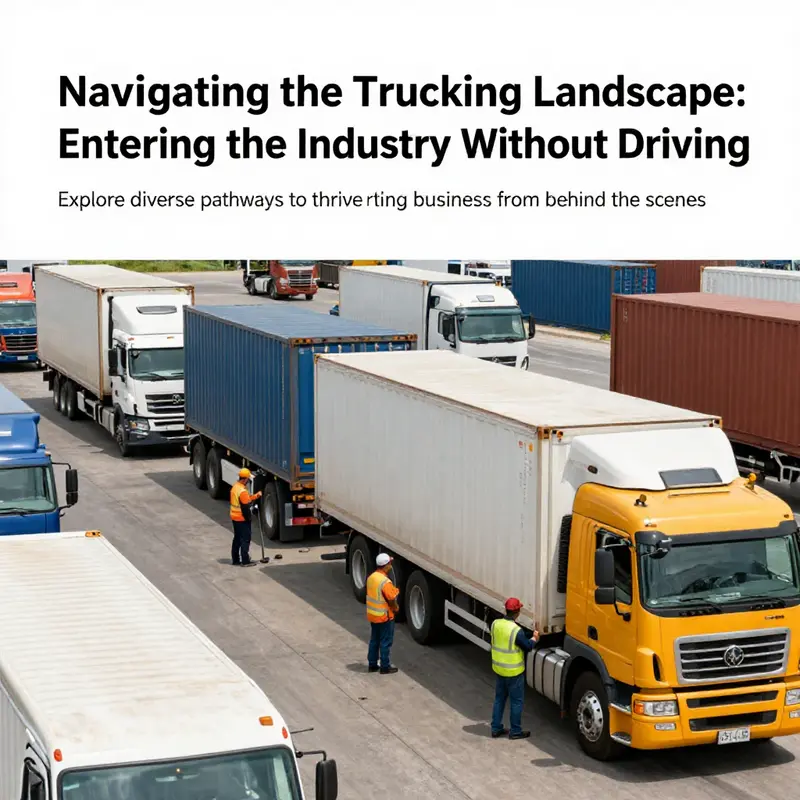
The trucking industry is a cornerstone of global commerce, and while driving a truck is a common perception of how to enter this field, numerous non-driving roles provide ample opportunity for success. Whether you are involved in trucking brokerage, dispatching, operations management, fleet management, or logistics coordination, you can significantly contribute to and profit from this essential sector. As you proceed through this guide, you will discover varied paths to enter the trucking business without ever needing a commercial driver’s license (CDL), equipping you with the insights necessary to take your first steps into this dynamic profession.
From Back Office to Freight Floor: Launching a Trucking Brokerage Without Driving

Stepping into the trucking industry without turning the key in a truck can feel like entering a vast network with the brakes engaged. Yet the backbone of modern logistics is not limited to those who sit behind the wheel. The brokerage model lets you build a thriving business by aligning shippers who need to move goods with carriers who can move them, all from a desk, a headset, and a well-tuned system. You become the connective tissue of the entire operation, translating demand into capacity and capacity into demand with accuracy, trust, and speed. In this chapter, the path is laid out not as a sales pitch for an industry role but as a practical blueprint for launching a legitimate, scalable enterprise that operates at the heart of the freight economy without requiring a CDL, a truck, or years behind the wheel.
What a trucking brokerage does is deceptively simple on the surface. You secure loads from shippers, match them with available carriers or owner-operators, and handle the coordination, documentation, and payment flow that keeps shipments moving. Your compensation comes as a commission or fee on each load you arrange. The beauty of this model—especially for newcomers—is the way it leverages your ability to sell, negotiate, and manage relationships rather than your need to physically operate a vehicle. You are the strategic conductor, ensuring the right loads find the right trucks at the right times, while drivers and fleet managers handle the actual driving and fleet maintenance. The focus shifts from fatigue management and fuel economy to capacity planning, rate negotiation, and compliance oversight. This is not a sidestep around hard work; it is a different kind of work—one that scales with your network and your ability to systemize operations.
The advantages extend beyond mere capital costs. A brokerage typically requires far less upfront investment than owning equipment or funding maintenance on a fleet. You do not bear the heavy exposure of fuel costs, tire replacements, or insurance on a fleet. Instead, your investments go toward software that helps you find and manage loads, a capable marketing apparatus to build your shipper and carrier networks, and the human capital that keeps the information flowing accurately and promptly. The focus shifts from asset-heavy risk to process-heavy reliability. With disciplined execution, you can build a durable revenue stream even as the freight market evolves. And because you are sitting at the center of the network, you can pivot more quickly when market segments surge or slow down, whether that means expanding into refrigerated freight, hazardous materials, or other specialized niches that reward brokers with higher margins and deeper industry knowledge.
The path to establishing a brokerage begins with understanding the regulatory and legal landscape. To begin operating as a trucking broker, you must recognize three core requirements. First, obtain a USDOT number to identify your business in the national transportation system. This is your formal credential that signals you are an active participant in interstate commerce. Second, secure an MCS-90, a federal requirement that ensures financial responsibility for the services you provide as a broker. This permit is not just a checkbox; it is a signal to shippers and carriers that you operate with a defined duty to protect their interests in the event of freight loss or damage. Third, you must secure a surety bond of seventy-five thousand dollars. This bond provides a financial guarantee that you will fulfill your obligations to pay carriers and meet contract terms. These steps may involve some upfront costs and paperwork, but they are far less burdensome than obtaining a fleet, maintaining equipment, or staying compliant across a large asset base.
With the regulatory framework in view, the next phase centers on building a scalable operating model. Your primary investments are threefold: technology, marketing, and relationships. Technology is the engine that makes a brokerage feasible at scale. You will rely on load boards and dispatch software to connect loads with carriers, track shipments in real time, and automate paperwork, including rate confirmations, pick-up and delivery confirmations, and invoicing. A robust technology stack minimizes the mundane and maximizes reliability, which in turn opens the door to repeat business. Marketing becomes your lead-generation engine. You must articulate a compelling value proposition to both shippers and carriers. For shippers, it is about reliability, speed, and transparent visibility; for carriers, it is about consistent, well-paying loads and predictable payment cycles. In this arena, personal outreach, industry events, and a well-crafted online presence become essential tools. Platforms that connect with industry players and direct outreach to decision-makers help you expand your network with a sense of credibility that comes from consistent, ethical behavior and proven performance.
The social capital you build matters almost as much as the technical capability. At the core of a successful brokerage is trust—trust that you will deliver the right information, communicate transparently, and respect the commitments you make. Building this trust requires a quiet discipline: accurate rate quotes, honest timelines, and reliable shipment tracking. It means communicating proactively when delays arise and offering practical alternatives rather than excuses. The most durable brokerages cultivate long-term relationships with both sides of the market. Shippers rely on you to consistently move freight on time; carriers rely on you to present legitimate loads, fair terms, and timely payments. Over time, the quality of your network becomes your strongest asset, enabling you to absorb market fluctuations more gracefully than a fleet-dependent model might.
As you gather momentum, the question of growth becomes essential. Scaling a brokerage is not about piling on more loads; it is about deepening the value you offer. You can add more carriers to diversify capacity and reduce logistical risk, ensuring you can meet service promises even when supply chains tighten. Another path is to expand into specialized freight niches that command higher rates and fewer competitors. Refrigerated or temperature-controlled freight, hazardous materials with certified safety profiles, or time-sensitive shipments can provide durable margins for a well-positioned brokerage. Some operators eventually consider launching their own fleet, but this step should be a measured evolution rather than an abrupt leap. The right move depends on market conditions, access to capital, and the confidence that a captive capacity strategy will deliver sustainable value to your shippers and your company.
The day-to-day cadence of a non-driving trucking business is focused on people, processes, and performance. Start with a clear onboarding process for new carriers, including baseline safety and insurance criteria, and a simple yet robust payment workflow that minimizes disputes. Your dispatch and operations teams then coordinate the actual movement of freight, while your sales and account management teams ensure shipper satisfaction and continued engagement. The beauty of this arrangement is that the top line grows in alignment with the bottom line whenever your processes deliver reliable, measurable results. You can quantify performance not just by loads moved, but by on-time delivery rates, carrier retention, and shipment visibility for your customers.
Within this broader framework, it is helpful to anchor your strategy in ideas about people and culture. The trucking industry thrives on skilled professionals who can manage complexity with calm judgment. The people-focused view of trucking emphasizes investing in the human capital that makes your operation reliable. For those exploring this path, a thoughtful perspective is offered in the article Investing in People: A New Path for Trucking Fleets, which argues that sustainable growth comes from building strong teams and shared norms across the business. Investing in People: A New Path for Trucking Fleets. This emphasis on people mirrors a core truth: without capable, accountable individuals managing relationships, systems, and compliance, even the best processes fail to deliver consistent results. Behind every successful load, there is a dedicated coordinator who knows how to navigate exceptions, a sales professional who can translate shipper needs into workable freight plans, and a financial administrator who keeps the books clean and disputes minimal.
No roadmap is complete without practical first steps and a sense of timing. If you are contemplating this path, start by researching the licensing and registration requirements in your state and at the federal level. Set up the legal entity, and prepare for the administrative steps that accompany USDOT and FMCSA registration. Begin engaging with industry stakeholders early—shippers, carriers, and service providers who can offer guidance, feedback, and, ultimately, partnerships. Build a small but capable core team that can handle sales, operations, and compliance while you shape the broader strategy. Early on, you may want to pilot with a narrow set of shipments to refine your workflows, ensuring your rate verification, carrier qualification, and payment terms operate smoothly before you scale.
As you lay the groundwork, you should also give attention to the ethical and risk-management dimensions of your business. Billing accuracy and timely payments are the lifeblood of trust in brokerage relationships. Your client and carrier agreements should reflect transparent pricing, clear responsibilities, and predictable remedies if a shipment misses a target. Keeping meticulous records is not just a legal safeguard; it also underpins your credibility, making new shippers and carriers more willing to partner with you as you expand. The capability to document every decision and every communication creates a trail that proves your reliability over time, and it is the cornerstone of long-term growth rather than a one-off success.
The brokerage model invites an expansive vision for the future. It is a business that scales not through capital-intensive equipment but through the growth of networks, the refinement of processes, and the alignment of incentives across participants in the freight ecosystem. Your success story is less about how many trucks you own and more about how many loads you connect, how smoothly you coordinate those connections, and how consistently you deliver on promises. The more you invest in technology to tighten visibility, in relationships that expand your capacity network, and in compliance practices that minimize risk, the more durable your position becomes in a market known for volatility and change.
For those who want to see a concrete pathway, the steps are straightforward, even if the execution requires discipline. Obtain the USDOT number and MC number, understand the MCS-90 requirement, and secure the $75,000 surety bond. Build a technology stack that supports load matching, scheduling, and documentation. Grow a network of committed shippers and reliable carriers, and cultivate a company culture that prizes prompt communication and fair dealing. Begin with modest milestones, measure performance with on-time delivery and payment metrics, and gradually broaden your portfolio into niches that offer higher-margin opportunities. If you are ready to commit to people-centric growth and systems-driven operations, a trucking brokerage can become a powerful way to participate in the freight economy without ever turning the key in a truck.
External resource: For official regulatory guidance, visit the FMCSA site at https://www.fmcsa.dot.gov
Dispatching Without Driving: Orchestrating the Trucking Network from the Desk

Dispatching is often described as the heartbeat of a trucking operation. It sits in the middle, where strategy meets execution, planning meets weather, and promises meet real-world road conditions. The phrase behind the wheel, once a badge of pride, has become less about which person sits in the cab and more about who sits at the desk shaping every mile. Dispatchers do not twist a steering wheel, but they do steer the entire network toward on-time delivery, safety, and cost control through information, speed, and coordination.
Every day begins with a plan: a load moved from shipper to consignee arrives on a schedule, but that schedule is a living document. Dispatchers start by receiving the load details, matching them with available equipment, and then aligning with the driver who will carry the freight. They consider the truck’s hours, the driver’s availability, the proximity of warehouses, and the preferred routes. They also scaffold the communication chain—what updates the shipper expects, what the driver needs in the cab, and what the broker or carrier requires for paperwork. When a weather front or unexpected traffic disrupts the plan, the dispatcher becomes the weather map and the traffic report rolled into one, rerouting the fleet in real time while preserving safety and compliance.
The core skills are less about physical endurance and more about mental agility. Organization is the bedrock: every load has a timeline, every driver has a rest requirement, every kilometer costs something. Communication is the lifeblood: the dispatcher speaks the driver’s language, the shipper’s language, and the broker’s language, often within the same hour. Analytical thinking helps the dispatcher weigh trade-offs—should we accept a tighter deadline with more fuel or accept a longer route that reduces risk? Comfort with software matters just as much as bedside manner. A modern dispatcher uses a Transportation Management System and telematics dashboards to translate data into action: live location, ETA updates, dwell times, and fuel usage all feed decision-making. The technician behind the desk does not replace the driver; instead, the dispatcher amplifies the driver’s effectiveness by filling in gaps, predicting snags, and keeping the operation synchronized.
Entering this field is surprisingly accessible. You do not need a CDL or a truck to begin, though a working knowledge of how freight moves helps. Many people come from administrative, customer service, or small-business backgrounds and pivot into dispatch roles because their experience translates into scheduling, problem solving, and relationship building. A typical path starts with an entry-level logistics or operations coordinator role, where you learn to handle paperwork, track shipments, and communicate with carriers and warehouses. From there you can move into a dedicated dispatch position, often within a few months if you show reliability and a knack for multitasking. Because the role sits at the intersection of people, systems, and physical movement, it rewards a blend of soft skills and technical literacy. Training can be informal—on-the-job coaching, vendor-led courses, or internal company mentoring—or formal, through logistics certificates or targeted curriculum that teaches route planning, detention practices, detention pay, and the basics of hours-of-service management.
Technology is not just a tool but the enabler that makes this frontier scalable. Real-time GPS, carrier portals, mobile messaging, and automated alerts create a fabric where the dispatcher and the driver can respond within minutes to changing conditions. This is why the best dispatch teams think about ergonomics and process design as much as they think about the latest app features. A well-designed dispatch workflow reduces empty miles, lowers detention time, and improves on-time performance. It also creates a traceable record of decisions for customers and regulators alike, which matters when disputes arise or when audits occur. The scene shifts from a single operator chasing a single load to a coordinated system where data flows between devices, people, and partners with minimal friction. In this new landscape, the performances of the desk and the driver are two sides of the same coin, each elevating the other in service of the customer and the bottom line.
Let’s walk through a plausible day to illustrate what dispatching looks like in practice. A dispatcher opens the morning with a rolling plan: five loads in the queue, each with a different origin, destination, and time window. One driver is en route to a retailer, another is waiting at a yard for a pickup. A third truck is rolling toward a supplier but encounters deteriorating road conditions ahead. The dispatcher checks the latest telematics feed and weather feeds, assesses the hours-of-service status for each driver, and considers alternative routes. A reroute might take a truck through a different corridor to avoid heavy congestion, preserving the timeline and reducing fuel burn. Simultaneously, the dispatcher reassigns a driver who is finishing a breakdown or a delay to a different load that matches the capacity window. The shipper is informed of the revised ETA, the consignee is updated with a preferred delivery slot, and the warehouse receives the dock instructions. The driver receives revised turn by turn directions, updated stop sequence, and a heads-up about any special handling at the receiving dock. This orchestration happens in seconds or minutes, not hours, and it hinges on the trust that the data will be accurate and the communication timely. It is a delicate balancing act between precision and flexibility.
Beyond the mechanics, the dispatch role carries a deep regulatory and safety responsibility. Hours-of-service rules govern how long a driver can stay on the road, with mandated rest periods designed to prevent fatigue. Compliance extends to vehicle maintenance windows, inspection routines, and the timely handling of paperwork like trip sheets and detention calculations. The dispatcher is often the first line of defense against miscommunication that can lead to delays, penalties, or unsafe practices. They must remember that every piece of the chain carries a risk, and that risk can escalate quickly if data is wrong or if a driver receives conflicting instructions. In this sense, dispatching is as much about stewardship as it is about planning. The goal is to create a stable rhythm for the fleet where drivers have the information they need to stay compliant, calm, and focused on safe operation, while customers receive clear expectations about when goods will arrive. This harmonic balance is what makes dispatchers essential to modern logistics.
As you advance, the horizon broadens. You can transition from daily dispatching into broader operational leadership: an operations manager who oversees recruiting, compliance, and maintenance; a fleet manager who steers acquisition, risk management, and cost optimization; or a logistics director who shapes strategic partnerships and capacity planning. Each step builds on the same core competencies: the ability to translate a plan into action, the skill to manage people and schedules across multiple teams, and the discipline to apply data-driven decisions in a world that never stops moving. The beauty of this path is that growth does not inevitably require owning trucks or pulling a trailer. It requires building influence, learning the levers of performance, and aligning teams around shared goals. In a field that punches well above its weight in terms of impact, the dispatch role can be both a launchpad and a compass for a long, rewarding career in trucking that does not begin with a solo driver’s license.
Ultimately, the most resilient dispatch operations treat people and processes as interdependent gears. They invest in the human dimension—the training, the communication culture, and the care for the drivers who move every shipment through the network. This is the spirit behind transforming fleet management—the case for investing in human capital. By acknowledging that technology alone cannot replace the nuanced judgment of experienced dispatchers, firms build teams that can adapt to volatility, regulatory shifts, and evolving customer expectations. Those who lead with this mindset tend to outperform peers who rely on gimmicks or static processes. The dispatch desk becomes a hub where empathy and efficiency converge, where you can balance the urgency of a delivery with the safety of a driver, and where a calm, well-informed operator can guide a truck through a sudden disruption with a cool head and a clear plan. If you are contemplating a career or a strategic shift, this human-centric approach is worth prioritizing from day one.
For curious readers seeking broader context about how dispatching fits into national logistics and the larger stream of freight movement, statistics and trends from national transportation data providers offer useful benchmarks. The dispatcher’s work is not isolated; it is part of a living system that responds to economic shifts, regulatory changes, and the evolving landscape of supply chains. You’ll find that real-time data, capacity trends, and safety metrics shape how dispatchers set expectations and negotiate capacity with carriers. As you explore the entry points in this chapter, consider how your own skills can be leveraged to connect people, technology, and operations in a way that keeps freight moving efficiently and safely. For broader statistics on how dispatching fits into national logistics, see https://www.bts.gov/programs/transportation_statistics.
Operations Management: A Non-Driving Route into the Trucking Business

From the outside, trucking often evokes images of big rigs and open highways, but the most important work happens off the road, inside offices, planning rooms, and data streams. For anyone who wants a hand in moving goods without climbing into a cab, operations management offers a compelling path. It is the art of turning complex networks of carriers, warehouses, shippers, and customers into a smooth, cost-effective machine. In this chapter, we explore how someone with a head for logistics, technology, and leadership can enter the trucking industry without ever turning a wheel, and how that choice can become a durable career rather than a one-time sideline. The key idea is to think of trucking as a systems business, where efficiency, reliability, and compliance are the products, and the people who design and supervise those systems are the value creators behind every mile traveled. In this frame, the non-driving route is not a compromise but a distinct and potentially scalable way to build expertise, earn influence, and drive outcomes across a logistics network that is expanding every year with e-commerce growth and global trade. As one reader focused on people strategies notes, investing in the human side of trucking is central to long-term competitiveness, and that emphasis translates directly into opportunities in operations management. Investing in People: Key to Trucking’s Success.
At its core, operations management in trucking is about orchestration. It begins with a clear map of how freight should move from point A to point B, then extends into the real-time decisions that keep that map accurate as conditions change. Dispatchers and brokers rely on a robust operations backbone, but the manager who designs that backbone is who earns the strategic influence. This role sits at the intersection of people, process, and technology. It requires a mindset that welcomes data as a guide and people as the primary drivers of performance. The operation manager must understand the lifecycle of a shipment—from the moment a load is tendered to the moment it delivers and the invoice is reconciled. That lifecycle includes route planning, load matching, scheduling, and ensuring that every step aligns with safety, regulatory, and customer requirements. The manager also coordinates between multiple stakeholders: drivers in the field, warehouse teams at destinations, customer service representatives handling inquiries, and finance teams closing the books. The challenge and the reward lie in keeping all these pieces moving in harmony, even when weather, demand spikes, or carrier capacity shifts demand a quick strategic pivot.
Technology is not an afterthought here; it is the lifeline. Transportation Management Systems (TMS), real-time tracking, and analytics dashboards are the tools that transform guesswork into evidence-based decisions. An operations manager learns to orchestrate not just the people and the routes, but the data that informs those routes. For instance, route optimization is more than choosing the shortest path. It is about balancing fuel efficiency, driver hours of service, tolls, and carrier availability while preserving service levels. It also means building contingency plans for disruptions—what do you do if a key carrier cancels, a port closes, or a weather system reroutes several lanes of traffic at once? The resulting playbook is a living document, refined through drills, feedback loops, and post-mortem analyses that identify where delays originate and how to eliminate them in the future. Strong operators understand that waste in one corner of the network bleeds into cost and reliability elsewhere, so they cultivate a culture of continuous improvement driven by data rather than by hunches.
That culture begins with people. An operations manager must lead with clarity, communicate across diverse teams, and create accountability without stifling initiative. Leadership in this context means setting expectations that align with customers’ needs and the company’s strategic goals. It also means developing talent—identifying rising coordinators, providing coaching on problem-solving, and ensuring teams have the tools they need to succeed. The leadership dimension is not about issuing orders from an ivory tower; it is about building confidence so that drivers, dispatchers, warehouse staff, and sales teams can contribute their best ideas. Good leaders in this space know how to translate a goal like “improve on-time delivery by five percent” into concrete actions: update the routing rules, refine the carrier mix, upgrade the notification process for customers, and schedule regular check-ins that surface bottlenecks early. Such a role rewards curiosity and resilience, because logistics challenges rarely come with a fixed playbook, especially as networks scale and customer expectations rise.
For someone embarking on this path, the education and training side is approachable and practical. A solid foundation in supply chain fundamentals, fleet management, and data analysis is highly valuable, yet not prohibitive. Many programs are designed to be accessible to people who are transitioning from other fields or who are entering logistics from a non-driving vantage point. This is one of the reasons operations management remains an attractive entry point: the return on investment in learning is relatively favorable compared with buying a truck or pursuing a driver career. Beyond formal coursework, real-world exposure—through internships, project work, or administrative roles in a logistics or warehousing setting—helps translate theory into actionable practice. And because trucking intersects with compliance, a beginner benefits from familiarity with basic safety and regulatory concepts. This is not about turning someone into a regulator, but about ensuring that the organization runs within the law and meets the service commitments customers depend on.
A crucial advantage of pursuing operations management is the potential for upward mobility within the industry. The function sits at the core of how a trucking company delivers value, so it naturally serves as a launchpad to senior leadership positions such as director of operations, vice president of logistics, or chief operating officer. The growth path is reinforced by the fact that logistics and transportation spend continues to rise in many sectors. The expansion of e-commerce has intensified the demand for reliable, scalable logistics networks that can handle variable demand, cross-docking, last-mile coordination, and cross-border movements. This means that the operations manager who can optimize networks, control costs, and uphold service quality is increasingly sought after not only by trucking companies but also by shippers and third-party logistics providers who value robust, data-driven operations. The result is a professional trajectory with meaningful responsibility, competitive compensation, and a chance to influence strategic decisions about network design, supplier relationships, and technology investments.
There is also a practical, day-to-day pragmatism to the non-driving route. It offers an opportunity to contribute meaningfully without assuming the physical demands or risk profile of a driving job. That can be a meaningful differentiator for individuals who prefer structured office work, or for those who want to blend logistics expertise with strategic planning. It also translates well into geographic flexibility. Operations roles exist in all sizes of organizations, from small regional carriers to large national fleets. When you add in the potential to work with international partners and cross-border operations, the scope broadens further, offering variety alongside career stability. The key is to build a skill set that spans process design, technology adoption, and people leadership, and to demonstrate the ability to translate that skill set into measurable improvements in service and cost.
Entering this field typically requires a measured plan. Start with an honest assessment of your current strengths—are you naturally analytical, or do you excel at coordinating people and schedules? If you lean toward data and systems, you can emphasize your capacity to implement and optimize TMS workflows and KPI dashboards. If you come from a customer service or sales background, you can highlight your talent for aligning stakeholder expectations, managing deadlines, and turning complex requirements into practical execution plans. Regardless of background, seek experiences that showcase cross-functional collaboration, project management, and process improvement. Networking plays a vital role: attend industry meetups, join supply chain associations, and seek mentors who can translate practice into strategy. Certifications or coursework in supply chain fundamentals, fleet management, and data analysis can accelerate entry and signal to employers that you bring both seriousness and a concrete toolkit to the table. Even in the early stages, you can begin to cultivate the habit of measuring outcomes—the percent of on-time deliveries, the average dwell time at docks, the cost per mile, the accuracy of carrier invoices—and use those metrics to tell a compelling professional story about your potential.
As you build your experience, it is valuable to frame your pursuit in terms that resonate with hiring managers. Emphasize your ability to reduce friction, improve visibility, and deliver cost savings while maintaining customer satisfaction. Describe how you would approach a typical trucking operation: map the network, identify bottlenecks, test alternative routing scenarios, and implement a standardized process with built-in checks and feedback loops. Explain how you would partner with dispatchers to refine schedules and with compliance teams to ensure that every shipment meets safety requirements. Demonstrate your capacity to lead teams through change—whether that means adopting a new software tool, revising performance metrics, or coordinating a complex, multi-stakeholder project. The story you tell should connect your background to the core goal of operations management: turning complex logistics into predictable, reliable performance that supports the company’s bottom line and the customer’s experience.
For those who want to see a broader blueprint of entry, the path is often not linear but navigable. Start with roles that sit closest to the operational pulse—dispatcher shifts, planning analyst positions, or coordination roles within a fleet or warehouse—then move upward as you prove your impact. The transition can be aided by professional development programs and company-sponsored training that deepen your understanding of how carriers, shippers, and customers interact. As networks become more sophisticated, the demand for savvy operators who can interpret data, manage people, and drive strategic initiatives continues to grow. The trucking industry is not shrinking; it is becoming more integrated with technology and more dependent on well-designed processes that can scale. The person who can speak both the language of operations and the language of business—the one who can explain a route optimization in terms of cost savings and service improvements—will likely find themselves in a strong negotiating position for advancement.
If you are curious about where you fit into this ecosystem, begin with the basics: study the lifecycle of shipments, understand the regulatory guardrails that govern trucking operations, and become comfortable with the software tools that illuminate performance. Gather experiences that demonstrate your ability to coordinate diverse teams and to translate strategy into action. Build a narrative that connects your daily work to tangible outcomes: fewer delays, happier customers, tighter compliance, and better margins. In time, you might be the person shaping the network design, advising senior leadership on capital investments, or leading a cross-functional transformation that positions a trucking company to compete more effectively in an increasingly complex market. This is not a fallback option; it is a deliberate, strategic route into the industry that leverages a unique blend of systems thinking, people management, and tech-enabled execution.
For those seeking additional context on how to enter operations management within trucking, consult broader labor market resources and industry analyses to anchor your plan. The Bureau of Labor Statistics offers up-to-date information on job trends, growth projections, and the skills that employers value. This external resource can help you validate your expectations and calibrate your preparation as you move forward in this non-driving yet highly influential branch of the trucking world. For more information on entering an operations management role in the trucking industry, visit: https://www.bls.gov/
From Cab to Corporation: Launching a Trucking Business Without Driving

Moving beyond the wheel is not a detour; it is a deliberate pivot into building a trucking business with structure, scale, and sustainability. For many, the barrier to entry feels high because the industry wears the badge of driving first. Yet the real engine of trucking is not a single driver behind the wheel; it is a broader ecosystem of operations, relationships, and regulated processes that keep cargo moving on time and within the rules. Entering the trucking business without driving begins with a mental shift: you must see yourself as a founder, a manager of risk, a negotiator of loads, and a steward of people and systems. This perspective matters because trucking is, at its core, service delivery at scale. It is about moving goods efficiently, safely, and predictably enough to earn repeat business. When you reframe your goal from learning to drive to orchestrating a network, you unlock avenues that require less upfront cash, lower exposure to vehicle ownership, and a quicker path to profitability than a traditional driver-centric model might offer.
The practical path forward starts with the regulatory framework. You will need to register with the Federal Motor Carrier Safety Administration, securing a USDOT number and a motor carrier (MC) number for the entity you plan to operate. The specifics vary by state and by the exact role you choose, but the core idea remains: trucking is a regulated industry, and compliance forms the backbone of trust with shippers, carriers, insurers, and lenders. You do not need a commercial driver’s license to pursue many non-driving roles, but you do need to understand the paperwork, reporting requirements, and safety obligations that keep a fleet compliant. With the proper structure in place, you can step into a field that remains remarkably fault-tolerant for new entrants who are disciplined, curious, and capable of building relationships.
One of the most accessible on-ramps for non-drivers is freight brokerage. A broker serves as the matchmaker between shippers with freight to move and carriers able to haul it. You do not need to sit behind a steering wheel to do this; you need to know how the market works, how to assess capacity and rates, and how to broker trust through contracts and dependable communication. Brokers typically earn commissions on each load they arrange, and while the margins can be lean early on, they scale with your network and reputation. A strong broker understands the risk every shipment carries—delays, damages, miscommunications—and structures protections accordingly, from load confirmations to clear communication channels with both sides of the transaction. The role demands sharp negotiation, precise scheduling, and a robust grasp of the legal and regulatory landscape, but the cost of entry, compared with owning a fleet or buying multiple trucks, is comparatively modest.
If you prefer a more hands-on operational role without driving, dispatching offers a clear, practical path. Dispatchers coordinate routes, optimize driver schedules, and manage communications between drivers and shippers. This role thrives on organization, reliability, and the ability to interpret data in real time. A dispatcher becomes the central nervous system of a small or mid-size operation, translating customer expectations into actionable tasks for drivers and third-party carriers. You learn how capacity is allocated, how delays ripple through the network, and how to balance customer service with cost containment. The skills you hone as a dispatcher—clear communication, meticulous record-keeping, and contingency planning—translate directly into more advanced operations management responsibilities down the line.
Beyond the front-line coordination roles, there are broader leadership tracks that do not require you to handle a tractor every day. An operations manager, for instance, oversees the day-to-day functioning of a trucking company—hiring, compliance, fleet maintenance, and customer service. This is where you begin to package the business as a single, coherent unit with predictable overhead, revenue streams, and performance metrics. An operations manager who understands how to align fleet readiness with customer expectations can dramatically improve service levels and profitability, often without ever turning a wrench themselves. In parallel, fleet management focuses more specifically on the life cycle of the assets themselves—how to schedule maintenance in a way that minimizes downtime, optimize fuel usage, and secure insurance and regulatory compliance across a growing number of units. The beauty of these roles is that success rests on systems thinking and process design rather than vehicle operation.
If your strengths lie in software, data, and process optimization, the trucking software and technology track can be especially compelling. Modern fleets rely on transportation management systems to plan, execute, and monitor shipments; GPS and telematics provide real-time visibility; and compliance tools ensure that the business adheres to evolving safety and environmental rules. This path teems with opportunities for developers, analysts, and product managers who want to apply technology to a traditional logistics world. Even without hands-on driving, you can shape the way loads are matched, tracked, and billed, and you can help carriers and shippers gain the predictability they crave in a volatile market.
Another high-value avenue sits at the intersection of risk management and regulatory compliance. Insurance and compliance consulting helps trucking companies navigate safety standards, insurance requirements, and federal regulations. This niche is particularly rewarding for professionals with legal or regulatory expertise, because firms in trucking often operate on thin margins and must avoid costly penalties and coverage gaps. If you enjoy policy interpretation, risk assessment, and client advisory work, you can build a consulting practice that serves fleets of all sizes. The core requirement here is credibility—being able to translate complex rules into practical actions that reduce risk and preserve margins. With the right foundations, you can become an indispensable adviser to fleets that want to scale their operations while remaining compliant and financially sound.
A common thread through all these paths is the emphasis on people and processes. This is where the chapter’s guiding idea crystallizes: trucking, when viewed as a business rather than a job, hinges on choosing a role that leverages your strengths, then building the capabilities that support steady, repeatable performance. You will need to develop a plan for how you acquire customers or contracts, how you finance growth, how you recruit and retain talent, and how you maintain equipment and compliance in a way that reduces risk and increases uptime. The shift from a driver-centric mindset to an entrepreneurial one is not merely philosophical. It is practical discipline: you invest in credible workflows, robust data, reliable partners, and a network of customers who trust you to deliver not just freight but also peace of mind.
The idea that people drive profits as much as engines is echoed in the broader industry literature. A notable resource from The Trucker highlights the concept that trucking is best viewed as a business with strategic planning, cost control, and long-term scalability at its core. That perspective resonates strongly with anyone who wants to enter the industry without driving. It suggests building a portfolio of capabilities—customer development, risk management, compliance, and technology leverage—that compounds over time. If you want to explore a concrete approach to transforming fleet management through human capital, you can read about investing in people as a path for trucking fleets in related industry coverage. This mindset—investing in people and systems—often differentiates fleets that stagnate from those that grow sustainably.
If you are reading this as a stepping stone to a practical plan, start by choosing a non-driving entry point that matches your strengths. Do you excel at relationship-building and negotiation? Freight brokerage or dispatching could be the right entry point. Are you drawn to operations, planning, and process design? An emphasis on operations management or fleet management may suit you better. If you lean into technology, the software and data track can open doors to roles that shape how freight moves in an increasingly digital world. If you prefer advising others and ensuring safety, insurance and compliance consulting offers a high-value, potentially scalable niche. Regardless of the path, the first steps remain consistent: learn the regulatory requirements for your chosen route, set up the business entity with the appropriate registrations, and map a realistic path to customers, carriers, or clients. In practice, this means outlining a simple business plan, identifying early milestones, and committing to a cadence of learning and networking. The right path also depends on your willingness to cultivate credibility—getting up to speed on industry standards, participating in professional communities, and building a track record of dependable performance.
As you contemplate the shift from the driver’s seat to a leadership position within a trucking enterprise, consider the role of people in your business design. The internal focus on human capital—recruiting, training, safety culture, and performance incentives—often determines whether a fleet grows or plateaus. For a deeper dive into how investing in people can transform fleet performance, see the discussion on investing in people a new path for trucking fleets. This link illustrates how strong teams and well-designed processes translate to better service levels, lower turnover, and higher utilization of equipment and capacity. The key is to treat your company as a living system where every function—sales, operations, maintenance, compliance, and finance—interacts to deliver reliable results for customers.
To lay the groundwork, start with a single, well-scoped objective. For example, you might aim to become a trusted broker for a particular commodity or a demographic of shippers. Build your network by attending industry events, joining freight broker groups, and establishing a reputation for transparent pricing and dependable communication. Invest in knowledge: understand rate structures, capacity markets, and how seasonality affects demand. Build documentation: standard operating procedures, client agreements, and compliance templates. Then scale gradually. Add staff as load volumes justify it; extend your network with reliable carriers; and layer in technology to improve visibility and efficiency. The longer you stay focused on systematic growth, the more your business will resemble a fleet-in-wabric, a scalable enterprise that can weather cycles in the trucking economy without requiring you to drive full-time.
In this light, the question shifts from Can I enter trucking without driving? to How can I structure a business that thrives on expertise, relationships, and disciplined operations? The answer is not a single formula but a family of pathways that align with your skills and risk tolerance. The non-driving entry points offer a shorter, lower-cost ramp into the industry, while still demanding the same commitment to compliance, cash flow management, and customer service as any driver-led operation. The breadth of opportunities underscores a broader truth: trucking is a marathon, not a sprint. Early wins come from learning fast, borrowing the right kinds of knowledge, and implementing systems that create predictability in a notoriously volatile market. When you look at the industry with that lens, you begin to see the possibilities—not as a substitute for driving, but as a gateway to owning a business that moves goods, people, and economies forward.
For readers seeking a practical roadmap, consider the following: identify your preferred track—brokerage, dispatch, operations, fleet management, logistics, software, or consulting—and then map the regulatory steps for that path. Build a minimal viable operation that can attract your first customer or carrier partner, and establish a scale-up plan that adds functions as revenue allows. Finally, cultivate credibility through consistent performance, transparent communication, and a commitment to safety and compliance. The non-driving routes may require less upfront cash but demand a parallel investment in knowledge, relationships, and process design. With that foundation, you can participate in the trucking ecosystem as a capable, credible business owner rather than simply as a driver.
External resource for further reading: Trucking as Business Not Just Driving. https://www.thetrucker.com/trucking-as-business-not-just-driving/
Internal link for deeper context on people-focused fleet strategy: investing in people—a new path for trucking fleets.
Building a Trucking Business Without Driving: Logistics, Brokerage, and Partnerships

The modern freight industry rewards those who can coordinate, negotiate, and leverage technology more than those who spend hours behind the wheel. By positioning yourself as a logistics architect, you can create a scalable, high‑margin business without ever driving a truck.
Freight Brokerage
A freight broker acts as the matchmaker between shippers who need cargo moved and carriers who have capacity. No commercial driver’s license is required, but you must obtain a USDOT number, MC authority, and a surety bond. Your revenue comes from commissions on each load you arrange, so success depends on market knowledge, strong relationships, and efficient use of load‑board software.
Dispatch Services
Dispatchers run the day‑to‑day operations for owner‑operators or small fleets. They assign loads, communicate route changes, handle paperwork, and troubleshoot issues in real time. This role requires excellent organization, rapid communication skills, and familiarity with carrier compliance requirements. Because the work is office‑based, it scales well as you add more drivers to your network.
Operations & Fleet Management
At a higher level, an operations manager oversees hiring, compliance, maintenance schedules, and performance metrics. Fleet managers focus on vehicle upkeep, fuel efficiency, and risk mitigation, using telematics and maintenance software to predict failures before they happen. Both functions turn data into cost savings and reliability—key selling points for shippers.
3PL and Supply‑Chain Coordination
A third‑party logistics provider (3PL) manages the entire shipping process for clients without owning trucks. You source carriers, negotiate rates, monitor performance, and charge a logistics fee. Success hinges on building a trusted carrier network, implementing robust SOPs, and leveraging transportation‑management systems (TMS) for visibility.
Technology & Consulting
If you have a tech background, develop or integrate software that streamlines load‑matching, tracking, or compliance. Alternatively, offer compliance consulting to help carriers navigate FMCSA regulations, insurance requirements, and safety audits. Both avenues provide high‑value, recurring revenue.
Getting Started
- Register – Obtain USDOT, MC numbers, and a $75,000 surety bond.
- Choose a Niche – Focus on a specific lane or commodity to build expertise.
- Build Relationships – Connect with reliable carriers and repeat‑shippers.
- Invest in Tools – Use TMS, telematics, and accounting software to automate workflows.
- Scale Gradually – Add more lanes, carriers, and services as you prove reliability.
By mastering coordination, technology, and partnerships, you can run a profitable trucking‑related business without ever sitting in the driver’s seat.
Final thoughts
Understanding how to tap into the trucking industry without the need for driving opens a myriad of opportunities for businesses and professionals alike. From brokerage to logistics coordination, each chapter has illustrated the unique roles and responsibilities that support the vital trucking ecosystem. By harnessing your organizational talents, strategic skills, and keen knowledge of compliance and operations, you can contribute significantly to this industry without ever sitting behind the wheel. The scope for innovation and efficiency is vast—begin your journey today in this fascinating sector.