
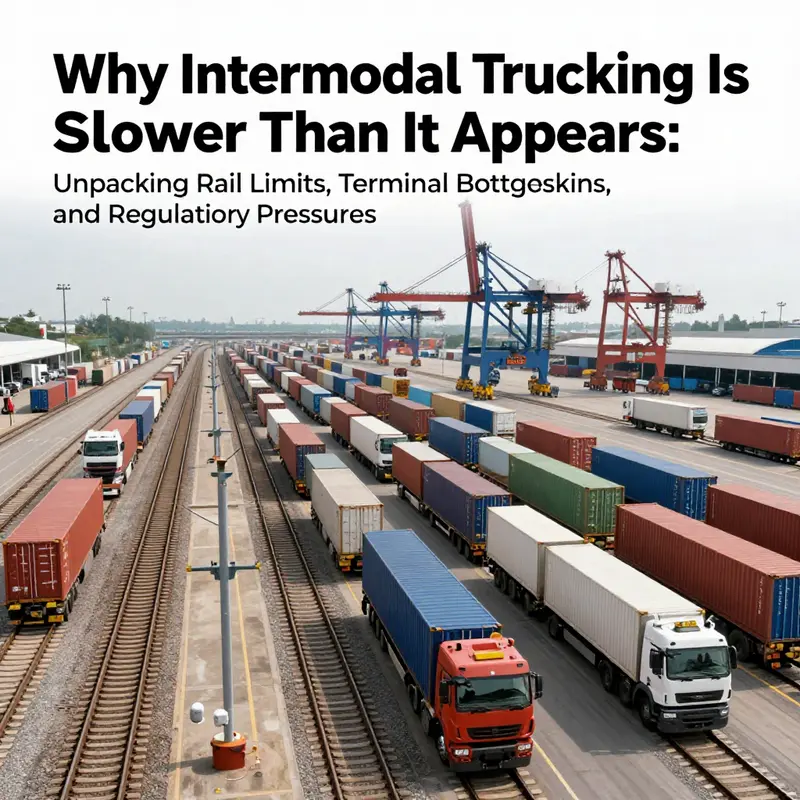
Intermodal trucking combines rail and road to deliver cost efficiency and lower emissions, yet speed remains a persistent constraint. For logistics and freight companies, construction and engineering firms, fleet managers, and food and beverage distributors, reliability and predictability often trump sheer velocity. The integrated nature of intermodal networks requires precise handoffs between rail, terminals, and trucking operations, all bound by fixed timetables, specialized equipment, and cross-border procedures. This article dissects the core reasons behind the slower pace of intermodal trucking—rooted in rail scheduling rigidity, terminal complexity, and downstream regulatory and infrastructure pressures—and translates that understanding into practical, action-oriented strategies. Each chapter builds on the previous one to present a holistic view: Chapter 1 identifies inherent rail limitations and scheduling dynamics; Chapter 2 examines terminal operations and bottlenecks; Chapter 3 analyzes equipment gaps, regulatory constraints, and broader infrastructure pressures. The goal is to equip Logistics & Freight Companies, Construction & Engineering Firms, Fleet Management Companies, and Food & Beverage Distributors with a clear framework for diagnosing slow intermodal performance and implementing improvements that enhance reliability and scalable throughput.
The Slow Relay: Why Intermodal Trucking Needs Time Across Rails, Terminals, and Rules
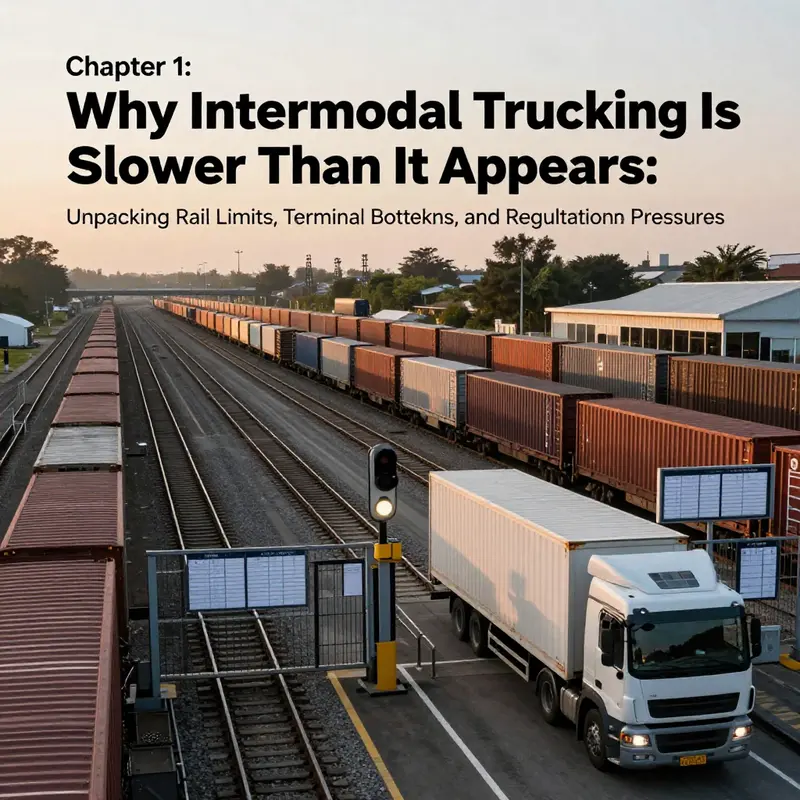
Intermodal trucking sits at the intriguing intersection of speed and efficiency. It promises long-haul cost effectiveness and environmental benefits by combining the reach of rail with the flexibility of road transport. Yet those advantages come with a built-in pace that feels deliberate, measured, even deliberate in its endurance. The slower tempo is not a flaw to be corrected so much as a feature of a system that must coordinate multiple moving parts as if they were pieces in a finely tuned orchestra. To understand why intermodal trucking tends to be slower, one must look beyond the truck and consider the rails, the ports, the terminals, and the rules that bind them. The rhythm of the entire chain rests on schedules that must align across disparate modes, institutions, and geographies. When any one section of the chain hesitates, the entire journey lengthens, sometimes by hours, often by days. The result is a network that prizes reliability and throughput at scale over instant speed for a single shipment. The trade‑off makes sense in the grand calculus of supply chains that must serve entire economies, but it also explains why the intermodal model, in practice, often feels slower than a truck alone crisscrossing a single highway corridor.
A first and fundamental source of slowness lies with rail transport itself. Rail networks are built around fixed schedules and published timetables that reflect decades of investment, maintenance cycles, and safety considerations. Trains cannot bend to a dispatcher’s whim the way a truck can on a highway. They run on predetermined routes with limited flexibility, which is a deliberate design choice to maintain safety and efficiency over long distances. The speed at which trains travel is also constrained by safety standards and track conditions. While modern freight trains can cruise along at respectable clip, the practical pace of intermodal legs often lands in a gentler range than what many shippers expect from road transport. In many corridors, average freight speeds on rail hover in the range of roughly 40 to 60 miles per hour, a bandwidth that, compared with highway speeds, translates into a meaningful delta over longer hauls. But it is not only the speed itself; it is the predictability and the cadence that rail timetables enforce. A delay to a single train can cascade, because rail lines are shared with passenger services and other freight movements. Priority routing decisions, congestion on mainlines, and the need to clear passing sidings all contribute to a schedule that is, in effect, a carefully choreographed ballet, where even minor missteps ripple outward.
If rail is the backbone, then the terminal is the heart that pumps within it. Intermodal containers travel in a relay, moving from truck to train, or vice versa, at specialized terminals designed for high throughput. These facilities rely on precise crane operations, accurate yard management, and seamless handoffs between railroads, trucking companies, and port authorities. The reality on the ground can be starkly different from the idealized picture of smooth transfers. Cranes must align with the correct track and the right train, containers must be sequenced so that the next leg is ready when the truck arrives, and the yard must be navigable amid peak flows. Bottlenecks at terminals are common, especially at major gateways where volumes spike seasonally. Congestion at ports such as those that handle the largest volumes can turn a routine pickup into a waiting game, sometimes stretching into hours or days, depending on the day’s traffic, weather, and administrative load. The terminal is thus not merely a place of unloading and loading; it is a critical control point where timing, equipment availability, and human coordination converge. In practice, the terminal’s performance can be the limiting factor in a chain where every other link operates efficiently. The day-to-day reality is that a container can be temporarily stranded in a yard while a chassis becomes available, or a planned transfer can stall because a crane is tied up with another unit. Each little delay feeds the perception—and the reality—that intermodal trucking is slow, even when the underlying idea is to capture savings and sustainability through rail efficiency.
Equipment availability and the matching of chassis to containers add a further layer of friction. The intermodal cycle hinges on the right combination of container size, chassis type, and availability at the precise moment of service. When a truck arrives at a terminal to pick up a container, it may discover that an empty chassis is not immediately on hand. The mismatch between demand and supply for the mobility frames that carry containers is a frequent bottleneck. During peak seasons, the problem intensifies as more containers accumulate in yards and the pool of usable chassis tightens. In some markets, the shortage of suitable equipment becomes a constraint that beats against the entire schedule, forcing longer dwell times in the yard and slower turnarounds at gate lines. The consequences ripple outward: drivers wait, the clock ticks, and the promise of a rapid handoff evaporates as the pool of available equipment slowly rebalances. This is not a mere inconvenience; it is a structural characteristic of intermodal networks that rely on synchronized equipment pools across multiple operators and terminals. The result is a visible drag on transit times, a drag that grows when one segment of the pool is temporarily depleted while other segments try to catch up.
Regulatory and customs dimensions introduce another substantial layer of delay. Containers traveling across borders face inspections, documentation checks, and compliance processes that can stretch transit times considerably. Even within national borders, regulatory frameworks—whether they govern vehicle dimensions, weights, or driver hours—impose clear limits on how quickly freight can move. The hours-of-service rules for truck drivers, for example, govern driving time and require mandatory rest periods. Those constraints, designed to safeguard road safety and driver welfare, also cap the momentum of the road legs of an intermodal journey. It is not unusual for a single intermodal movement to pause as a driver complies with mandatory rest, or for a shipment to be held while customs authorities complete paperwork and verify compliance with import or export regulations. In some corridors, border crossings introduce additional layers of inspection, which can be time-consuming, dependent on the level of customs scrutiny, the efficiency of the border agency, and even the time of year. The regulatory dimension thus converts what might be a smooth technical transfer into a negotiated choreography that must be repeated across many shipments and jurisdictions.
Infrastructure constraints offer another, more systemic reason for intermodal slowness. Rail capacity is a finite resource, and many networks operate near capacity during busy periods. Aging rail yards and limited intermodal facilities reduce the speed of unit moves and create cascading bottlenecks. When rail infrastructure lags behind demand, even well-planned schedules can unravel. The pace of improvement hinges on capital investment decisions that often span political cycles as well as fiscal calendars. The result is a chronic tension between the potential for higher throughput and the reality of constrained capability. In many regions, upgrade cycles sit behind demand, leaving intermodal routes with aging yards, limited handling capacity, and a miss between the volume that rail can absorb and the volume the market demands. The outcome is predictable: more congestion, longer dwell times at terminals, and slower overall transit times. The intermodal model then becomes a system that favors long‑haul reliability and scalability over the instantaneous speed of a lone truck on a straight route. The design choice is not accidental but instrumental to the larger objective of distributing freight across a network that is cost-effective, adaptable, and capable of serving multiple markets with fewer emissions per ton-mile. Yet the price of that design choice is measured in time.
There is also value in considering regionally specific constraints that illustrate the global texture of intermodal limits. For example, the intermodal trucking domain includes regulatory regimes with explicit dimension and weight limits on trucks carrying containers. In certain markets, such as Hong Kong, trucks transporting containers face tight specifications: maximum width of 2.5 meters, maximum height of 4.6 meters, and weight limits around 23,000 kilograms for a 20-foot container and 25,000 kilograms for a 40-foot container. These numerical thresholds shape what can be moved in a single trip, where and when, and how quickly. They also interact with cross‑border movement, where the same weight caps apply for interchanges between adjacent regions. The handling of dangerous cargo adds another layer of regulatory rigor, requiring special procedures and compliance with safety standards that can slow loading, routing, and unloading. Such specifics matter because they reveal how even apparently straightforward constraints—like the body of a truck or the weight of a container—are embedded in public policy, safety regimes, and regional planning. They remind readers that intermodal trucking is, in large part, a system governed by rules and physical constraints that shape what is possible and when it becomes practical to haul freight.
Beyond the operational details, it is important to acknowledge the concept of combined transport within intermodal logistics. Combined transport places restrictions on the length of the road segment and on how rail services are utilized. These constraints reflect both the desire to optimize rail efficiency and the need to preserve road leg viability for shorter hops or for last‑mile connections. The upshot is that even where rail corridors are capable of moving large volumes quickly, the effective speed is moderated by how long the road legs can be, and by how seamlessly the two modes can be connected. The scheduling challenge, therefore, is to orchestrate a sequence that keeps trains moving at cadence while ensuring that truck legs arrive in time to hand off without creating idle time in yards and at gates. The heart of the scheduling problem is this: a misalignment in one leg can render a perfectly efficient rail movement moot, because the chain remains dependent on a precise, often narrow, window of opportunity to transfer a container between modes. The need for this precision underscores why intermodal networks invest heavily in planning and visibility across the whole journey, rather than focusing solely on the performance of any single leg.
All these layers—rail rigidity, terminal complexity, equipment matching, regulatory strictures, and infrastructure gaps—accumulate into a single, practical message for managers, drivers, and shippers. Intermodal trucking is designed to deliver scale, reliability, and environmental advantages. But it does so by accepting a disciplined tempo that makes it more dependable across the long run, even as it slows down the moment-by-moment experience of moving freight. The slow pace is not incidental; it is the structural implication of a system that must operate across borders, across modes, and across complex networks of equipment, people, and policies. It is a rhythm that emerges from decades of network design choices, safety cultures, investment cycles, and governance frameworks that prefer coordinated efficiency over speed in any individual link. In that sense, the intermodal answer to modern freight demands is a deliberate one: better risk management, improved predictability, and greater capacity to absorb spikes in demand, all backed by the possibility of achieving lower emissions per ton of freight. The speed is the trade-off for resilience and reach.
If one looks beyond the surface, a practical implication emerges for those who manage fleets, terminals, and corridors. Speed is not the sole objective; reliability and total cost of ownership across a multi‑modal journey are the real north star. The same constraints that cause delays can also be leveraged to stabilize network performance. For instance, by decoupling peak demand from the most sensitive rail slots, operators can smooth the flow and reduce random disruptions. By investing in better terminal automation, predictive maintenance for handling equipment, and more accurate scheduling data, facilities can shorten dwell times even within the existing framework. By harmonizing regulatory expectations with industry practice—for example, through harmonized hours-of-service rules or expedited inspection procedures at certain gateways—policymakers and operators can remove bottlenecks without compromising safety.
The broader implication for policy and strategy is clear. The intermodal model relies on shared infrastructure and cooperative governance across modes. When rail operators, terminal operators, trucking firms, and border authorities align incentives, the system can glide with fewer interruptions. The cost of misalignment—longer dwell times, inconsistent handoffs, and unpredictable service windows—translates into higher total transit times and increased volatility for shippers. A more synchronized approach can help reduce the friction that currently slows the relay. This does not mean eliminating the pace at which intermodal movements occur; rather, it means engineering the schedule so that the parts of the chain can work together more predictably, even as they move at different physical speeds. It is a practical acknowledgment that the strength of intermodal logistics lies in its deliberate balance between speed, cost, and environmental performance, and that the ultimate performance metric is not the speed of a single leg but the reliability of the whole journey.
To bring a more concrete sense of what these dynamics look like in practice, consider the concept of terminal dwell and the role of equipment pools. A typical intermodal cycle starts with a trucking leg to a terminal, followed by container handoff to a railcar, then transfer at a rail yard, and finally a truck‑out to the final destination. Each leg has its own dwell times, which depend on the availability of space in the yard, the readiness of the train, and the speed at which cranes can operate. In peak periods, dwell times can extend dramatically as yards fill up and gate queues lengthen. In turn, the transport plan must absorb those delays and reconfigure the sequence of moves, which can force carriers to rearrange loads, reassign drivers, and adjust detention charges. The mathematical complexity of this coordination grows quickly as the scale of operations expands, proving that even with advanced planning tools, the system remains, in essence, a dynamic optimization problem in which every new shipment adds constraints and opportunities alike.
The intermodal ecosystem is, therefore, a study in trade-offs. It is a deliberate stance that markets, planners, and operators adopt when they choose to distribute freight across a rail corridor linked to multiple gateways, instead of pushing everything along a single, direct road route. It is not a failure of efficiency but a different kind of efficiency—one that seeks to maximize throughput over time, minimize emissions, and stabilize costs by leveraging rail’s mass movement capabilities and the flexibility of trucking for the last mile. In this sense, the slower pace of intermodal trucking is less about impairment and more about the strategic design that aligns large-scale capacity with everyday reliability. The challenge—and the opportunity—lies in continuing to improve coordination, invest in infrastructure where it yields the greatest throughput, and cultivate practices that reduce friction across terminals, across borders, and across the many regulatory touchpoints that still shape the tempo of intermodal freight.
For readers who want to explore how these dynamics play out at the policy and industry level, the discussion should include the real-world realities of cross‑border and international intermodal movements. A useful route into this topic is to examine cross-border challenges and how they shape the scheduling discipline of intermodal networks. See navigated cross-border challenges in intermodal trucking for a deeper look at how the governance, regulatory, and operational considerations converge across borders to influence the timing and reliability of intermodal movements. This lens helps connect the micro-level friction at a terminal or rail yard with macro-level patterns in transport policy and international trade.
Ultimately, the slow rhythm of intermodal trucking is a designed characteristic that supports scale, resilience, and sustainability. It reflects a network designed to handle large volumes with fewer emissions and greater flexibility than point-to-point trucking could achieve alone. Yet it remains essential for practitioners and scholars to continuously examine the balance between speed and reliability, to identify where investments can compress the worst delays, and to pursue innovations that reduce dwell times without compromising safety. In that ongoing effort, the intermodal model stands as a testament to how logistics can be engineered not merely to move goods quickly, but to move them consistently, predictably, and with an eye toward a long-term, system-wide efficiency that benefits the entire supply chain.
External resources can provide additional perspectives on intermodal challenges and trends. For more detailed insights into intermodal logistics challenges, refer to the American Association of Railroads’ report on intermodal transportation trends and challenges: https://www.aar.org/intermodal-transportation-trends-and-challenges.
For broader context on cross-border issues that influence intermodal scheduling decisions and to see specific industry discussions on border-related challenges, you can explore related analyses at the internal resource: navigated cross-border challenges in intermodal trucking. This link offers a closer look at how border regimes shape the timing and sequencing of intermodal moves in practice, and how operators adapt to regulatory realities in real time. navigating cross-border challenges in intermodal trucking.
Terminal Tightropes: Unraveling the Slow Pace of Intermodal Trucking Through Complex Operations and Bottlenecks
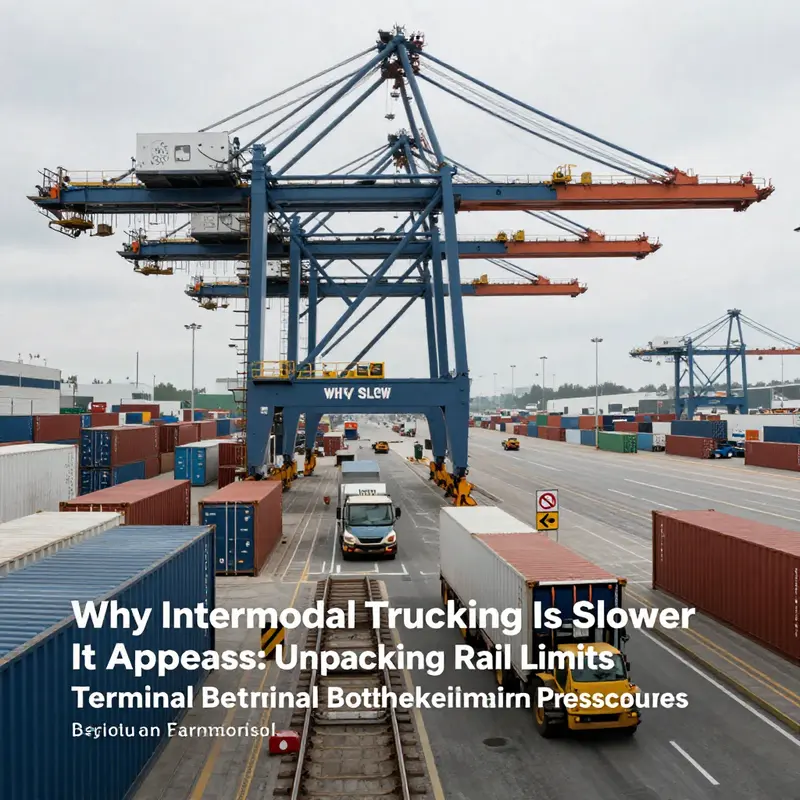
Intermodal trucking sits at the intersection of rail and road, a cross-continental choreography that promises efficiency and scale but often delivers patience instead of speed. The appeal of intermodal freight lies in combining the reach of trucks with the capacity and fuel efficiency of rail. Yet the practical tempo of this system is governed not merely by distance or engine power but by a lattice of interactions that must align perfectly for a container to move from origin to destination. In this sense, intermodal trucking is less a straight line and more a carefully managed ecosystem where each link—the truck, the terminal, the rail segment, and the crossing points at the border or port—must execute its piece at the right moment. When one element falters, the entire chain slows, creating what operators and researchers describe as bottlenecks that ripple across gate lanes, yards, and even the surrounding road network. What appears on a delivery timetable as a straightforward transit time is often the culmination of a concert of delays, some expected and some emergent, that together define the real speed of intermodal freight today.
The first constraint to acknowledge is the inherent limitation of rail transport itself. Trains follow fixed schedules and operate on fixed tracks, which grants them immense efficiency at scale but reduces flexibility. A rail corridor cannot suddenly bend to a new destination the way a truck can. Even where rail networks are modern and well maintained, safety and signaling requirements mean that trains run at conservative speeds. In many regions, rail lines are shared with passenger services, adding a layer of priority routing that can delay freight movements and force longer queues for loading and unloading. The result is a system that, by design, emphasizes reliability and predictability over instantaneous speed. Freight cars and locomotives may be capable of long-haul performance, but their tempo is tethered to timetables, track availability, and the rhythms of the rail system as a whole. In practical terms, a container moved by intermodal means will often wait for the right slot in a train, wait again at the terminal for a berth to become available, and wait still again while the yard orchestrates the transfer from rail to road or vice versa. All of these waiting periods accumulate.
Terminal operations sit at the heart of this slow tempo. Intermodal terminals are high-efficiency environments designed to handle enormous volumes, yet their efficiency is measured in cycles per hour rather than miles per hour. The process of transferring a container between truck and train requires a precise sequence: gate entry, chassis assignment, yard routing, crane operations to lift containers, and the coordination of multiple parties—railroads, terminal operators, port authorities, and trucking companies. Each step depends on synchronized timing and accurate data. Even small misalignments—an misrouted chassis, a crane idle due to a missing signal, or a motorist waiting for an available lane—can cascade into longer dwell times and slower throughput. The terminal has to balance safety, speed, and capacity, a balancing act that grows more complex as volumes increase. When volumes rise, bottlenecks intensify. A spike in containers arriving at a terminal can overwhelm gate operations, create yard congestion, and extend dwell times for import containers, which in turn restricts the terminal’s ability to process subsequent inbound and outbound flows. The net effect is a system that fights for every minute of throughput even as demand pushes the gates wide open.
Gate operations, in particular, become a chokepoint that can erode efficiency even when the physical handling equipment is modern and the yard is well designed. The gate is not merely a point of entry or exit; it is the portal through which data, permissions, and physical movement must all pass in a highly synchronized fashion. Long waiting times for trucks to enter or exit terminals create queues on surrounding roadways, emit higher levels of idling emissions, and contribute to local traffic disruption. The gate acts as a mirror for the overall health of the terminal’s processes: if the gate is slow, it often signals upstream and downstream bottlenecks, from pre-gate documentation checks to post-gate yard loading inefficiencies. In the face of rising container volumes, gate congestion does not just slow a single truck; it propagates through the system, compounding delays as trucks wait for entry windows, a berth at the dock, or an available chassis. The environmental and safety implications are tangible as well, with idling engines increasing local air emissions and creating audible concerns in nearby neighborhoods, port communities, and freight corridors. In many ports, the gate has become a symbolic choke point where the value of terminal automation and digital gate processes is tested in real time against weather, volume surges, and the unpredictable arrival patterns of late shipments.
A particularly stubborn part of the bottleneck picture is the interplay between dwell times and yard throughput. Prolonged import container dwell times are widely recognized as a major contributor to terminal congestion. When a container remains in a terminal beyond its expected dwell window, it occupies a critical space in the yard that could otherwise be used for the next incoming cargo. The longer containers sit, the less space is available for routing and stacking, and the more likely it becomes that yard operations will slow down as staff must navigate tighter configurations and dynamic routing constraints. Dwell time is not merely a function of the terminal’s physical space; it is a signal of a broader inefficiency in the flow of information and the synchronization of activities. If the system lacks precise visibility into the container’s status and location, or if the anticipated transfer events fail to occur on schedule, staff will compensate by allocating extra time buffers. Those buffers, while prudent on a human level, become a source of systematic delay, particularly during peak seasons when every additional minute of dwell time translates into a compounding effect on the terminal’s overall throughput.
To address these issues, researchers and practitioners have proposed several structural responses. One approach focuses on scheduling discipline at the gate: truck appointment systems that allocate specific time windows for entry and exit, which can drastically cut idle time and gate-related congestion. A well-designed appointment system aligns arrival patterns with available gate capacity, enabling smoother flows through the terminal and reducing the strain on surrounding roads. In practice, appointment systems require reliable data about gate availability, truck arrivals, and terminal status, and they rely on a feedback loop in which real-time information continuously updates the schedule to accommodate delays or early arrivals. The promise of such systems lies in the potential to smooth demand, minimize queuing, and decrease the variability that tends to cascade through the terminal. When paired with predictive analytics, appointment systems can anticipate surges, adjust gate capacity in advance, and distribute traffic more evenly across the day. The outcome is not a faster gateway, but a more predictable gateway, which translates into better overall terminal performance and improved service for customers who depend on reliable delivery windows.
Process mining and real-time data analytics are the logical siblings of appointment-based gate access. They provide a means to improve the accuracy and completeness of yard-loading data, capturing how containers actually move through the terminal, rather than how the process is intended to function on paper. This clarity helps terminal operators identify inefficiencies, such as repeated handling, unnecessary moves, or misrouted flows that waste time and space. With robust process mining, managers can observe the true sequence of events, quantify delays, and quantify the impact of specific bottlenecks on throughput. The insights gained from this kind of data-driven analysis feed back into operations, enabling targeted interventions that reduce non-value-added steps. The combination of appointment systems, predictive analytics, and process mining offers a powerful toolkit to move from reactive troubleshooting to proactive optimization. In concert, these tools can lower dwell times, improve yard utilization, and raise the yard’s overall throughput without requiring the physical expansion of rail capacity or the construction of new docks.
To illustrate the practical implications of these concepts, consider a terminal that processes a high volume of inbound containers during peak season. Gate queues lengthen as trucks arrive in unpredictable patterns, while yard space becomes a patchwork of occupied stacks and lane conflicts. The introduction of an appointment-based gate access system can transform this scene by creating a regular rhythm to truck movements. Drivers pre-schedule arrival times, and the terminal schedules gate openings to align with those slots. Predictive analytics monitor expected arrivals against actual flows, flagging potential mismatches before they occur. If a truck is delayed, the system can reallocate an available slot to prevent further backlog, and the yard management system can steer containers to the most efficient lanes and stacks given the current conditions. Process mining then audits the actual sequence of events, highlighting where the most time is lost—whether it is due to late crane availability, misrouted chassis, or miscommunication between rail and truck partners. The result is not a magical surge in speed, but a more coherent, less disruptive flow that reduces the variability of operations and enhances reliability. The broader implication is that by tackling bottlenecks at the gate, and by aligning the entire terminal operation with a data-informed, appointment-driven cadence, intermodal trucking can achieve meaningful improvements in throughput and service levels without necessarily expanding infrastructure.
Of course, these improvements are not a panacea. They depend on a constellation of factors, including chassis availability, inter-terminal coordination, and the pace of regulatory adjustments that influence cross-border shipments and domestic flows. Equipment availability and matching remain a central constraint. The number of available chassis—those frames that carry the container—and the readiness of trailers to accept and move a loaded container are both subject to fluctuation with demand cycles. In periods of peak throughput, the mismatch between chassis supply and trucking demand becomes acute, leading to additional waiting times and reduced confidence in delivery schedules. The problem is compounded when the rail and terminal networks must coordinate with multiple carriers, each with its own scheduling constraints and performance metrics. In such a context, even the best-designed appointment system can be overwhelmed if chassis fleets are insufficient or if one link in the chain experiences a fault that reverberates to the entire system.
Beyond the yard and gate, regulatory and customs procedures contribute to delays in ways that are sometimes invisible to the everyday user but are deeply consequential for overall speed. Cross-border shipments face inspections and documentation checks that can stall an otherwise efficient handoff. Within countries, hours-of-service rules govern truck drivers, limiting continuous driving time and mandating rest breaks. These regulatory constraints are not optional variables; they are embedded in the operating environment. They shape when and how trucks move, influencing patterns of arrivals at terminals and the timing of departures. When combined with the finite capacity of rail networks and the fixed pathways through port terminals, these regulatory constraints create a system that must trade speed for safety, compliance, and reliability. The intermodal model, then, is designed to optimize reliability and scalability, not raw velocity. This is an essential insight for readers who want to understand why intermodal trucking often seems slower, even as it promises greater efficiency and environmental benefits over long distances.
Infrastructure constraints also play a substantive role in shaping speed. In many regions, rail capacity is constrained by aging yards, limited interchange facilities, and insufficient investments in intermodal capability. The consequence is slower turnarounds, longer transfer times, and a backlog of containers waiting for sequencing. Even with modern yard equipment and well-trained staff, an insufficient network backbone prevents the system from achieving higher throughput. The scale of intermodal operations means that incremental improvements in one area—say, terminal automation—must be complemented by broader systemic enhancements in rail capacity and intermodal facilities. Without such complementary investments, improvements can become localized and fail to deliver the fuller impact that a holistic upgrade would generate. This is not merely a matter of money; it is a question of coordinating investments across modes, jurisdictions, and private and public stakeholders to raise the terminal’s capacity ceiling without sacrificing the reliability that customers rely on.
In sum, the slow pace of intermodal trucking emerges from a layered reality. The rail network imposes rigidity; terminal operations demand precision and coordination; gate and yard bottlenecks magnify even minor delays; equipment mismatches create queues; regulatory demands constrain movement; and infrastructure gaps cap throughput. Taken together, these elements form a design that prioritizes reliability, predictability, and scalability over instantaneous velocity. The result is a system that is robust in its ability to move large volumes over long distances while absorbing shocks and disturbances that would derail conventional trucking. The slow tempo has a logic rooted in operational coherence and risk management. For shippers and operators alike, the lesson is not to chase speed in isolation but to pursue coordinated improvements across the entire ecosystem. The chapter you will read next in this book further examines how these dynamics are evolving with technology, policy changes, and new business models, and what that portends for the future of intermodal freight.
In this spirit, the industry continues to experiment with ways to reduce friction without compromising the very advantages that make intermodal attractive. If gate management and yard throughput can become more predictable, if dwell times can be shortened through better planning and tighter data sharing, and if equipment availability can be aligned with demand patterns through smarter allocation, the pace of intermodal trucking can accelerate where it matters most—at the points where trucks and trains exchange loads, and where the data behind those movements can be trusted to tell the truth about what is happening in real time. The path forward is not a single silver bullet but a portfolio of improvements: refined appointment protocols, smarter use of analytics, deeper process mining to illuminate hidden bottlenecks, and a renewed focus on infrastructure and equipment readiness. Together they offer a route to greater efficiency, even if the core character of intermodal transport remains one of measured tempo and disciplined coordination. For readers seeking practical windows into how these concepts translate on the ground, a closer look at terminal case studies and industry reports can shed light on the nuanced trade-offs that define every port, yard, and gate.
As you consider the broader arc of intermodal logistics, the takeaway is that speed in this context is not simply a function of engine power or lane capacity. It is the product of an ecosystem that thrives on disciplined timing, reliable data, and disciplined process management. The slow pace is not a flaw but a feature of a system designed to move immense quantities with high reliability while navigating the inevitable frictions of cross-modal movement. In this sense, intermodal trucking embodies a deliberate, resilient approach to freight that aligns with the demands of global trade: scale, predictability, and sustainable throughput. And while the chapter ahead will continue to unpack the intricacies of this ecosystem, the current analysis underscores that the speed of intermodal freight is a design choice shaped by centuries of infrastructure, regulation, and practice—a design that continues to evolve, even as its core purpose remains steadfast: to move the world’s goods with efficiency, safety, and scale, one deliberate move at a time.
For further reading on intermodal transport challenges and potential gate optimization strategies, see the external resource: https://www.aar.org/intermodal-transportation-trends-and-challenges. The chapter’s discussion of gate optimization and yard throughput benefits from recent academic work, including work on novel truck appointment systems that aim to streamline gate access and reduce idle time. See also the practical examples of modern intermodal terminals that have experimented with smart chassis and integrated gate processes, such as the Stoughton initiative described here: Stoughton Innovative Intermodal Container Smart-Chassis. This combination of data-driven scheduling and equipment innovations helps explain not only why speed remains elusive in intermodal trucking but also how the sector continues to innovate toward a more reliable, scalable, and sustainable model of freight movement.
The Slow Junction: Unraveling Why Intermodal Trucking Lingers Between Ports, Rails, and Roads
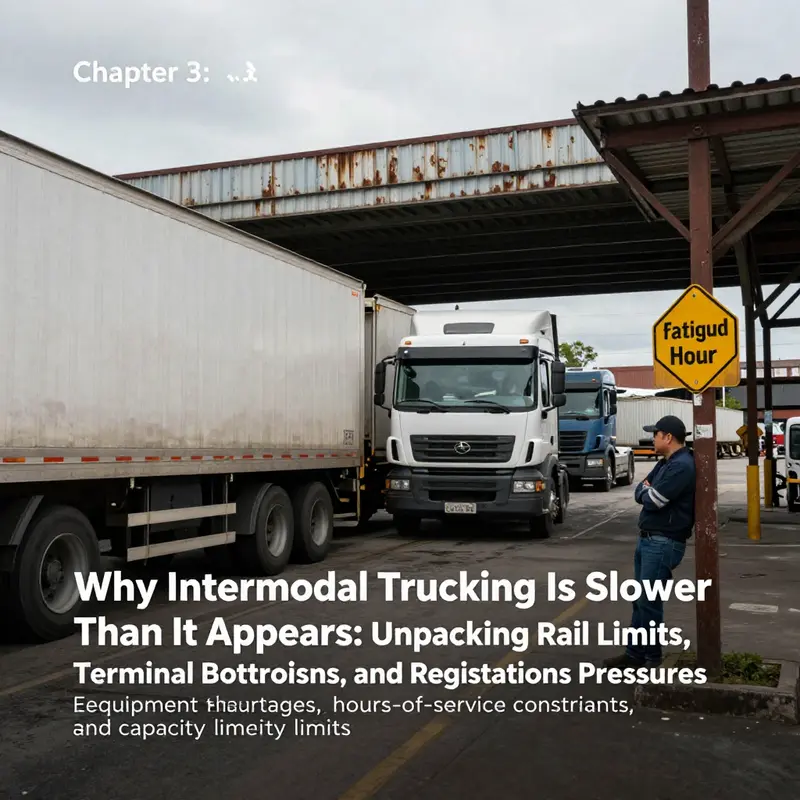
The intermodal chain resembles a complex braid where freight threads must travel through several intertwined fibers at once: the rail network, the terminal yard, and the last mile of trucking. When one strand slackens or tightens, the whole braid behaves differently, often slowing rather than accelerating. The chapter you are about to read treats slow intermodal trucking not as an isolated quirk of culture or markets but as the emergent property of three persistent forces working in tandem: equipment constraints, regulatory constraints, and infrastructure pressures. Each force operates at different stages of the intermodal transfer, from the moment a container is loaded onto a chassis at a port gate to the precise moment it reaches the final mile. The interplay among these forces matters more during peak demand and high-volume seasons, when the system is stretched to its limits. Yet even in calmer times, the structural nature of intermodal movement tends to favor reliability and scalability over speed, a design choice born of the need to coordinate disparate systems with their own rhythms and priorities.
The first strand of this braided problem is equipment. Intermodal facilities rely on a carefully balanced set of assets: yard cranes, reach stackers, transfer units, containers, containers ready for loading, and, crucially, the chassis that carries containers between truck and rail. Each asset type is capital-intensive and requires maintenance cycles that can disrupt availability. A terminal does not simply need more of one asset; it needs the right mix across multiple asset families to match the throughput forecast and the seasonal ebb and flow of demand. When volumes surge, the shortage of any single component can cascade into broader delays. A terminal may have enough outriggers and trolleys, but if cranes are aging or if reach stackers are under maintenance, the transfer sequence—truck arrives, container is detached from the chassis, rail car arrives, container is placed on the rail car, and so forth—slows. The situation worsens when the equipment pool is misaligned across facilities: too many chassis in one port and too few at a neighboring terminal, creating idle time and long trucks queues. The literature highlights that the problem is not simply one of capacity but of visibility and coordination; the same terminal that cannot move containers quickly may still be operating at high utilization for other cargo, masking the bottleneck in a different part of the network. In recent studies, equipment constraints are repeatedly paired with issues around empty-container flows and chassis resource tightness, underscoring how the absence of a balanced, cross-facility asset pool translates directly into longer dwell times and slower handoffs. The upshot is not merely that a crane can lift one container at a time, but that the entire choreography of loading, unloading, and reassigning assets across trucks and trains can become a bottleneck that ripples through the system. The pervasive reminder is that large-scale efficiency requires more than incremental improvements at a single site; it demands coordinated asset deployment, improved asset visibility, and proactive planning that anticipates aging equipment, scheduled maintenance, and the inevitable gaps that appear when demand spikes.
Where equipment constraints bite most is in the transfer nodes that decide whether a container will become a local delivery or a cross-country haul. In practice, a given transfer sequence hinges on the timely availability of the right chassis at the right moment and the right type of handling equipment at the terminal. If a chassis pool is thin on the ground or if an aging crane is offline for a maintenance window, the port gate becomes a choke point. The delay does not simply reflect the time to move metal; it reverberates through the entire intermodal chain by pushing back every scheduled handoff. When a terminal cannot offload a rail car in the time window required by downstream trucking slots, the truck driver faces a waiting period that becomes another layer of idling time, further reducing the efficiency of the entire leg. The literature also notes that the problem is amplified by the logistics of matching container moves with truck and rail slots. The misalignment between modes—between when a chassis is available, when a crane can operate, and when a train is scheduled to depart or arrive—creates a mosaic of idle intervals that add up to meaningful delays over a typical route. In this sense, equipment constraints are not mere headwinds; they are structural features of the system, reminding stakeholders that value is created not by moving more boxes per hour in isolation but by moving them with fewer unnecessary pauses across the entire network.
Regulatory constraints, the second leg of the braid, add another layer of discipline that can slow pace while safeguarding safety and standardization. The most salient example is the hours-of-service regime that governs driver activity. In jurisdictions where these rules apply, the driver can operate within a limited driving window and must observe mandatory rest periods. These rules are designed to protect truck drivers and other road users, but when intermodal chains require tight scheduling across multiple modes, the cumulative effect of rest breaks and driving time restrictions becomes a constraint on throughput. Planning intermediations—such as setting routes that can accommodate rest requirements, aligning driving windows with windowed rail departures, and finding gates at ports during the scarce hours when both rail and port operations run smoothly—requires optimization that can substantially complicate operations. Modern scheduling models increasingly embed hours-of-service compliance into the core of their route design, recognizing that feasible itineraries must satisfy regulator-imposed constraints as well as physical ones. The consequence is a shift from the old assumption that drivers can simply press through a sequence of handoffs to a more deliberate approach that blends feasibility with efficiency. The regulatory dimension also touches other aspects of the intermodal ladder. Documentation demands, inspections at international borders, and the necessity to carry and present certain records all contribute to the incremental time passengers and freight spend at gates and terminals. Even when regulatory steps occur outside the strictly mechanical transfer process, they shape the pacing of the chain by setting the cadence at which the system can release cargo into the next stage. In practice, the regulatory environment compels planners to create buffers, build contingencies for delays, and maintain flexible appointment slots that can accommodate unforeseen slowdowns without cascading into late deliveries. The net effect is a choreography that values reliability and compliance over pure speed, a choice that aligns with the long-term goals of intermodal networks that prioritize predictable throughput and scalable capacity over sprinting between handoffs.
Infrastructure pressures sit at the intersection of policy, capital, and geography. The state of physical infrastructure— rails, yards, gates, and road connections to terminals—plays a decisive role in throughput. In many regions, rail capacity remains limited by aging yards, constrained track layouts, and insufficient yard capacity to support rapid container transfers. Even where track capacity exists, the internal logic of the yard can slow things down: long lines of containers waiting for a crane or a truck waiting for an available chassis. The result is a multi-layered congestion problem where the terminal cannot aggressively push throughput because it must maintain safe separation distances, account for equipment cycles, and accommodate variations in ship arrivals and train schedules. The sea-to-rail interface, a critical bottleneck for many intermodal chains, suffers especially when port connectivity to hinterland networks remains fragile. The port gates may process dozens of trucks per hour, but if the adjacent rail yard cannot receive containers with the same speed or if the road connections to the terminal are choked, the gains from other improvements are quickly eroded. Infrastructural constraints do not simply slow down the transfer; they define the ceiling on how much throughput a given corridor can realistically sustain. A digital layer—shared data in real time about container location, chassis status, and train arrival times—offers a potential remedy, but it must be paired with tangible investments in yard modernization, track expansion, and better road-rail interfaces that reduce dwell times and improve turn times.
Taken together, equipment constraints, regulatory constraints, and infrastructure pressures form a triad that shapes the tempo of intermodal trucking in meaningful ways. They interact in a manner that makes the problem inherently systemic: a bottleneck at a single node can propagate delays downstream, and a concerted improvement in one area without corresponding advances in the others often yields suboptimal results. This is why studies emphasize cross-modal coordination and asset-sharing rather than isolated optimization at one port or one railway yard. Predictive analytics and optimization approaches are repeatedly highlighted as promising paths forward because they can weave together constraints from multiple domains into a coherent plan. They can incorporate driver hours, inventory of handling equipment, maintenance windows, and the real-time status of vessels, trains, and gates. The aim is not to eliminate all delays but to reduce their frequency and duration by making the flow more predictable and better aligned with the realities of multi-modal coordination. In this sense, the slow pace of intermodal trucking is not simply a problem of inefficiency; it is the price of resilience. The network accepts slower speed in exchange for broader coverage, safer operations, and the flexibility to scale across diverse markets and cycles of demand. A capacity-limited system that thrives on reliability and cross-facility collaboration inevitably prioritizes the predictable, repeatable segments of the chain over the occasional rapid sprint. The cost of this design is measured in minutes and hours, not days, but those minutes and hours accumulate across thousands of moves to shape the comparative economics of intermodal freight.
What does this mean for practitioners and policymakers who seek to accelerate certain components of intermodal performance without compromising reliability? The literature suggests a few directional shifts that could offer meaningful gains without undermining safety or systemic integrity. First, investment in modernizing handling equipment and in creating balanced asset pools across facilities can substantially reduce idle times and dwell at critical transfer points. This means not just more cranes, but smarter deployment of equipment that allows assets to move in a more synchronized fashion between ship, rail, and road legs. Second, embracing data-driven scheduling and cross-facility asset sharing can mitigate the misalignment of modes. When a port has a high forecast for container moves, it should be able to draw from a shared pool of chassis and containers across nearby terminals, as well as coordinate with rail slots to minimize waiting times. Third, policy and planning should proceed hand in hand with infrastructure upgrades. Modernization of rail yards, expansion of intermodal facilities, and improved port access are more effective when complemented by standardized digital interfaces that enable real-time data exchange among shippers, trucking entities, terminal operators, and rail providers. The goal is to reduce the friction at the boundaries between modes, where sequential dependencies often govern speed. Finally, the regulatory framework must be aligned with operational realities. This does not imply loosening safety standards, but rather refining rules to recognize the joint nature of intermodal transfers. For example, harmonized gate procedures across modes, standardized documentation, and more flexible scheduling allowances could yield meaningful gains in throughput if implemented with proper oversight and transparency. The challenge is not simply to push the system harder; it is to push it smarter—to move more freight through the same network by reducing the non-value-added time that creeps in at the most fragile chokepoints.
In closing this integrated portrait, it is important to connect the dots across the elements described above. The three drivers do not operate in isolation; they reinforce each other in ways that shape the measured tempo of intermodal trucking. When equipment is scarce or aging, and when drivers are bound by strict hours-of-service rules, terminals slow, pipelines tighten, and gates become waiting rooms. When infrastructure is strained by insufficient rail capacity or outdated yards, even well-coordinated equipment and compliant operations cannot sustain high throughput without creating bottlenecks elsewhere. The upshot is a system that has learned to prioritize reliability, predictability, and cross-modal coherence over the raw speed of any single leg. This is a deliberate design choice. If intermodal trucking were to chase speed alone, it would risk destabilizing the schedule across multiple stakeholders and modes, potentially creating more severe delays when disruptions occur. The faster, more fragile model would be less resilient in the face of peak volumes, port congestion, or border delays. Instead, the slow pace is a feature that enables scale, coverage, and consistency across geographies and seasons. It is a balance that, when managed with sophisticated scheduling, shared asset pools, and digital transparency, yields a network capable of absorbing shocks while maintaining sustainable throughput.
For readers who want to dive deeper into the policy and operational dynamics that shape how these constraints manifest at the sea-rail interface, there is a wealth of analysis that connects infrastructure investment decisions with measurable throughput. One external resource provides a detailed examination of how sea-rail connectivity, intermodal yard modernization, and digital platform integration can unlock higher throughput while maintaining resilience. This resource argues that coordinated infrastructure upgrades, backed by data standardization and cross-modal collaboration, are essential to realize the gains promised by intermodal strategies while keeping the system robust enough to weather seasonal spikes and regulatory shifts. As the intermodal ecosystem evolves, stakeholders will increasingly rely on these integrated approaches to move freight not merely with more capacity but with better flow and fewer unnecessary pauses across the chain.
Internal link reference for further context on cross-border coordination (recommended reading): Navigating cross-border challenges—key insights from the TCA annual meeting.
External resource for extended reading: Toward an efficient sea-rail intermodal transportation system. MDPI Sustainability 2024. https://www.mdpi.com/2071-1050/16/14/5893
Final thoughts
The pace of intermodal trucking is bounded by three interlocking domains: the inherent limits of rail transport and its scheduling discipline; the complexity and bottlenecks of terminal operations that govern handoffs; and the confluence of equipment availability, regulatory constraints, and aging infrastructure. Each factor elevates reliability and predictability as primary success metrics over speed, shaping how carriers, shippers, and operators design networks and service levels. However, the path forward is clear. Investing in synchronized data sharing and collaborative planning across railways, terminals, and motor carriers reduces idle times and misalignment. Expanding chassis pools and container availability, improving yard automation and cross-dock capabilities, and adopting standardized, auditable regulatory and compliance processes can materially reduce transfer times. Finally, targeted infrastructure investments and public–private partnerships to modernize rail yards, optimize capacity, and streamline cross-border movements will unlock faster, more reliable intermodal throughput at scale. The end goal is not merely to move freight faster, but to increase throughput predictably while preserving the cost and environmental advantages that make intermodal attractive in the first place.