

The U.S. trucking landscape in 2026 presents a bifurcated reality: a broad market grappling with persistent profitability pressure, severe driver scarcity, and capacity constraints, juxtaposed with a robust, stabilizing surge in cross-border freight flowing from Mexico. This dual dynamic is not purely academic; it shapes how logistics and freight companies, construction and engineering fleets, fleet management providers, and food and beverage distributors design resilient supply chains. Profitability in the domestic market remains constrained even as spot and contract rates trend modestly higher. At the same time, the Mexico freight boom introduces a steady, high-value demand stream that cushions carriers from shocks and provides a clearer path to sustainable margins. The chapters that follow unpack this complex picture: Chapter 1 examines the profitability landscape and market health; Chapter 2 assesses driver shortages, capacity constraints, and cost structures; Chapter 3 highlights the stabilizing force of cross-border trade with Mexico; Chapter 4 explains how high-value, time-sensitive loads favor niche carriers; and Chapter 5 assesses regulatory risk and strategic responses. Together, these sections equip readers to identify where the trucking business is actually good, and where focused strategy is essential to success.
Stability by the Border: The Mexico Freight Boom and the Real Profit Landscape of U.S. Trucking in 2026
The trucking business in 2026 sits at a curious inflection point. On one side, a broad swath of the U.S. market remains pressed by margin compression, a stubborn driver shortage, and capacity constraints that make even modest demand spikes painful. On the other, a long, quiet but powerful current runs from Mexico—nearshoring, foreign direct investment, and a steady march of high-value, time-sensitive freight that is reshaping profitability at the segment level. When you step back and map the landscape, the question “is the trucking business good?” becomes less a single yes-or-no verdict and more a nuanced calculation that depends where you sit in the market and which freight lanes you own. The 2026 picture is a tale of two realities: a fragile balance in the broader U.S. trucking ecosystem, and an increasingly lucrative corridor across the border that is acting as a stabilizing anchor for North American logistics.
Across the United States, the indicators are telling a cautious story. Even as spot rates edge up—roughly 3.6 percent from the earlier troughs and contract rates about 2.6 percent higher—the gains are largely absorbed by inflation. Analysts describe a “no-profit recovery,” a phrase that captures the sense that improving top-line revenue is eroded by rising costs and a difficult operating environment. The acute driver shortage compounds the challenge. With an estimated shortfall around 80,000 drivers, the industry is forced to stretch existing capacity, pay higher wages, and accept more conservative utilization. Capacity itself remains structurally tight; orders for new tractors and trailers have collapsed to levels that mirror or even fall below pandemic lows, leaving fleets’ expansion plans frozen and amplifying sensitivity to demand fluctuations. When you couple this with high fixed costs, rising fuel expenses, and the persistent overhead of compliance, it’s easy to see why the sector struggles to translate improved rates into real profitability.
The cost side of the ledger further complicates the math. The industry continues to wrestle with a high operating cost per mile, even when trucks are loaded. Empty miles account for roughly 15 percent of total mileage, and the combined effect is that the effective cost per full mile sits around $2.60. Yet spot market rates frequently hover near $2.15 per mile, a spread that leaves many carriers operating below break-even, especially smaller fleets and owner-operators who shoulder a disproportionate share of overhead and financing costs. In this environment, even seemingly positive rate movements must be weighed against a backdrop of fuel volatility, maintenance, insurance, tolls, and the costs of recruiting and retaining a professional driving workforce. The regulatory environment adds another layer of risk. Proposals to restrict commercial driver licenses to non-residents threaten to shrink the available pool of drivers by as much as 200,000 carriers if enacted, a scenario that would tighten capacity further and elevate freight rates during periods of peak demand. Legal reviews and political debates around such rules inject a level of uncertainty that complicates medium-term planning for fleets of all sizes.
In this tense broader market, it is easy to overlook a countervailing force that is quietly redefining profitability for a subset of carriers: the Mexico freight boom. The U.S.-Mexico cross-border corridor is becoming the market’s primary stabilizer, and its impact is not merely cyclical but structural. Nearshoring trends have driven a surge of foreign direct investment into Mexico—some $34.3 billion in 2025 alone—fueling the relocation of automotive, electronics, and industrial manufacturing from Asia to Mexican facilities. This shift translates into a tangible, high-velocity stream of goods crossing the border into the United States, and the data are hard to ignore. Mexican exports to the U.S. grew by roughly 15 percent in recent months, a sign that the cross-border supply chain is undergoing fundamental change rather than a temporary rebound. Border crossings such as Laredo and El Paso have seen daily freight volumes rise by about 8 percent year over year, even in December, a season when volumes typically soften in other markets. The stability of this channel is particularly notable because it persists even as domestic markets wobble under tariff adjustments and uneven macro signals.
What makes this corridor especially meaningful is the composition and value of the loads. A substantial portion of cross-border traffic—more than 40 percent—consists of auto parts and other high-value, time-sensitive shipments. These loads command higher margins, typically in the range of 15 to 20 percent above more commoditized freight, and they tend to be more predictable in terms of scheduling and reliability. For carriers that can control the end-to-end flow—efficient border crossings, customs clearance, and timely delivery windows—the cross-border lane can deliver steadier utilization and a stronger cash cycle, even when the domestic market remains volatile. In practical terms, the border freight boom acts as a stabilizer: it shores up revenue during periods of domestic softness and cushions some of the volatility that otherwise ripples through the U.S. trucking ecosystem. As one observer notes, clients in this space have adapted to tariff environments while maintaining consistent import volumes, a testament to how structural shifts in manufacturing and consumption are reshaping demand patterns across the network.
From the vantage point of profitability, the Mexico freight niche is not a mere exception; it has become the most meaningful benchmark for what sustainable, profitable trucking can look like in 2026. For carriers with access to efficient routes through the key border crossings and the operational discipline to handle high-value, time-sensitive cargo, the math is more favorable. The higher margins on a meaningful share of loads can offset the revenue stagnation in other segments and help strengthen a carrier’s overall margin profile. In addition, the predictability of cross-border demand—fueled by nearshoring and a more stable tariff landscape—helps with capacity planning and fleet utilization. It is not that the entire industry suddenly becomes flush with cash; rather, a strategic pivot toward Mexico freight opens a viable path to profitability for those willing to invest in border operations, compliant processes, and the specialized know-how needed to service high-value cross-border shipments.
The practical implications for the broader market are clear. For many smaller operators and mid-sized fleets, profitability remains fragile unless they can lean into this stabilizing corridor. That means rethinking logistics networks, prioritizing border-crossing efficiency, and building capabilities around time-sensitive, high-margin cargo. It also implies greater investment in people and processes: bilingual operations for customs and compliance, tighter partnerships with cross-border brokers and carriers, and smarter scheduling that reduces dwell time at border points. In other words, the difference between a marginal, barely-profitable operation and a healthy, sustainable one could hinge on how well a carrier aligns its core competencies with the cross-border opportunity rather than simply chasing volume on domestic lanes.
For readers who want a deeper dive into the policy and operational dynamics of cross-border trucking, there is valuable context to be found in analyses that examine the regulatory and logistical environment surrounding border movements. This conversation is not only about tariffs or CDL rules; it is about how supply chains adapt to sustained changes in trade flows, manufacturing footprints, and supplier diversification. As these shifts unfold, the cross-border corridor does more than provide revenue; it shapes willingness to invest in equipment, people, and technology that improve reliability and service levels across the entire network. In this sense, the trucking industry’s outlook in 2026 is less a single narrative of profit or loss and more a mosaic of strategic choices. Fleets that cultivate a Mexico-centered operational model—without neglecting domestic service where feasible—stand the best chance of turning what could be a precarious market into a durable, even resilient, business.
For a broader understanding of cross-border policy and its effect on trucking operations, you can explore this analysis on cross-border challenges—key insights from the TCA annual meeting, which provides context on how industry participants are adapting to evolving trade and regulatory conditions. navigating cross-border challenges—key insights from the TCA annual meeting.
Beyond the tactical adjustments, the larger question remains: Is trucking good? The answer depends on the lens. In the aggregate, the U.S. trucking market is not broadly robust—profitability remains stubbornly modest, capacity is tight, and regulatory shocks carry outsized risk. Yet for carriers that harness the Mexico freight opportunity, the outlook is markedly more favorable. The corridor’s mix of high-value loads, stable demand, and improved margins creates a counterweight to domestic headwinds and offers a blueprint for sustainable growth in an otherwise challenging environment. This nuanced truth is essential for stakeholders to acknowledge as they chart capital allocation, fleet strategy, and talent development in the years ahead.
For readers seeking a complementary external perspective on industry profitability and long-term resilience, the American Trucking Associations’ Industry Outlook Report provides a comprehensive framework for interpreting freight-rate trends, utilization, and financial performance across segments. External resource: https://ata.org/research/industry-outlook-reports/.
Chapter 2: A Tight Road to Profit — Navigating Driver Shortages, Capacity Crunch, and Cost Pressures in 2026 Trucking
The year 2026 in U.S. trucking tells a story of contrasts. The sector is not uniformly thriving, yet it has started to lift its head after years of pressure. Rates have inched higher—spot markets up about 3.6 percent and long term contracts roughly 2.6 percent—yet inflation gnaws away most of those gains. In this environment, the question of whether the trucking business is good cannot be answered with a simple yes or no. It depends on where you sit in the network: the broad market remains fragile and price sensitive, while pockets of high value, time sensitive freight offer a sturdier path to profitability for carriers that position themselves correctly and operate with disciplined efficiency. This duality is exactly why 2026 feels like a pivot point—a moment when the market tests new strategies instead of just chasing higher rates. The broader arc of the industry is shifting toward a model where reliability and specialization matter as much as price, and that shift is most visible in the way carriers are learning to relate to scarce drivers, constrained capacity, and the evolving cost landscape.
The driver shortage remains the most enduring constraint in the system. Official estimates point to a gap of roughly 80,000 drivers, a figure that translates into slower service, longer onboarding times, and elevated labor costs across fleets of all sizes. Carriers are responding with a blend of better pay, enhanced benefits, and more robust retention programs, alongside investments in training, onboarding, and culture. Yet even as companies try to make the role more appealing, the fundamental work–life balance issue haunts the industry. Long stretches away from home, limited home time, and the feeling of being a number in a payroll system persist as major sources of turnover. A 2015 review of worker sentiments still resonates with today’s reality: minimal home time, wages not keeping pace with the cost of living, and the relentless cycle of recruitment that never fully resolves the underlying tension. While this is not a novel problem, its persistence shapes how fleets plan capacity, project demand, and structure compensation programs. The practical impact is visible in scheduling, lane profitability, and the willingness of drivers to switch lanes for better conditions rather than chasing a marginally higher hourly rate.
Cost dynamics add another layer of complexity to a market that is otherwise tightening its belts. The cost of operating a truck is high and rising. Fuel, maintenance, insurance, and driver wages all contribute to a cash flow equation that is not easily balanced by modest rate increases. An important statistic in this mix is the share of empty miles, which runs about 15 percent of total mileage. Those empty miles translate into a higher effective cost per loaded mile. When spot rates cluster around 2.15 per mile for full moves, many carriers struggle to cover costs, particularly on routes with long dwell times or frequent detentions. This is the essence of a no-profit recovery: marginal gains from rate increases are largely offset by inflationary pressures and the ongoing expenditure on labor and equipment, leaving many operators with little real improvement in bottom-line profitability. The reality is particularly acute for small carriers and regional fleets that cannot spread fixed costs across a broad network. In that sense, profitability in 2026 is less about a broad market uplift and more about disciplined routing, stable, high-value lanes, and careful asset deployment.
The market’s capacity picture remains stubbornly tight, reinforced by structural constraints rather than cyclical shortages. Demand for new tractors and trailers has sunk to levels that even precede the most acute parts of the pandemic, implying that fleet expansion is unlikely in the near term. When capacity is constrained in this way, the industry becomes highly vulnerable to demand spikes. The risk is not only price spikes but also service disruptions, longer transit times, and increased detention. Fleets are forced to optimize use of every asset, often by stacking trips in dedicated lanes, prioritizing lanes with more predictable demand, and leveraging data-driven scheduling tools. The result is a more deliberate, less speculative growth trajectory where profitability hinges on efficient utilization of a limited set of assets rather than rapid expansion.
Regulatory uncertainty compounds these pressures. The possibility that commercial driver licenses could be limited to non-residents threatens to shrink capacity even further. If enacted, this policy could remove a substantial slice of the driver pool and reorganize the entire capacity map. Even the contemplation of such a rule reverberates through equipment orders, route planning, and fleet age profiles. The regulatory atmosphere thus adds a layer of risk that operators must price into their plans, in some cases slowing investment decisions and complicating long-range budgeting. The legal review surrounding this rule underscores how policy design can ripple through the supply chain, reminding operators that the market remains vulnerable not only to economic forces but to the political currents that govern it.
Yet the domestic headwinds have a countercurrent that is powerful and structural: the Mexico freight boom. Nearshoring and reconfiguration of supply chains have redirected significant manufacturing activity to Mexico, bringing a steadier and higher value stream of freight across the border. This shift is not a temporary blip; it shows a structural growth pattern that is reshaping risk and opportunity in the sector. Mexican exports to the U.S. have grown by about 15 percent in recent months, while crossings such as Laredo and El Paso report daily freight volumes that are up year over year. A large portion of this cross-border traffic comprises high-value, time-sensitive shipments such as auto parts and other components, where margins run roughly 15 to 20 percent higher than standard freight. The cross-border corridor is not just an alternative route for existing customers; it is a strategic channel that diversifies risk and stabilizes cash flow for carriers willing to invest in border competencies, compliance, and dedicated lanes.
This cross-border stabilizing force has begun to redefine profitability expectations for the sector. The core logic is straightforward: when domestic markets are uncertain, the reliability and scale of cross-border flows provide a predictable revenue stream that can absorb volatility elsewhere. Carriers with access to efficient cross-border routes, strong border crossing operations, and the capacity to handle time-sensitive cargo can anchor a portfolio that would otherwise be exposed to a squeeze on margins. In practice, this means training staff on cross-border compliance, investing in border-specific dispatch capabilities, and building relationships that ensure timelines hold even as tariffs or policy questions ripple through supply chains. It is not a panacea, but it is a powerful counterweight to domestic fragility. Industry executives highlight that the border corridor offers not only resilience but also an opportunity to deepen capabilities around shipment visibility, risk management, and customer service—areas where reliable performance translates directly into higher margins in a market that has long rewarded consistency over price competition alone.
From a strategic perspective, the current year is teaching operators to recalibrate what it means to be profitable. The financial renaissance that observers note is not a blanket uplift but a selective, discipline-driven improvement. Rate increases, where achieved, are meaningful only when matched with cost control, asset utilization, and a focus on higher-value freight. In this sense, the trucking business is becoming more like a portfolio management exercise than a straightforward volume game. Operators that optimize routes to minimize empty miles, invest in driver training and retention, and choose lanes where service quality is the differentiator can realize solid returns even when the macro backdrop remains uncertain. Technology is playing a crucial role here, not by replacing human capital but by making it more productive. Advanced driver assistance systems, route optimization software, and end-to-end visibility tools help shrink delays, reduce detention, and boost the performance of limited-capacity fleets. They do not solve the driver shortage, but they make the available workforce more effective, enabling carriers to serve customers with greater reliability and at acceptable costs.
It is also worth noting that the cross-border opportunity reshapes how fleets think about growth, risk, and capital allocation. The most successful carriers are not chasing a broader market blindly but are instead pursuing depth in a few high-value, high-reliability lanes. They understand which customers demand punctuality and which cross-border corridors offer the best predictability and margin. They cultivate talent, not only in driving but in the operational disciplines that accompany a border-centric business—compliance, border crossing timing, cargo verification, and cross-functional coordination across freight teams. In doing so, they create a virtuous cycle: reliable service attracts more shipments in preferred lanes, which in turn justifies investments in equipment and people. This approach aligns with the broader industry movement toward service differentiation as a core strategy, rather than relying solely on price competition to win business.
For readers seeking a deeper framing of cross-border dynamics and policy context, see Navigating cross-border challenges: key insights from the TCA annual meeting. This linked discussion helps illuminate how border policy, tariff regimes, and regulatory shifts shape capacity allocation and schedule reliability, reinforcing the idea that your niche matters as much as your overall footprint. And for a broader historical perspective on collaboration in trucking, consider the longer view offered by this external reference: Trucking 2014: Collaboration is the game.
Chapter 3: The Trucking Business in 2026: How the Mexican Cross-Border Freight Boom Stabilizes a Fragile Market
Is the trucking business good? In 2026, the answer is nuanced, and the truth depends on which lane you operate. The overall North American market wears a resilient face, yet a closer look reveals a landscape under pressure, where gains are hard-won and risk is a regular feature. The domestic freight scene is marked by what analysts call a “no-profit recovery”: modest price bumps on spot rates, a little higher contract pricing, and, crucially, inflation that swallows most real gains. For many small operators and mid-sized fleets, every mile logged is a test of discipline, cash flow, and the ability to navigate a fragile equilibrium between demand and the cost of moving goods. In this environment, the most consequential development is not a single policy or a single market surge, but a stabilizing current running through the border with Mexico that makes the broader picture far less bleak than it would otherwise be. A growing, steady stream of cross-border commerce is acting as the market’s anchor, and that anchor is changing the math for carriers who can capitalize on it.
Within the United States, the market’s challenges are well documented. A record-breaking driver shortage—roughly 80,000 fewer drivers than the industry needs—places a heavy burden on scheduling, service reliability, and wage pressure. Structure constraints further complicate the picture: orders for new tractors and trailers sit at or near historic lows, a sign that fleet expansion is unlikely any time soon. That lack of capacity makes peak-season congestion not just an annoyance but a real risk, creating bottlenecks that can reverberate through the supply chain. The cost structure of trucking remains unforgiving. Even with some rate improvements, the effective cost per mile stays high because empty miles persist at about 15% of total miles. With spot rates around $2.15 per mile and loaded miles being the main revenue source, many carriers still operate below break-even, especially when factoring in fuel, insurance, maintenance, and regulatory compliance. And looming over all of this is regulatory uncertainty—a proposed rule that could limit CDLs to non-residents threatens to shrink carrier capacity by a substantial margin if enacted, a policy under legal review that could destabilize an already tight market.
Against that backdrop, a bright and unexpected stabilizer has emerged: demand for U.S.-Mexico cross-border freight. Nearshoring and a new wave of foreign direct investment into Mexico have reshaped the trade flow and, with it, the economics of trucking along the border. In 2025, Mexico attracted approximately $34.3 billion in FDI, a powerful signal that manufacturing and supply chains are reconfiguring toward Mexico as a regional hub. This is not a temporary or cyclical shift; it is a structural trend that feeds sustained demand for reliable, time-sensitive trucking capacity. Mexican exports to the United States grew around 15% over recent months, a rate that exceeds ordinary seasonal fluctuations and points to a durable acceleration in cross-border trade. Border crossings at major arteries like Laredo and El Paso have seen daily freight volumes climb about 8% year over year, even as December wrapped with more cautious economic sentiment.
What makes this cross-border freight so compelling, and how does it translate into real opportunity for carriers? A significant portion—more than 40%—of this traffic consists of auto parts and other high-value, time-sensitive shipments. Those loads command margins that run roughly 15% to 20% higher than standard freight, offering a cushion against the high operating costs that gnaw at every carrier’s bottom line. In practical terms, a stable, high-value cross-border lane translates into more predictable revenue streams, better asset utilization, and a lower risk of price erosion caused by sudden domestic demand shocks. The reliability of this corridor matters especially when domestic demand remains uncertain and tariffs or policy shifts threaten to destabilize supplier networks. Industry voices, including observers who follow cross-border movements closely, emphasize that clients have adapted to tariff environments and that import activity along the U.S.-Mexico axis has “steadily stabilized.” This is not a marketing narrative; it is an observable shift in where and how carriers can earn a living in today’s market. A growing corpus of trend data supports the conclusion that the border corridor is the most important driver of near-term profitability for many fleets. To stay competitive, operators are increasingly prioritizing cross-border expertise: the routes, the border-crossing timing, the handling of perishable or high-value cargo, and the compliance requirements that accompany cross-border shipments. In other words, this is a market where geography, policy, and product mix collide in ways that reward those who can align operation with the border’s rhythms. For readers following the latest frontier in cross-border logistics, the route map isn’t just about lanes; it’s about understanding the evolving border economy and the way manufacturers, suppliers, and transport providers renegotiate risk in a border-first supply chain. Navigating cross-border challenges: key insights from the TCA annual meeting offers a concise snapshot of how carriers are adapting to border realities and policy adjustments in real time. This growing body of cross-border insight is not a sidebar; it is central to any assessment of trucking’s health in 2026.
The practical implications of the Mexico freight boom extend beyond margin expansion. Carriers that establish efficient border routes and cultivate capacity on the key crossings gain a more stable footprint, which in turn supports better forecasting and investment discipline during periods of domestic volatility. Firms with a coastline of reliable cross-border lanes can optimize equipment usage, align maintenance cycles with the slower, steady rhythm of lower-trade months, and hedge against the risk of domestic tariff-driven demand swings. The cross-border corridor also pushes carriers to sharpen their compliance posture, because border logistics demand precision in paperwork, timing, and customs coordination. This is why many operators view the current moment as a test of strategic clarity: can they reallocate vehicles and talent toward the border, build stronger cross-border partnerships, and still manage a domestic freight base that remains volatile? The answer for those who can adapt appears clear: the cross-border freight market is not merely a growth opportunity; it is a stabilizing backbone for a sector that otherwise trembles under price pressure, capacity constraints, and regulatory risk.
Despite the optimism surrounding border freight, the broader sector must contend with a countervailing truth: the market’s health will continue to hinge on the durability of cross-border demand and on the ability of carriers to manage risk. In this sense, 2026 is less about a broad recovery in trucking profitability and more about how quickly fleets can anchor themselves in high-value, cross-border lanes while maintaining strong performance on domestic routes. The near-term outlook suggests a bifurcated landscape: a challenging domestic environment where many operators struggle to cover costs, and a comparatively favorable niche where Mexico-bound freight sustains volumes and profitability. For the average U.S. trucker, the picture remains mixed; for carriers that specialize in cross-border traffic and can execute high-value, time-sensitive loads with discipline, the year looks substantially better and, crucially, more predictable. The cross-border corridor is not a cure-all, but it is the sector’s most reliable bulwark against a cascade of domestic market headwinds. In this sense, success in 2026 will resemble a strategic narrowing of focus, aligning with a structural growth path that has already begun to redefine which fleets thrive and which fleets simply weather the storm. External economic currents may still test the sector, but the border economy offers a durable, value-rich horizon that makes the broader trucking landscape appear less unstable than it otherwise would.
External resource: U.S.-Mexico Cross-Border Freight Market Update: https://www.dot.gov/transportation-operations/cross-border-freight-update
Chapter 4: When Profit Rides on Precision — High-Value, Time-Sensitive Freight and the Fate of Niche Carriers in a Challenging Market
In 2026, the trucking industry remains a study in contrasts. The broader market wrestles with thin margins, constrained capacity, and lingering uncertainty about regulatory shifts that could reshape who can move freight and how quickly. Yet within that same landscape, a quieter conviction is taking hold: niche players who specialize in high-value, time-sensitive loads can still carve out durable profitability. Their strength lies not in broad volume but in the precision of service, the trust they build with shippers, and the disciplined execution that turns risk into reliability. This chapter follows that thread. It explores why certain freight segments—electronics, pharmaceuticals, aerospace components, and other critical goods—offer not just resilience but real upside when paired with the right capabilities. It examines what makes a carrier a true specialist, what operational discipline underpins success, and how cross-border dynamics, especially the growing U.S.–Mexico corridor, act as a stabilizing force in a market that otherwise buckles under pressure. The story is not that niche is a universal cure for a weak market, but that niche excellence is the most consequential minority report in 2026’s trucking economy.
High-value, time-sensitive freight is defined by more than price tags on a lane. It is freight that must arrive on time, with verifiable conditions, and with near-zero tolerance for disruption. In many cases, the loads require exacting handling, precise temperature controls, and robust chain-of-custody documentation. Gasoline-fuelled optimism about quick wins in trucking has long since given way to a rational calculus: premium loads command higher rates because they carry higher risk and higher potential costs if delays occur. For shippers, the premium is justified by the downstream costs of late deliveries—lost production lines, disrupted assembly schedules, or critical outages in healthcare and electronics manufacturing. For carriers, the premium is earned by reducing those costs through predictable schedules, rigorous monitoring, and advanced contingency planning.
The market dynamics for these loads tilt in favor of those who can promise, and prove, reliability. Capacity is tight across the board, but niche carriers can secure and defend dedicated or semi-dedicated lanes. They invest in equipment and processes that generic fleets cannot easily replicate at scale—validated temperature profiles for sensitive goods, secured chain-of-custody procedures, and real-time visibility that makes exceptions manageable rather than catastrophic. The competitive edge comes from a combination of three elements: specialized equipment and environments, disciplined operations, and tight coordination with customers that translates into predictable dwell times and minimal handling. When a carrier can deliver on all three, the premium rate structure tends to hold even as the broader freight market softens.
Equipment is a foundational pillar. Temperature-controlled trailers, certified clean environments where necessary, shock- and vibration-minimized loading protocols, and secure, tamper-evident packaging all reduce the risk of spoilage, damage, or regulatory exposure. Telemetry and remote condition monitoring turn a climate-controlled asset into a low-uncertainty instrument. Real-time alerts about deviations, coupled with trained staff who can reroute or adjust on the fly, convert potential losses into recoverable delays. Where the general market struggles with variability, niche operators translate a high level of control into a durable premium. This is the backbone of why high-value shipments stay in demand when freight cycles turn volatile.
Compliance and expertise complete the picture. Many time-sensitive loads demand regulatory familiarity—pharmaceuticals with GDP-like expectations, electronics with strict handling, or hazardous or sensitive goods requiring specific documentation and handling. Niche carriers invest in certifications, audits, and staff training that demonstrate a capability far beyond typical freight moves. The result is trust: shippers know they can count on a carrier to meet stringent requirements, to document every step, and to minimize risk in transit. In a market where a misstep can trigger costly penalties or product recalls, that trust is not merely an asset; it is a license to operate on premium lanes.
The role of cross-border freight, particularly with Mexico, cannot be overstated in this discussion. The U.S.–Mexico corridor has evolved into the market’s stabilizing core, a source of steady, high-value loads that can sustain margins even when domestic demand softens. Nearshoring trends, bolstered by substantial foreign direct investment in Mexico, have intensified the flow of goods that are time-sensitive and high-value. A growing share of cross-border traffic comprises auto parts, electronics, and industrial components—load types well-suited to premium service models. Data across border crossings show sustained gains: daily freight volumes have risen year over year, and the share of value-added shipments that require fast, secure delivery remains robust. The tailwinds here are structural, not seasonal, meaning carriers who build cross-border competencies can expect a steadier revenue stream in a volatile macro environment. This is where the niche advantage multiplies. A carrier with efficient routes, strong border coordination, and the capability to handle high-value shipments can capture a disproportionate share of premium cross-border work while the rest of the market wrestles with capacity and rate volatility.
For trucks and carriers leaning into the Mexico corridor, the economics can tilt decisively in favor of profitability. Not all cross-border work carries the same risk or reward, of course. High-value, time-sensitive loads in the corridor tend to offer better margins and more predictable turn times than bulk or commodity freight. More than a simple lane, these loads benefit from the whole-service approach: door-to-door, end-to-end visibility, validated temperature data, and a secure chain of custody from pickup to delivery. In practice, this means a carrier can command premium pricing on lanes that align with just-in-time manufacturing or critical repair cycles, especially when combined with reliable transit times and transparent invoicing. The challenge remains, as always, the availability of drivers, the cost of compliance, and the need to maintain high levels of service despite a constrained asset base. Yet niche operators who optimize for efficiency in border crossings, cross-loading procedures, and rapid clearance can lock in consistent throughput that offsets the higher operating costs intrinsic to specialized work.
The strategic imperative for shippers, and for the carriers who serve them, is to embrace collaboration that goes beyond standard service levels. Just-in-time and high-velocity supply chains demand close, ongoing planning. This includes shared metrics, synchronized scheduling, and joint risk management. When a shipper and a niche carrier align on pick-up windows, temperature ranges, and contingency playbooks, the value delivered compounds. It is here that technology plays a decisive role. End-to-end visibility platforms, digital proofs of delivery, and automated exception management turn complex requirements into manageable processes. The most successful niche operators blend these capabilities with a culture of proactive communication—drivers and dispatchers who anticipate issues and communicate them before they become penalties or delays. In turn, shippers gain improved predictability, reduced safety stock, and lower total landed costs, which can translate into more aggressive pricing on other segments with higher risk. For readers following the cross-border narrative, a detailed exploration of these dynamics appears in resources that discuss how cross-border strategies are evolving in the wake of tariff environments and policy shifts. See the linked analysis on cross-border challenges and insights from the TCA meeting for deeper context on the regulatory and operational shifts shaping these corridors.
One practical implication of this market reality is that the right niche can weather a broad downturn by creating concentric value around a few strategic capabilities. A carrier that proves it can manage time-critical loads with minimal dwell time, maintain product integrity, and document every step of the journey creates a moat around its business. The pricing discipline that follows—premium rates for premium service, long-term contracts, and performance-based incentives—can support higher employee investment, better retention, and more efficient equipment utilization. The virtuous circle is not universal; it requires careful market selection, disciplined capital allocation, and a willingness to walk away from low-margin segments that do not align with core competency. It is precisely this focus that differentiates the handful of niche players who sustain profitability from the mass of operators who struggle to break even in pressurized domestic lanes.
For stakeholders exploring strategic partnerships, the takeaway is clear: prioritize capability over volume. Seek niche operators whose value proposition is anchored in reliability, regulatory competence, and end-to-end control. Favor partners who demonstrate robust risk management, strong onboarding practices, and transparent, metrics-driven collaboration. And for readers curious about where the next wave of opportunity may come from, consider the cross-border perspective as a leading indicator. Cross-border freight has become the heartbeat of the North American logistics market, a role that shows no sign of diminishing as nearshoring continues to unfold. The path to enduring profitability in trucking now leans heavily on mastering this corridor while continuing to excel in specialized lanes that require discipline, precision, and a relentless focus on service quality.
For further reading on cross-border strategy and insights from industry discussions, see this perspective: navigating-cross-border-challenges-key-insights-from-the-tca-annual-meeting. This resource delves into policy, regulatory dynamics, and practical implications for operators who aim to sustain premium service levels across borders. And for those looking to ground macro data in real-world performance, a broad external data perspective on freight movements and trends can be found at BTS Freight Data, which provides a macro lens on how near-term shifts in demand and capacity translate into pricing and utilization.
In summary, is the trucking business good in 2026? The broad market is not, if measured by the traditional yardstick of volume and price alone. But within the maze of challenges, high-value, time-sensitive freight unlocked by niche carriers presents a meaningful bright spot. The stability and profitability of these segments hinge on three things: specialized equipment and environments, process rigor and regulatory competence, and a deep, collaborative relationship with customers that sustains predictability. As the U.S. freight landscape continues to evolve—with Mexico’s freight growth anchoring many networks—the fate of the industry may hinge less on breadth of capability and more on the depth of service a carrier can provide at the right place and the right time.
External resource: BTS Freight Data — https://www.bts.gov/freight
Chapter 5: The Trucking Business in 2026: Regulatory Fog, Cost Pressures, and the Mexico Freight Lifeline
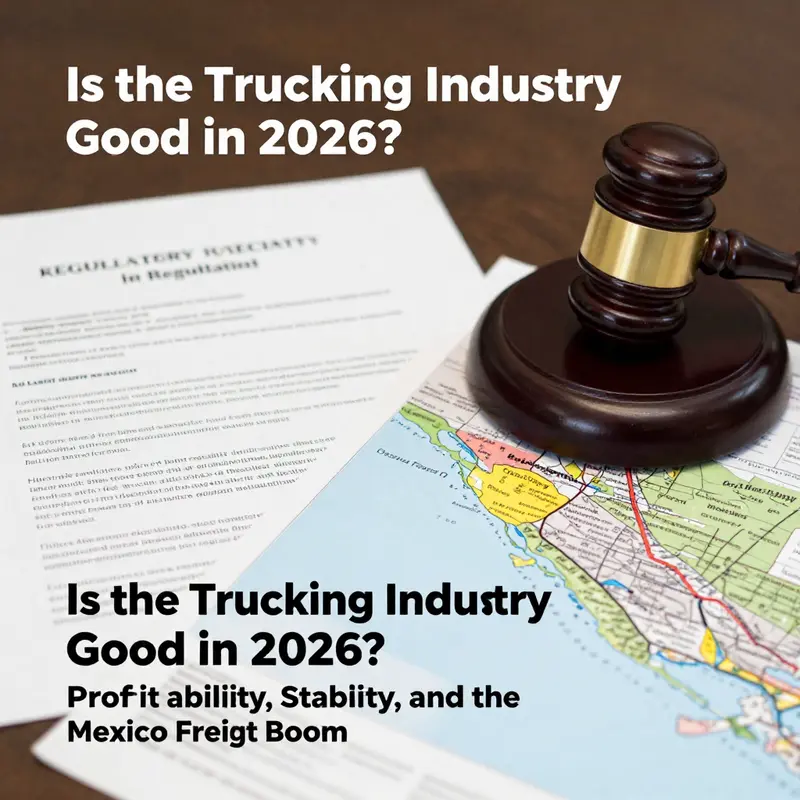
The year 2026 presents a paradox for the U.S. trucking industry. On the surface, the demand for freight movement remains robust—driven by e-commerce, just-in-time manufacturing, and a growing need for specialized logistics such as cold chain and pharma. But beneath that surface lies a landscape thick with regulatory uncertainty and cost headwinds that test the resilience of every carrier, whether a one-truck operator or a mid-size regional fleet. Market signals reflect this tension. After years of tight margins, carriers have finally begun to edge into a modest profit space, reporting the first meaningful rate increases in several cycles. Yet inflation erodes these gains, and many operators still hover near break-even points. The result is a delicate balance: a sector that can survive and even grow in niches, but only if the right levers are pulled and the right risks are managed.
A defining constraint of the 2026 environment is the driver shortage. The industry is contending with a record gap of roughly 80,000 drivers, a force multiplier for costs and service fragility. With fewer hands on the wheel, operational complexity rises. Shifts widen, dock queues lengthen, and service levels become more sensitive to disruptions. This tightening of capacity compounds the already stubborn structural limits on expansion. Orders for new tractors and trailers are at historically low levels, some below pandemic lows, which means fleets cannot meaningfully increase capacity even when demand surges. The market becomes acutely vulnerable to seasonal spikes, and congestion during peak periods becomes not just a nuisance but a strategic risk that can cascade into missed deliveries and rising customer dissatisfaction.
The cost picture compounds these pressures. Operational expenses are high, and the share of miles driven empty remains stubborn at about 15%. If a carrier spends roughly $2.60 per mile for an empty or partially empty run, the loaded miles must deliver enough revenue to cover not only the cost per mile but also the carrying costs of debt, maintenance, insurance, and labor. Current spot rates hovering around $2.15 per mile, when applied to a cycle that includes a notable portion of empty miles, leave many carriers operating below break-even. This reality forces tough choices about lane strategy, customer selection, and timing. It also elevates the importance of back-office efficiency, load optimization, and asset utilization. In such a climate, even a small shift in rates or a modest improvement in load factor can translate into meaningful margin changes, but the upside remains constrained by the stubborn baseline economics of the sector.
Regulatory dynamics add another layer of complexity that no operator can ignore. The possibility of a rule limiting commercial driver’s licenses to non-residents threatens to reduce capacity sharply, potentially removing as many as 200,000 carriers from the market. Even if this policy remains under legal review, the mere prospect injects strategic risk into fleet planning, rate setting, and competitive positioning. Operators must think not only about today’s routes and customers but also about regulatory scenarios months and years hence. The FMCSA’s tightening of hours-of-service rules, more stringent electronic logging device (ELD) enforcement, and evolving vehicle safety standards collectively raise compliance costs and administrative overhead. Alongside these, environmental policies push toward zero-emission trucks by 2035, a bias that presses fleets to consider expensive fleet renewal, charging or fueling infrastructure, and new maintenance regimes. The policy risk is not hypothetical; it reshapes capex planning, financing structures, and long-term service commitments.
Against this backdrop, the trucking industry has found a lifeline in cross-border freight with Mexico. Nearshoring and a steady stream of foreign direct investment into Mexico—reported at around 34.3 billion dollars in 2025—have created a durable, high-value corridor that anchors North American logistics. Mexican exports to the U.S. posted about 15% growth over recent months, and border crossings such as Laredo and El Paso have seen daily freight volumes rise by roughly 8% year over year, even in December, which is not just a seasonal blip but a structural shift in trade flows. A notable feature of this traffic is its higher value density and time sensitivity. More than 40% of the loads are auto parts and other time-critical shipments, a category that commands margins 15–20% higher than more routine freight. For carriers able to operate efficiently through key crossings and manage cross-border documentation, fuel, and regulatory compliance, the Mexico corridor offers predictable volumes, stronger customer relationships, and improved load stability. In an environment where domestic demand is volatile and tariff policies keep investment visibility uncertain, the cross-border stream acts as a stabilizer, a reliability anchor that cushions the broader market’s cyclical weaknesses. Industry voices, including analysts and operators who have observed tariff environments adjust, emphasize that imports from Mexico have “steadily stabilized” as a core revenue source.
Given these dynamics, a fair assessment emerges: the trucking business is not uniformly good in 2026, but not uniformly bad either. For the vast majority of U.S. truckers and small carriers, profitability remains challenging, capacity is tight, and policy shocks could reverberate through pricing and service levels in minutes rather than months. The broader market requires a careful, risk-aware posture, with attention to diversification, efficiency, and strategic partnerships. However, for fleets that carve out a niche in Mexico freight, the outlook is notably brighter. The cross-border corridor has become the single most important stabilizer—an essential, ongoing source of demand in a market otherwise unsettled by domestic policy volatility and rising costs. The resilience and profitability of this niche are not incidental; they reflect a structural shift in how goods move across North America, influenced by manufacturing realignment, tariff adjustments, and a recalibration of global supply chains. The contrast between a fragile domestic market and a robust border corridor underscores a shift in strategic thinking for the industry overall. Operators should view 2026 as a year when success hinges less on broad market expansion and more on precise market positioning and smart risk management.
This evolving reality dovetails with broader industry analyses that point to a renaissance in trucking profitability after a prolonged period of stagnation following the Great Recession era. The Reuters-like synthesis in industry journals highlights a delicate financial recovery, where rate increases are finally aligned with rising costs, signaling a potential inflection for carriers with the right cost structure and risk controls. Yet this is not a victory lap. The sector remains exposed to policy shifts, environmental mandates, and labor constraints that require proactive planning. Technology can play a pivotal role here. Real-time compliance monitoring, better load matching, and more sophisticated fleet management can reduce the operational drag caused by tighter HOS compliance, ELD requirements, and the need for safer, more fuel-efficient vehicles. Firms that invest in human capital—training, safety culture, and retention—are well-positioned to weather regulatory shifts and to avoid the expensive churn caused by driver shortages. In short, the chapter of 2026 is not one of broad triumph or total collapse; it is a chapter of selective advantage. Those who align with high-value niches, invest in efficiency and people, and plan for policy changes will likely outperform.
From a broader market perspective, the Dow Jones Transportation Average and similar benchmarks provide a useful lens for understanding industry health, yet the real story in 2026 sits at the margins—where cross-border stability and niche specialization determine who profits and who strains under the base costs. It is a narrative of opportunity tethered to risk, where the most promising path forward lies in blending disciplined risk management with niche expertise. The presence of a corridor that supplies high-value, time-sensitive loads creates a stabilizing current that can offset domestic volatility. It is not a universal endorsement of the trucking business as an easy, high-margin enterprise; rather, it is a call to focus on strategic segments that deliver reliable margins and predictable demand. For operators ready to adapt, the year offers a compelling invitation to recalibrate, to partner more deeply across borders, and to pursue innovations that improve efficiency, safety, and service quality. In that sense, success in 2026 is less about chasing broad growth and more about anchoring strategy in the Mexico freight corridor while staying agile enough to respond to evolving domestic policy and market rhythms. To navigate this landscape, operators should lean on policy resources that clarify regulatory expectations and on cross-border partnerships that amplify capacity and resilience. For instance, regulatory relief discussions and guides can help carriers manage uncertainty in the near term, while cross-border collaborations can stabilize revenue streams over the longer horizon. Regulatory relief for trucking amid winter storms provides a framework for approaching policy changes with preparedness rather than fear.
As the sector continues to evolve, the imperative for smaller operators is clear: sharpen the focus on where demand is most durable, invest in people and processes, and maintain a disciplined approach to capital. Those who can translate the volatility of the domestic market into a stable cross-border advantage will avoid the worst of the cycle while extracting meaningful growth in a constrained, high-stakes environment. TheMexico corridor, with its high-value shipments and steady demand, will likely remain the anchor that keeps the North American logistics system functioning when other parts of the market wobble. The strategic takeaway is not merely to survive but to align with a period of selective growth that rewards efficiency, reliability, and thoughtful risk management. External perspectives on how collaboration and strategic alignment reshape trucking economics offer additional depth for readers seeking broader context; see the historical discussion on industry collaboration for a sense of how collective action can alter cost structures and service capabilities: https://www.transportationdaily.com/trucking-2014-collaboration-is-the-game/
Final thoughts
In 2026, the trucking industry presents a nuanced prognosis. The broad domestic market remains under pressure, with profitability largely absorbed by inflation, capacity structurally constrained, and driver shortages intensifying operational risk. However, the Mexico cross-border freight boom stands out as a defining stabilizer. It delivers high-value, time-sensitive loads, provides a reliable revenue stream, and cushions fleets from domestic volatility. For logistics and freight companies, construction and engineering fleets, fleet management providers, and food and beverage distributors, success hinges on channeling capacity into cross-border corridors and high-margin niche loads, while maintaining disciplined cost control and resilience against regulatory shocks. Strategic emphasis should include strengthening cross-border routes through key crossings, investing in driver recruitment and retention, embracing data-driven load optimization, and maintaining flexibility to adapt to tariff and policy changes. The market is not uniformly good, but with targeted focus and operating discipline, meaningful profitability and stability are achievable.