
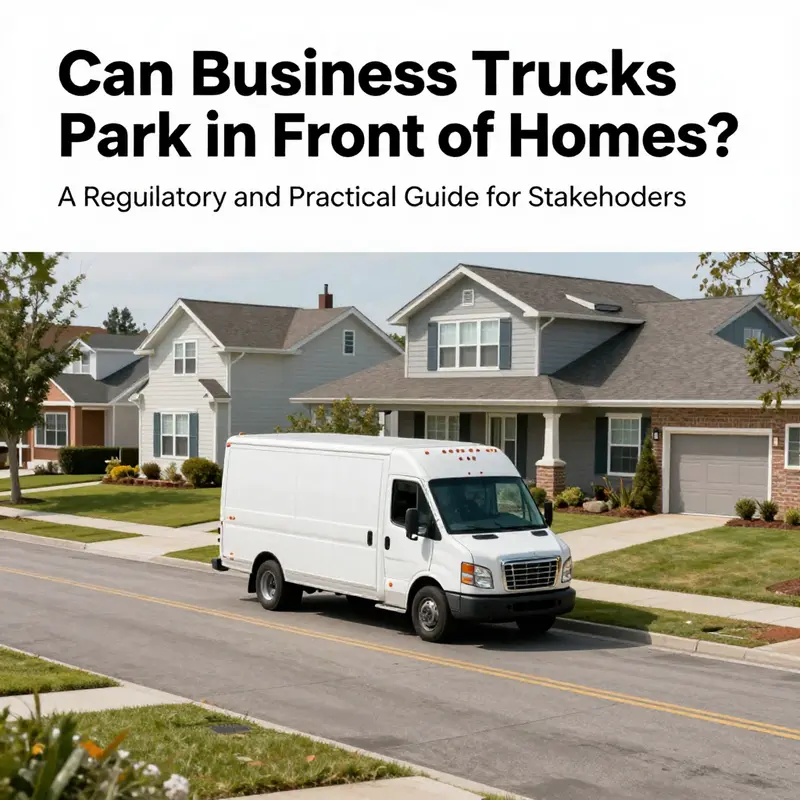
Decisions about where business trucks may park in residential areas affect days-to-day logistics, site access, and community relations. While streets and driveways are central to last-mile deliveries and service calls, parking in front of homes can implicate private-property rights, local ordinances, and enforcement actions. For Logistics & Freight Companies, Construction & Engineering Firms, Fleet Management Providers, and Food & Beverage Distributors, clear guidance on consent, regulatory compliance, and operational controls reduces risk, avoids towing, and preserves neighborly relations. This article unpacks the core question—can business trucks park in front of homes?—by examining private-property rights and homeowner consent, the regulatory landscape governing public streets, the nuances of temporary versus permanent parking, and the enforcement remedies and best practices that stakeholders should implement. Each chapter builds toward a holistic, solution-oriented framework you can apply to routing, scheduling, site access planning, and contractor coordination, while staying aligned with local guidelines and safeguarding asset productivity. The discussion places emphasis on practical steps, from obtaining explicit permission to documenting compliance and coordinating with municipal authorities, ensuring operations remain lawful, efficient, and respectful of the communities in which they operate.
Beyond the Driveway: Private Property Rights, Public Rules, and the Question of Parking Business Trucks in Front of Homes

The question of whether business trucks can park in front of homes cuts straight through the tension between private property and public governance. It is not a simple yes or no anchored to a single rule. Instead, it unfolds as a layered negotiation among homeowner authority, municipal parking laws, and the practical needs of a mobile, service-based economy. At its core lies a fundamental insight: ownership of a private parcel does not grant unlimited access to or use of public space. Conversely, consent from a private property owner does not automatically override the traffic and zoning rules that regulate what can occur on a public street. These two ideas—private control and public constraint—shape the practical reality for any business that moves goods, tools, or personnel through a residential neighborhood. The interplay is not abstract. It governs daily operations, neighbor relations, and the safety of everyone who shares the street with a moving fleet. When a truck sits at a curb in front of a home, what residents experience is a small but telling intersection of civil rights, neighborhood policy, and commercial logistics. If the truck is there for a moment to deliver or service, the balance might be acceptable. If it remains for hours, or becomes a pattern, the balance shifts toward enforcement, potential towing, and regulatory censure. Understanding this balance begins with a clear-eyed view of two domains that govern parking in front of homes: private property rights and public space regulations.
Private property rights are robust in most jurisdictions. A homeowner typically controls access to their driveway, the portion of the curb immediately adjacent to the curb cut, and the sidewalk directly in front of the property. This is the space where driveway clearances, pedestrian safety, and front-yard aesthetics matter most to the resident. A business may gain implicit permission through a conversation or a formal authorization, but that permission is not a universal exemption. The homeowner’s consent covers the private property itself, not the streets that belong to the public. If a truck stops in front of a house because the homeowner has invited it to do so, the arrangement still sits within a larger legal framework. The street remains subject to city, county, or state traffic laws, and it may be governed by time restrictions, loading-zone designations, or residential parking rules. In some neighborhoods, the line between a convenient service call and an obstructive blockage can be thin. A curbside stop for a few minutes may be perfectly lawful and not troublesome. The same curb in front of the same house, if left unused for hours or if it blocks a sidewalk that pedestrians with strollers rely on, can become a hazard or a nuisance. This tension illustrates why private consent cannot be treated as a blanket license to park any time, any length, or for any purpose that a business might claim.
Public space regulations are the other half of the equation. Streets and curbs are typically public, governed by municipal ordinances that aim to preserve traffic flow, ensure emergency access, and maintain neighborhood livability. Even with homeowner permission, a truck parked in front of a home may violate street-side parking rules if it obstructs traffic, blocks driveways, or stands for an extended period beyond what is allowed by signage or permits. Local governments often restrict commercial vehicle parking on residential streets to certain hours, or to specific zones where loading and unloading can occur without compromising safety. Signs, painted curbs, and posted time limits translate into real-world consequences for fleets that fail to observe them. The consequences can range from warnings to tickets and, in some cases, towing. The stakes are not only financial. They include the potential disruption of neighborhood harmony, complaints from residents, and reputational risk for a business that appears to disregard local standards.
This double frame—private rights plus public rules—explains why the question cannot be answered with a universal rule. In some cases, a homeowner might welcome a business truck for a scheduled delivery during a narrowly defined window, provided the vehicle does not impede traffic and adheres to posted restrictions. In other cases, the same arrangement might be unlawful if it creates a safety hazard or violates a city’s curbside loading policies. The practical upshot is that consent alone does not guarantee lawful parking, and legal parking on a public street does not override the need to minimize disruption to the neighbor’s daily life or to comply with safety requirements. Businesses that depend on a mobile, on-demand service model must recognize this paradox and design their operational habits around it. A truck can be a symbol of reliable service, but it can also become a source of conflict if it stops and stays in a front-yard corridor without regard to the street’s broader responsibilities.
To navigate this landscape, it helps to understand a few core distinctions that frequently influence the day-to-day decisions of fleet managers and service crews. First, private property rights take precedence on the owner’s land, including driveways and any space immediately adjacent to the property that the owner controls. If a truck is asked to park on private property, furnished with explicit consent, the arrangement should be documented to avoid ambiguity should circumstances or ownership change. Second, public streets are governed by municipal regulations that specify where and when a commercial vehicle may park, regardless of private consent. Even a well-intentioned delivery may breach city rules if it blocks a sidewalk, interferes with traffic, or occupies a space reserved for residents’ own vehicles. Third, the combination of these two domains means that the practical solution often lies not in a legal loophole but in thoughtful scheduling and proactive coordination. The aim is to reduce the friction between service needs and neighbor expectations while staying squarely within the law.
For businesses, the implications are concrete. Wherever feasible, leveraging off-street parking or loading zones within commercial or industrial zones reduces the risk of conflict. When on-street parking is unavoidable, fleets should plan for short, well-communicated visits that comply with time restrictions and signage. Where a homeowner’s consent exists, it should be treated as a goodwill agreement rather than a permit that creates new rights for the mover. Clear communication about expected duration, the exact location of the stop, and the steps being taken to ensure pedestrian and vehicle safety can prevent misunderstandings. In this light, consent becomes not a free pass but a collaborative arrangement that respects both private ownership and public safety.
The practicalities extend beyond the curb. Regulatory frameworks often include provisions about emergency access, snow removal, street cleaning, and noise considerations. A vehicle that blocks a driveway or an exit route for emergency responders, even for a short time, can trigger enforcement actions. Likewise, if a curbside stop interferes with wheelchairs, strollers, or visually impaired pedestrians, it invites scrutiny from both residents and city inspectors. The neighborhood’s welfare extends beyond the immediate needs of a service call. This broader view is not about punishing businesses for trying to operate; it is about aligning business efficiency with community safety and livability. In many communities, the objective is to enable essential services while maintaining the civic fabric that makes a street friendly to all residents.
A useful way to think about this is to differentiate between a momentary, compliant stop and a recurring pattern. A once-off, short delivery to a home with the driver present to direct the process may be permissible if it does not create a hazard and complies with posted rules. But when a truck settles into a routine—every afternoon or every morning, parked permanently in front of a residence—the arrangement is no longer about a single service interaction. It enters a gray zone where public space usage competes with the neighborhood’s sense of order and safety. In such circumstances, authorities may request relocation or impose penalties to restore compliance. The homeowner’s role in this scenario is still essential, but it is limited to an advisory or enforcement capacity within the public framework, rather than a unilateral permission that changes the legal status of the curb.
The chapter’s logic, then, is not about denying legitimate business needs. It is about acknowledging the legitimate rights of residents and the public space’s governance. A community thrives when dialogue, rather than unilateral action, shapes how service fleets operate near homes. When a business plans a route through a residential area, it benefits from intentionally built processes: pre-approved contacts with property owners where necessary, clear checks against signage and local ordinances, and a culture of notifying neighbors about scheduled visits that require curbside activity. This approach reduces the risk of miscommunication, minimizes potential conflicts, and protects the reputation of the business by demonstrating a commitment to lawful and courteous operations.
The legal landscape itself often reflects a city’s broader aims: to preserve residential quiet, maintain pedestrian safety, and ensure that commercial activity does not overwhelm public spaces intended for everyday life. In some jurisdictions, the discussion around commercial vehicle parking on residential streets has evolved to balance freight mobility with neighborhood concerns. Acknowledging this shift helps businesses adopt proactive strategies rather than reactive ones. It encourages fleets to seek out permitted arrangements, use loading zones when available, and coordinate with property owners to identify parking solutions that respect both private and public rights. The practical outcome is clearer: while a homeowner’s consent can facilitate certain arrangements, it does not substitute for the rules that keep streets safe and accessible for all users. That is why, even with private permission, a business must align its curbside practices with the letter and spirit of local laws.
For readers who want to see how this principle translates into concrete guidance, one can consider established municipal frameworks that articulate the boundaries between private consent and public regulation. In some major cities, official parking guidance explicitly coordinates private access with street rules by delineating when commercial vehicles may stop, how long they may stay, and what precautions must be taken to keep sidewalks clear and driveways accessible. The result is a blueprint for responsible practice: plan ahead, verify that a curbside stop complies with rules, and communicate with the homeowner and neighbors about what to expect. The goal is not to create a bureaucratic maze but to reduce ambiguity so that service calls can be completed efficiently without compromising safety or neighborhood standards. With this mindset, the front of a home becomes a shared space that serves both private ownership and public necessity rather than a battleground between a business’s needs and a resident’s rights.
As communities navigate the evolving landscape of urban and suburban parking, the question remains nuanced and situational. The right answer depends on the local code, the specific street, the time of day, and the particular arrangement with the homeowner. It also depends on the business’s stated commitment to responsible parking practices, clear communication, and respect for neighbors’ routines. In practice, a cautious, well-documented approach that prioritizes safety and compliance tends to yield better outcomes than a permissive, ad hoc approach that relies on personal goodwill alone. This is especially true in an economy where fleets are increasingly signaled by digital routing, real-time updates, and heightened scrutiny of curb usage. Businesses that embed these considerations into their daily operations not only reduce risk but also contribute to a neighborhood ecosystem where essential services remain reliable without disrupting the cadence of residential life. The compatibility of private rights and public rules is not a zero-sum game; rather, it is a shared framework that, when respected, supports both mobility and community well-being.
For readers seeking a concise reference point on how cities are handling these questions in practice, consider regulatory guidance that frames commercial parking in relation to private consent and public space. Loaning a curb to a service vehicle must be done with an eye toward the street’s overall function, including travel lanes, pedestrian paths, and access for emergency services. This understanding helps owners, drivers, and neighbors approach curbside activity with balanced expectations. It also shapes the design of fleets’ daily routines: notification protocols, route planning that minimizes curb time in front of homes, and prioritizing off-street loading when possible. When the private and public spheres align—private consent supported by compliant public-space practices—residential streets can host necessary services without tipping into congestion or disruption. And when misalignment occurs, the path back to compliance often involves clear communication, documentation, and a willingness to adapt routing and scheduling until the curb becomes a space that serves the needs of all stakeholders rather than a point of friction.
In sum, the question is not merely about permission but about responsible use. Homeowners grant private rights over their property, but public authorities retain oversight over the street. A business truck parked in front of a home sits at the crossroads of these authorities. By respecting both, fleets can continue to provide essential services while preserving the quiet, safe, and orderly character that makes residential neighborhoods livable. The best practice is proactive planning: verify local rules, secure necessary permissions, coordinate with property owners, and limit curb time to what is strictly necessary. In doing so, the delivery of services remains efficient, neighbors feel respected, and the street remains open to everyone who relies on it.
For readers who wish to explore practical implications further, see the broader guidance on commercial vehicle parking in municipal contexts here: Regulatory relief for winter storms trucking. This resource illustrates how regulatory nuance can shape expected behavior on the curb and help fleet managers anticipate shifts in street-level allowances during exceptional conditions. Regulatory relief for winter storms trucking
As a final note, for those seeking authoritative, jurisdiction-specific guidance, consult the official guidelines from your local city or county transportation or planning department. A representative, widely applicable reference is the City of Los Angeles Department of Transportation, which outlines a clear framework for commercial vehicle parking and related requirements. See their guidance at https://www.ladot.la.gov/parking/commercial-vehicle-parking for detailed information on where and when business trucks may park, with emphasis on safety, neighborhood standards, and compliance. The practical takeaway remains consistent: private consent and public rules coexist, and success lies in honoring both as you plan curbside activity near homes.
Public Streets, Private Rights: Can Business Trucks Park in Front of Homes
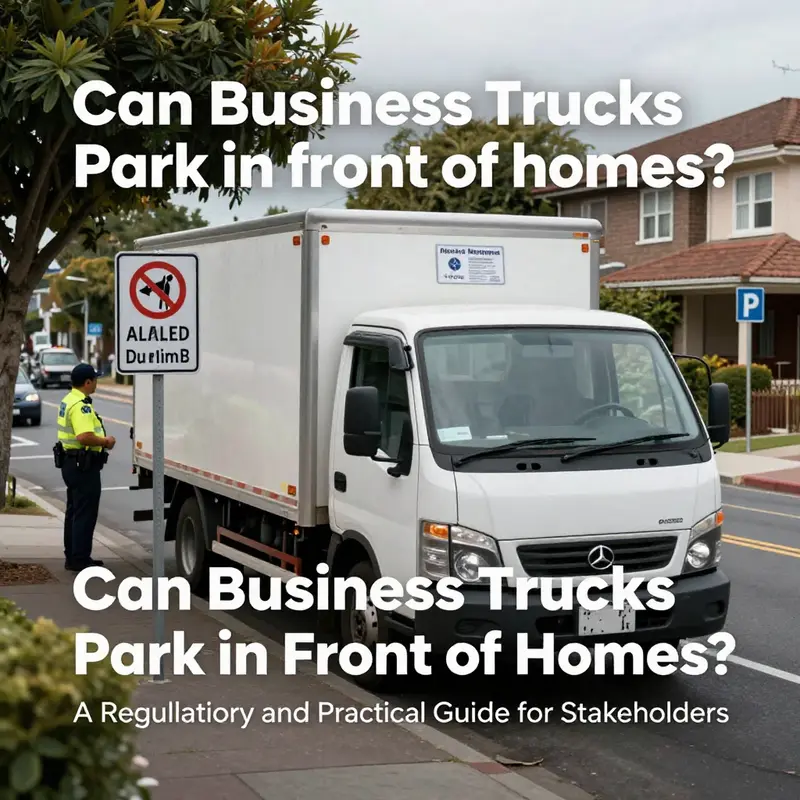
Parking a business truck in front of a home sits at the intersection of private property rights, public space rules, and the everyday needs of commerce. It is not merely a matter of convenience; it tests how cities balance neighborhood livability with the demands of delivery and service economies. When a truck idles on a public street in front of a residence, the space is technically public terrain but used by private enterprise for a moment. Homeowners’ consent is not the same as a lease or ownership; public streets are regulated by municipal codes and traffic rules that often limit duration, vehicle type, and whether commercial activity may take place there.
In practice, most places distinguish between on-street parking and private property. Parking a vehicle on a private driveway or yard without permission is generally prohibited, and a truck blocking a driveway or hydrant typically triggers enforcement actions. On public streets, communities usually impose time limits, loading zones, or outright prohibitions on continuous commercial parking in residential zones. Violations can lead to fines or towing, especially if safety or access is compromised.
Best practices for businesses include planning routes to avoid blocking driveways, using designated loading zones when available, obtaining permits if required, and coordinating with residents to minimize curb occupancy. Residents benefit from clear signage and predictable curb use, while cities maintain safe, accessible streets and reasonable avenues for commerce. The overarching aim is to balance reliable service with the right of neighbors to enjoy a safe, quiet, and accessible neighborhood.
Front-Facing Freight: Navigating Temporary and Permanent Parking for Business Trucks in Residential Frontages
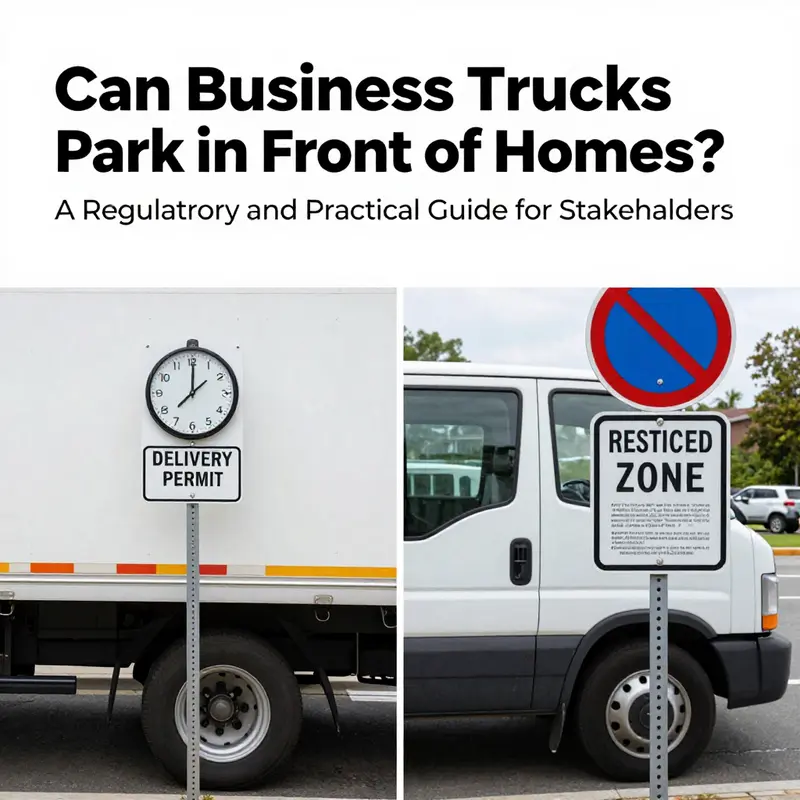
Front-Facing Freight is more than a curbside image; it is a point where property rights, public space, and neighborhood safety converge. In many communities, the sight of a large business truck idling or stopping in front of a home triggers questions: Who owns that curb? Who decides what can be parked there? How do local ordinances apply? The practical answer rests on a balance between the public nature of streets and the private rights of homeowners to control their land. The guidance is that a business truck generally cannot assume a parking right in front of a home without explicit permission or a lawful exception. The distinction between temporary stops for quick deliveries and longer, more intrusive parking matters, as do signage, time limits, and the local regulatory environment. The chapter below dissects this terrain with a focus on aligning industry practice with neighborhood expectations and legal obligations.
Temporary vs permanent: A brief stop with signs and no obstruction may be permissible; if the truck remains for an extended period or becomes a de facto parking spot, the analysis shifts. Residential zones are designed for private vehicles and family life, not commercial fleets; large trucks can affect sight lines, introduce noise, and raise enforcement concerns. Signage helps: ‘No Commercial Vehicles’, ‘Residential Only’, ‘Loading Zone – 10 Minutes Max’, etc. When signage is clear, compliance is smoother; when not, enforcement may follow. Homeowners have the prerogative to permit or deny parking on driveways or front yards and may engage towing if unauthorized. Municipal authorities balance safety and traffic flow with the needs of commerce.
Best practice: temporary parking under controlled conditions; permanent parking generally not compatible with private property rights unless explicit permission and alignment with zoning. The curb is a shared resource; fleets should plan to minimize curbside use and consider off-street loading zones, secured parking, or centralized distribution.
Responsibility chain: driver verifies legality; fleet managers ensure their ops understand local restrictions; homeowners enforce property boundaries; authorities translate norms into enforceable rules. The guidance evolves with traffic patterns and urban mobility trends.
Conclusion: there is no universal yes or no; context matters: duration, signage, local regs. Prefer off-street options and seek clarity from authorities and property owners.
External resource: For official guidance on parking on private property, see NSW Government resource: https://www.service.nsw.gov.au/transaction/parking-on-private-property
Front-porch Jurisdiction: Navigating Enforcement, Remedies, and Responsible Parking for Business Trucks in Residential Areas
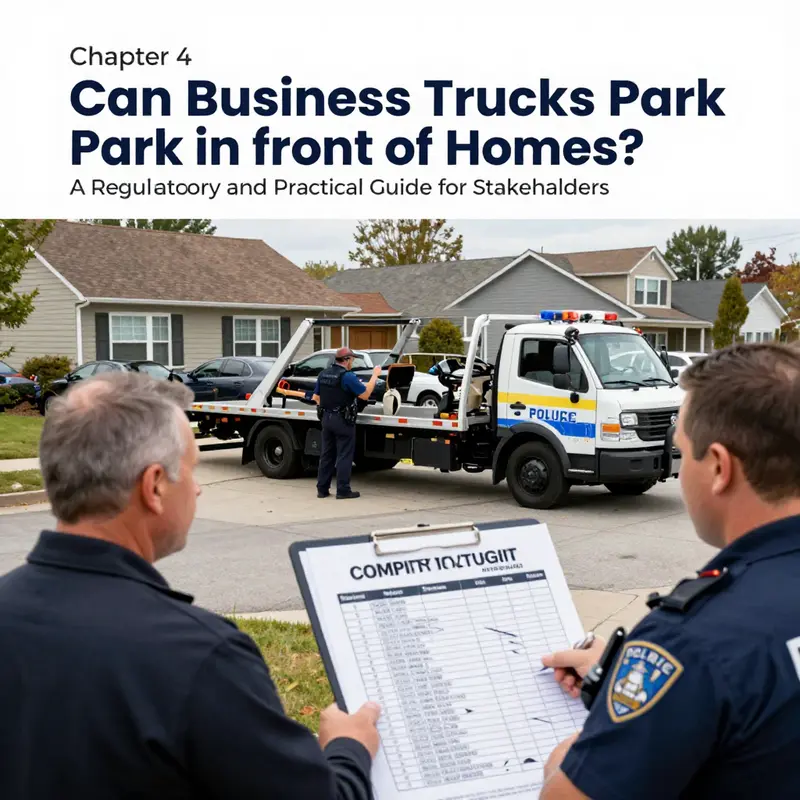
Parking a business truck in front of a private home sits at the intersection of property rights, neighborhood norms, and municipal policy. It is not simply a matter of whether a vehicle can legally be in a given space; it is about how the space is used, who controls it, and how the law interprets the balance between commerce and community quiet. Across many jurisdictions, including those shaped by broad principles of public space versus private property, a commercial vehicle on a residential street is not categorically prohibited. Yet the act is seldom free of constraints. Time limits, permits, and practical considerations such as blocking driveways or obstructing emergency routes can transform a routine delivery into a violation with visible consequences. The chapter that follows threads these threads into a coherent narrative of enforcement, remedies, and best practices for stakeholders—homeowners, business operators, and local governments alike—so that the ordinary act of servicing a home or delivering a product does not become a source of ongoing friction.
At the core is a simple yet consequential distinction: a street on public land is typically governed by public parking rules, even when a business vehicle is involved. The legality hinges on compliance with local ordinances rather than the vehicle’s purpose. A typical residential street permits parking but with caveats designed to prevent obstruction. The presence of a delivery truck is not an automatic license to linger. For example, many cities impose strict time limits during which a commercial vehicle may stand on a residential street. A common window might be two to four hours, enough for a delivery or a service call but insufficient for unplanned or indefinite parking. These limits help ensure that streets remain passable for residents, visitors, postal workers, school buses, and emergency responders. They also prevent a single commercial vehicle from gradually converting a stretch of curb into a long-term loading zone.
The nuances deepen when we consider permits. Some municipalities require a residential commercial vehicle permit, particularly for vehicles that display commercial signage or that routinely park in residential zones during business hours. Permits, however, are not a blanket permission to occupy curb space without regard to time or access. They are a recognition that community flows, driveway access, and pedestrian safety must be preserved. In practice, a permit often accompanies specific conditions—limits on the duration of parking, designated zones, or restrictions to certain hours. When these conditions are ignored, the permit loses its protective value, and the vehicle becomes subject to enforcement like any other non-compliant street user.
A critical consideration is access. Even when parking on a public street is permissible, blocking a driveway, mailbox, fire hydrant, or any point of ingress or egress changes the equation. The act of blocking access—whether intentional or incidental—transforms a routine delivery into a violation. The same holds for impeding emergency vehicle routes. In dense residential neighborhoods, where every inch of curb matters, a truck that overhangs a curb or anchors a corridor can disrupt routines and pose safety concerns. Because access is central to the home’s functioning, many enforcement actions begin not with a broad policy dispute but with a complaint about specific obstruction. The homeowner’s right to unobstructed access remains a core element of the private property framework.
Zoning adds another layer. In neighborhoods zoned exclusively for residential use, some communities restrict or outright prohibit commercial vehicle parking. The zoning map, along with overlays and homeowner association covenants, can set boundaries that do more than discourage heavy trucks in front of homes. They can create a de facto prohibition that requires operators to seek off-street alternatives or to schedule short, carefully choreographed visits. This complexity helps explain why a truck can be lawful in one street yet out of place on another block two miles away. The variability in how towns implement parking rules reflects a balance between enabling commerce and preserving the residential character that makes neighborhoods desirable. It is precisely this balance that invites ongoing dialogue among residents, business operators, and municipal authorities.
In telling the enforcement story, one can point to a typical mechanism: a patrol or a citizen complaint triggers a response from a local traffic or parking authority. Officers or inspectors review the vehicle’s compliance with signage, posted time limits, and any applicable permits. If a violation is found, enforcement options can range from a courtesy notice to a formal citation, and in severe cases, towing. Fines can vary widely depending on jurisdiction and the seriousness of the violation, with penalties that escalate if the issue recurs or blocks critical access points. A practical takeaway for households is simple: document what you observe. A photo or video showing the exact time, duration, and location of the truck’s presence provides a solid basis for complaints and helps authorities determine whether a time-limit or permit condition has been breached.
The legal example often cited by cities interested in a transparent baseline is the broader framework embodied in municipal codes. A commonly referenced standard is that no person shall operate or permit any motor vehicle to stand on a street for more than a defined period unless otherwise permitted. While the exact language and thresholds vary, the logic is shared: curb space on residential streets remains a public resource that requires stewardship. Tulips of nuance sprout when we consider alternating regimes across cities—some allow temporary commercial stops for deliveries, others restrict commercial parking altogether in pure residential zones. The overarching pattern is simple: compliance with local parking regulations is the passport to lawful curbside activity for business trucks, and noncompliance invites enforcement actions that residents and drivers alike should take seriously.
For those trying to navigate a specific situation, a practical approach can help prevent friction before it arises. Documentation is the first line of defense for residents, and it contributes to a more predictable enforcement environment. A careful log that records dates and times when a truck appears and how long it remains can reveal patterns—whether the truck is a transient delivery or a prolonged sojourn that violates time limits. Residents who must address a recurring issue should contact the local police or parking authority through official channels, rather than engaging in ad hoc disputes. This formal channel often allows for a quicker assessment of whether a vehicle has a valid permit or whether signs and time restrictions are being respected. Attempting to resolve matters through confrontation rarely yields lasting results; formal processes, even when time-consuming, usually produce more durable outcomes and preserve neighborhood civility.
Businesses, to minimize conflict, should plan with the same transparency. The most straightforward path is to utilize designated loading zones or off-street parking facilities within reasonable distance of residential areas. When practical, deliveries should be scheduled to coincide with times that minimize disruption, and drivers should be trained to adhere to time limits and to respect pedestrian pathways, mailboxes, and driveways. A simple yet effective practice is to train drivers to seek the closest available compliant space and to avoid lingering beyond the authorized window. In some contexts, a brief on-site stop—just long enough to unload with minimal obstruction—can be the difference between a routine service call and a formal complaint. Guidance to drivers should also emphasize respect for quiet hours and neighborhood norms, a small but meaningful courtesy that reinforces the social contract between commerce and community.
The question of best practices for stakeholders returns us to the central idea: sharing space requires clear expectations and enforceable rules. For homeowners, this means becoming familiar with local ordinances, municipal parking policies, and any neighborhood covenants that govern curb space. Proactive engagement can be more effective than reactive confrontation. Homeowners can request clearer signage or better delineation of zones where commercial vehicles may or may not park. They can also advocate for policies that promote off-street options, such as designated loading zones or municipal partnerships with nearby lots that reduce the need for curbside storage. The goal is not to eliminate business activity but to ensure it happens in a way that does not erode the daily rhythms that define residential life.
From the government side, the focus is on clarity and accessibility. Municipalities should present zoning and parking rules in user-friendly formats, with signage that clearly communicates time limits and permitted uses. Education campaigns that target commercial drivers and residents alike can reduce misunderstandings. In practice, this means distributing concise summaries of local rules, offering online tools to check permit status, and using data-driven enforcement to address hotspots where conflict is most common. When enforcement is necessary, it should be predictable and proportionate, balancing the need to keep residential streets passable with the recognition that businesses serve essential functions for families, schools, and communities. The interplay among these elements—clear rules, accessible information, and respectful behavior—creates a framework in which commercial activity can occur without eroding the lived experience of residents.
A note on terminology helps to ground these discussions. The vehicle itself is not the central issue; rather, the context of its parking is what matters. A delivery truck that briefly stops to unload a package at a front door is not inherently problematic, provided it complies with time limits and does not obstruct access. A vehicle that parks for hours on end in front of multiple homes, or one that redefines curb space into an informal loading zone, raises legitimate concerns about safety, accessibility, and neighborhood character. The aim of policy, then, is not to stigmatize commerce but to ensure that commercial activity coexists with residential life in a manner that respects both private property rights and public space rights. When conflicts arise, a process-driven response, grounded in local law and guided by community norms, offers the most durable path to resolution.
As this chapter closes its loop, it is worth returning to the idea of informed, constructive engagement. If a homeowner is confronted with repeated parking conflicts, the first step is to verify that local rules are being followed and to document visible evidence. If a business is the source of the problem, the responsible conduct is to reassess operational practices, perhaps adjusting routes, delivery windows, or off-street options. The most enduring solution combines practical logistics with a shared understanding of what constitutes reasonable curb use. In many places, a conversation among neighbors, backed by explicit guidance from the municipality, can prevent escalation and foster cooperative solutions. Where dialogue fails, the formal channels—police, parking authorities, or municipal dispute-resolution processes—remain available, but their use should be a last resort after parties have attempted cooperative remedies. The result is not merely compliance with a rule but a more resilient urban fabric where homes and businesses coexist with mutual consideration.
For readers seeking broader context on regulatory frameworks that shape these issues, see the broader guidance on regulatory relief and context for trucking operations during exceptional conditions, such as winter storms, which can influence how municipalities interpret and enforce parking rules during disruptions. regu latory-relief-winter-storms-trucking
External reference: City of Los Angeles Municipal Code – Section 56.01. https://www.lacity.org/laws/municipal-code/section-5601
Final thoughts
Navigating the question of can business trucks park in front of homes requires a disciplined approach that respects private-property rights, adheres to public-street regulations, and aligns with a proactive compliance program. The private-property framework begins with explicit homeowner consent and clear boundary understanding—without it, parking on a private driveway or front yard is not permissible for any commercial vehicle. On public streets, operators must follow posted signage, time restrictions, and permit requirements where applicable, recognizing that residential zones may limit or prohibit commercial vehicle parking outside authorized windows. Differentiating between temporary and permanent parking—and documenting permits, signage, and durations—helps fleets avoid inadvertent violations. Enforcement mechanisms may involve towing, fines, or service restrictions, but they are most effective when paired with preventive practices: pre-delivery confirmations with homeowners, scheduled delivery windows that align with local rules, robust communication protocols with local authorities, and clear routes that minimize on-street occupancy in front of homes. For stakeholders, the takeaway is clear: embed property-right awareness, regulatory diligence, and transparent cross-stakeholder coordination into planning, routing, and fleet policies to maintain operational efficiency while honoring community standards.